

Immune checkpoint inhibitors represented by anti-PD-1 and PD-L1 monoclonal antibodies have significantly improved the survival rate of cancer patients and have been widely used in melanoma, lung cancer, etc. However, this therapy is only effective for some patients, and many patients eventually develop resistance; therefore, how to further enhance the effectiveness of immunotherapy in cancer patients is a critical issue. One approach is to target different immune checkpoints simultaneously. Tiragolumab is an anti-TIGIT antibody with active IgG1κ Fc and is currently in the phase 2 clinical trial CITYSCAPE.(ClinicalTrials.gov: NCT03563716)Certificate of Approval for Atezolizumab(anti-PD-L1)Combined use can improve patient treatment outcomes. However, it remains unclear how Tiragolumab enhances the response mechanism of combination therapy.February 28, 2024, Genentech, Inc. (Genentech.Inc) Namrata PatilandRobert JohnstonTeam(Guan XiangnanAndHu RuozhenCo-first authors)InNatureThe journal published an article titled:Anti-TIGIT antibody improves PD-L1 blockade through myeloid and Treg cellsResearch Paper.The study revealedTiragolumab(Tislelizumab, an anti-TIGIT monoclonal antibody)By acting on the tumor microenvironmentMacrophage(macrophages)AndRegulatory T Cells(regulatory T cells)To improveAtezolizumab(Atezolizumab, aanti-PD-L1 monoclonal antibody)The effect in lung cancer patients depends on the activity of Tiragolumab's IgG1κ Fc. The study collected samples from clinical patients, including tumors, serum, and peripheral blood mononuclear cells.(PBMC)Samples, as well as mouse tumors and in vitro Model, utilizing methods such as bulk RNA sequencing, single-cell sequencing, mass spectrometry, and flow cytometry to study the mechanism of action of Tiragolumab. Serum sample analysis showed that macrophage activation is associated with the clinical efficacy of combination therapy. PBMC single-cell sequencing further validated that combination therapy can activate various blood cells, including monocytes.(monocytes)In mouse tumor models, anti-TIGIT antibodies activate myeloid cells in the tumor microenvironment through FcγR-Fc interactions.(Macrophages, Monocytes, and Dendritic Cells)And eventually alter anti-tumor CD8+T Cell Status(From exhaustion-like state to memory-like state)。
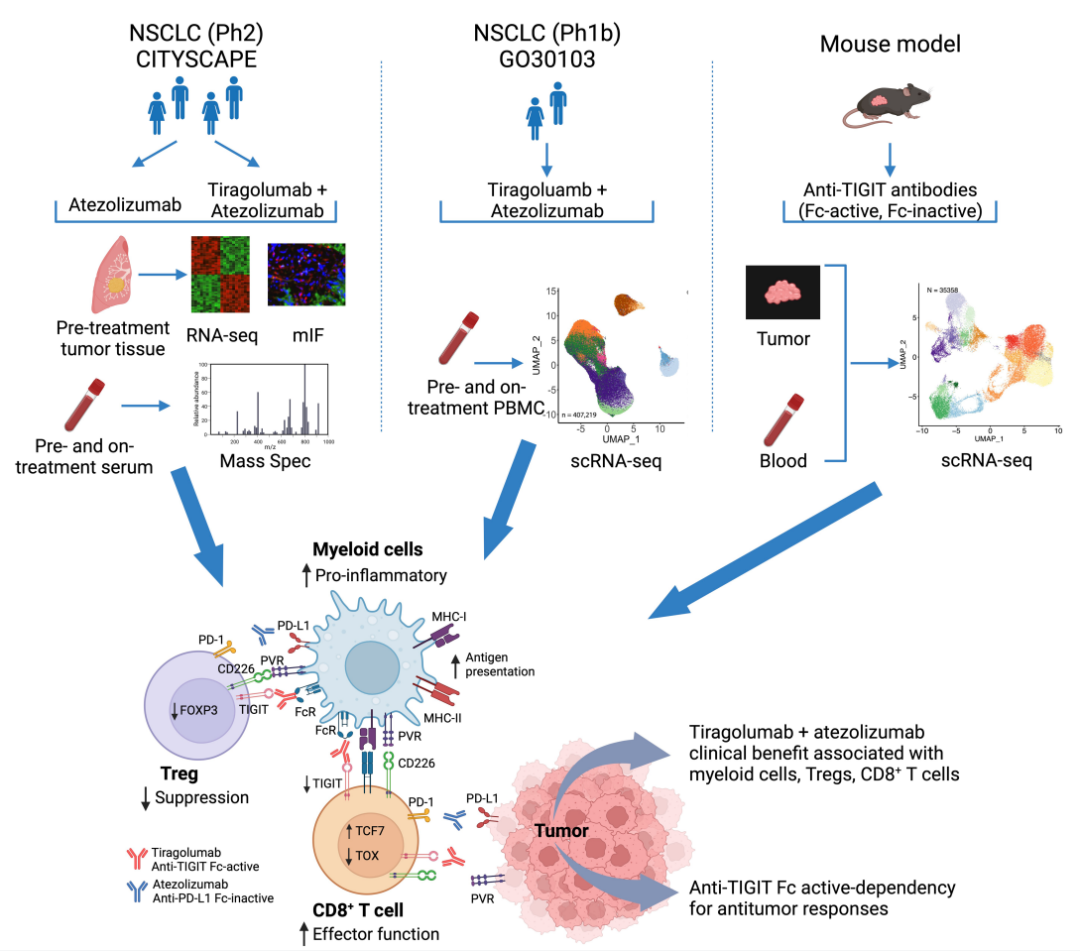 These results reveal that anti-TIGIT checkpoint inhibitors can reshape the immune cell status within the tumor microenvironment and suggest that the development of anti-TIGIT antibodies should consider the role of FcγR-Fc.Translational Medicine Department, Research and Early Development Division, Genentech, Inc. (Translational Medicine, gRED)Namrata Patil And Robert Johnston Co-corresponding author of the paper,Guan XiangnanAndHu RuozhenCo-first authors of the paper.
https://www.nature.com/articles/s41586-024-07121-9
SettingsStar Marker`, Not Missing Any Exciting Tweets`
Welcome to share on Moments and WeChat groups.To promote the dissemination and exchange of cutting-edge research, we have established severalProfessional Exchange Group, Press and hold the QR code below to add the editor's WeChat and join the group. Due to the large number of applicants, please include a note when adding WeChat:School/Professional/Name, ifPI/Professor, please also indicate.
PointIn View, Convey Your Taste