Tides Weekly | Global Peptide and Oligonucleotide Therapeutics News Roundup
Ractigen Therapeutics
Innovative Drug R&D Developer
SANEGENEBIO
Small Nucleic Acid Drug Developer

Boehringer Ingelheim
Developer of Innovative Drugs and Therapies

Viking Therapeutics
Innovative Therapy Developer
Vivani Medical
Biopharmaceutical Manufacturer

Avidity Biosciences
Antibody Oligonucleotide Conjugates Developer
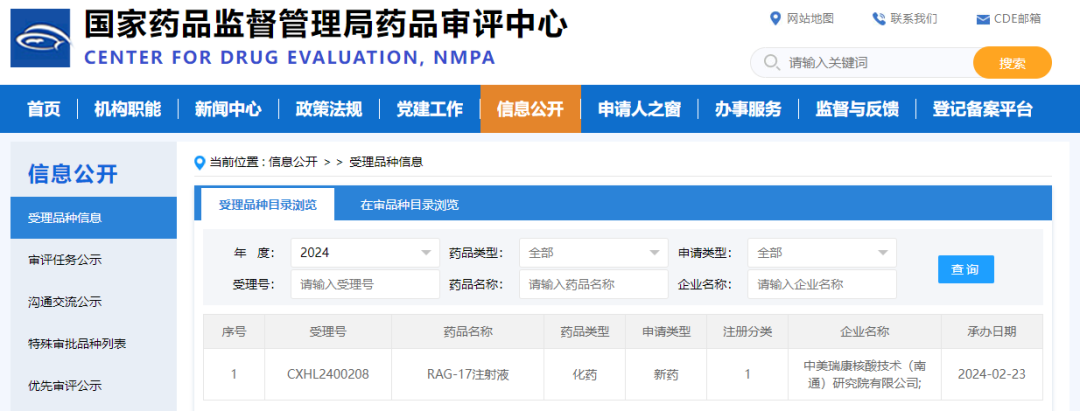
On February 23, 2024, the Center for Drug Evaluation (CDE) of the National Medical Products Administration (NMPA) announced that Ractigen Therapeutics' "RAG-17 Injection" had been submitted for clinical trial. This investigational drug is developed based on Ractigen's proprietary Smart Chemical-Assisted Delivery (SCAD™) platform, which enables efficient and safe delivery of targeted therapeutics to the central nervous system. Preclinical studies have shown that RAG-17 significantly delays disease onset, extends animal survival time, and improves motor function.
RAG-17 is an siRNA drug that targets and inhibits the expression of the SOD1 gene, intended for the treatment of ALS caused by SOD1 mutations. RAG-17 utilizes Ractigen Therapeutics' proprietary SCAD delivery platform technology, which achieves efficient and long-lasting delivery in the central nervous system (CNS) by conjugating double-stranded RNA with auxiliary oligonucleotides (ACO). Multiple preclinical efficacy studies have demonstrated that RAG-17 exhibits superior therapeutic effects compared to reference drugs in ALS disease models (e.g., the hSOD1G93A mouse model).
About Ractigen

Ractigen Therapeutics is a platform-based new drug development company based in China and targeting the global market, committed to developing breakthrough small nucleic acid drugs and disease treatment methods. Ractigen Therapeutics is one of the very few companies globally that simultaneously masters both intrahepatic and extrahepatic delivery technologies for small nucleic acid drugs, and has developed several internationally leading small nucleic acid drug delivery platform technologies with independent intellectual property rights, including SCADTM and LiCOTM.
On February 26, 2024, SANEGENEBIO announced that its self-developed siRNA drug SGB-9768 for the treatment of complement-related diseases had recently received approval from New Zealand's Medicines and Medical Devices Safety Authority (Medsafe) and the Health and Disability Ethics Committees (HDEC) to initiate Phase I clinical trials in New Zealand. SGB-9768 is an RNAi therapy targeting Complement 3 (C3) protein and represents SANEGENEBIO’s second siRNA drug to enter clinical trials.
SGB-9768 is an siRNA-GalNAc conjugate targeting Complement 3 (C3), delivered to liver cells using SANEGENEBIO's uniquely innovative next-generation LEAD™ GalNAc technology, inhibiting the synthesis of hepatic C3 through RNAi. The safety, efficacy, and stability of GalNAc-delivered siRNA drugs have been extensively validated by a large amount of data. This is also the second siRNA drug developed by SANEGENEBIO to enter the clinical trial stage.
About SANEGENEBIO
SANEGENEBIO was founded in early 2021 as a biopharmaceutical company dedicated to developing novel small nucleic acid drugs based on RNA interference (RNAi) technology. The founding team has deep expertise in the small nucleic acid field. Dr. Wang Weimin, the founder and CEO, is one of the leading small nucleic acid drug chemists in the industry. He developed one of the world's first lipid nanoparticle delivery platforms for nucleic acid therapy and pioneered the liver-targeting GalXC technology as well as extrahepatic delivery platforms. The core team possesses extensive experience in drug development, non-clinical and clinical research, industrialization, and business development.
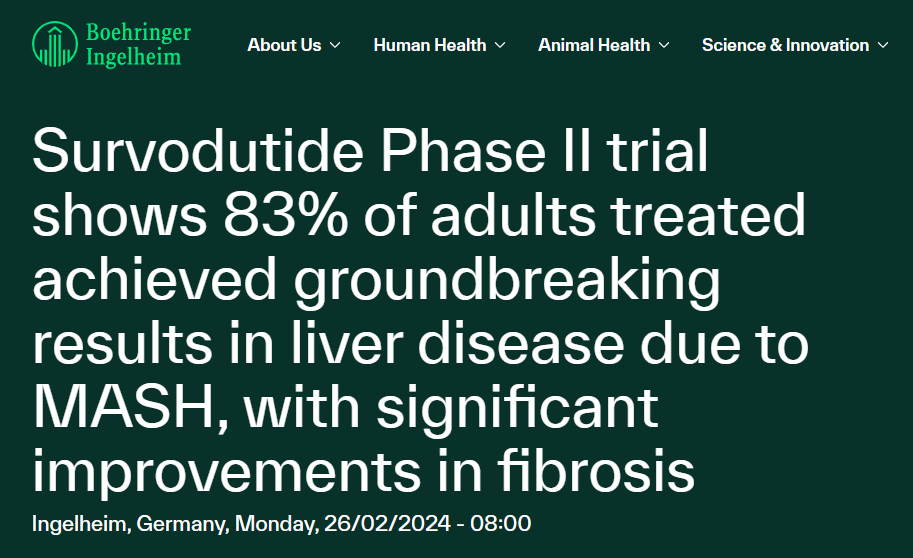
On February 26, 2024, Boehringer Ingelheim announced that survodutide, a dual agonist of glucagon/glucagon-like peptide-1 (GLP-1) receptor co-developed with Zealand Pharma, met the primary endpoint and all secondary endpoints in the Phase II clinical trial for the treatment of metabolic dysfunction-associated steatohepatitis (MASH).
About Survodutide
Survodutide is a GCGR/GLP-1R dual agonist that can simultaneously activate glucagon-like peptide-1 (GLP-1) receptors and glucagon (GCG) receptors, suppressing appetite while increasing energy expenditure, thereby treating obesity.
About Boehringer Ingelheim
Boehringer Ingelheim is committed to researching breakthrough therapies aimed at transforming lives and safeguarding the health of generations to come. As a global leader in biopharmaceuticals driven by research and development, the company demonstrates its value through innovation in areas of high unmet medical need. Since its founding in 1885, Boehringer Ingelheim has remained an independent, family-owned business with a long-term focus on sustainability. With over 53,000 employees worldwide, the company serves more than 130 regions across two core business areas: human pharmaceuticals and animal health.
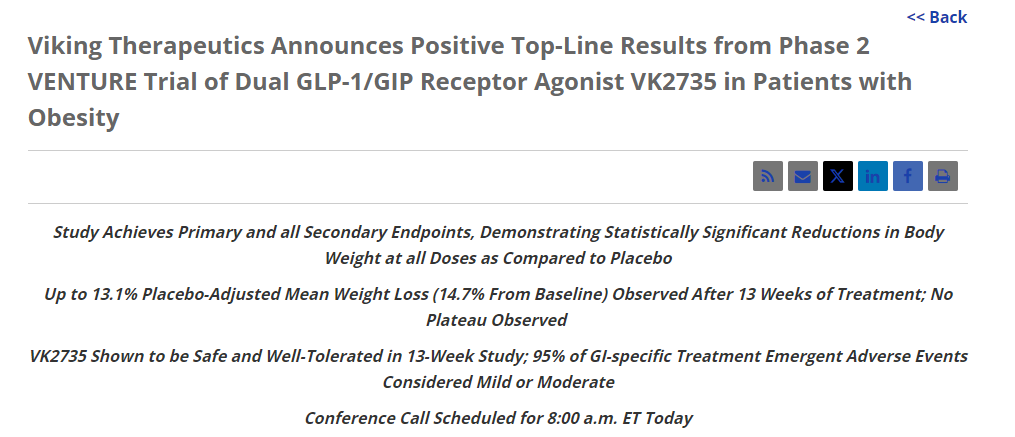
On February 27, 2024, Viking Therapeutics announced that the Phase II VENTURE study of VK2735, a GLP-1R/GIPR dual agonist, successfully met its primary endpoint and all secondary endpoints. Compared to placebo, patients receiving VK2735 experienced statistically significant weight loss. Additionally, the study demonstrated that VK2735 was safe and well-tolerated, with most treatment-emergent adverse events (TEAEs) being mild or moderate. Based on these findings, Viking plans to meet with the FDA to discuss the next steps in the development of VK2735.
About VK2735
VK2735 is a novel dual agonist based on peptides, currently under research, targeting glucagon-like peptide-1 (GLP-1) and glucose-dependent insulinotropic polypeptide (GIP) receptors for the potential treatment of various metabolic disorders. GIP and GLP-1 are natural incretin hormones that regulate blood glucose.
About Viking Therapeutics
On February 27, 2024, ConjuStar announced that the first-in-China Nectin-4-targeted peptide-drug conjugate, SC-101 Injection, completed the enrollment and dosing of its first subject in a Phase I clinical trial at Peking University Cancer Hospital. The clinical trial is led by Professor Jun Guo as the principal investigator. This Phase I clinical trial aims to evaluate the safety, tolerability, pharmacokinetic profile, and preliminary efficacy of SC-101 Injection in patients with advanced Nectin-4-positive tumors, with an estimated enrollment of approximately 80 subjects. The enrollment and dosing of the first patient in this Phase I clinical trial marks a significant research and development milestone for ConjuStar in the field of peptide-drug conjugates for cancer treatment.

About SC-101
SC-101 is a peptide-drug conjugate molecule composed of a peptide targeting the hNectin-4 protein, which is highly expressed in multiple tumors such as urothelial carcinoma, triple-negative breast cancer, non-small cell lung cancer, and esophageal cancer, linked to a microtubule inhibitor through a linker.
About ConjuStar
ConjuStar is a clinical-stage biotechnology company focusing on building a miniaturized conjugated drug R&D platform. By combining collaborative development with independent research, the company has rapidly established a robust pipeline, dedicated to bringing more effective, safer, and highly accessible new oncology treatments to a broad range of cancer patients. The company currently has five products at various stages of development. In early 2024, ConjuStar’s first product received clinical trial authorization and entered clinical research.
On February 28, Vivani Medical announced positive preclinical data regarding the weight loss effects of NPM-115. The exenatide implant is under development for the treatment of chronic weight management. The company also disclosed that NPM-115 (exenatide...Peptide ImplantCompared with injectable semaglutide (Ozenpic®/Wegovy®), it achieved significant weight loss in a single administration with an expected twice-yearly dosing schedule.

About Vivani Medical, Inc.
Vivani MeVivani Medical utilizes its proprietary NanoPortal™ platform to develop biopharmaceutical implants designed to stably deliver drug molecules over an extended period, ensuring compliance and potentially improving drug tolerance.Vivani's NPM-115 and NPM-119 are micro, six-month GLP-1 implants under development for chronic weight management in obese or overweight patients and for type 2 diabetes, respectively.These NanoPortalTM implants are designed to provide patients with the opportunity to fully realize the potential benefits of their medications by avoiding the challenges associated with daily or weekly oral and injectable drugs.
Vivani's wholly-owned subsidiary, Cortigent, is developing targeted neurostimulation systems designed to helpPatients regain key bodily functions.Research equipment includes Orion®, designed to provide artificial vision for the severely blind, and a new system aimed at accelerating the recovery of arm and hand function in patients partially paralyzed by stroke.Vivani Medical, Inc. Continues to Evaluate Strategic Options to Advance Ractigen Therapeutics' Groundbreaking Technology.
February 29, 2024Avidity BiosciencesAvidity Biosciences Announces $400 Million Private Placement FinancingAvidity Biosciences announced the completion of a $400 million private placement financing, with funds coming from existing investors and several large investment firms. Avidity intends to use the net proceeds from the financing to support the development of its clinical-stage product candidates, other research programs, working capital, and general corporate purposes. The proceeds from this financing, together with current cash, cash equivalents, and investments, are expected to fund current operations through the end of 2026.
About Avidity
Avidity's mission is to profoundly improve people's lives by providing novel RNA therapies — Antibody Oligonucleotide Conjugates (AOCs™). Avidity is leveraging its proprietary...AOCCompletely Transforming the RNA Field, This AOC Aims to Combine the Specificity of Monoclonal Antibodies with the Precision of Oligonucleotide Therapies to Address Targets and Diseases Previously Unreachable with Existing RNA Therapies. Leveraging Its Proprietary AOC Platform, Avidity Successfully Delivered RNA to Muscles for the First Time and Is Leading Clinical Development Programs for Three Rare Muscle Diseases: Type 1Myotonic Dystrophy(DM1), Duchenne Muscular Dystrophy (DMD), and Facioscapulohumeral Muscular Dystrophy (FSHD)FSHD). Avidity is advancing and expanding its pipeline, including cardiology and immunology programs, through internal discovery efforts and significant partnerships, thereby broadening the impact of AOC.