

Six Innovative Therapies Await FDA Approval in March: Pipeline Highlights and Company Updates

Madrigal Pharmaceuticals
Developer of Fatty Liver Disease Treatment Drugs
Orchard Therapeutics
Gene Therapy Developer

Parker
Pharmaceutical R&D Developer

MSD
Pharmaceutical R&D and Manufacturer

Akebia Therapeutics
Biopharmaceutical Manufacturer
Regeneron
Biopharmaceutical Manufacturer

Eli Lilly
Global Pharmaceutical R&D and Production Company
▎Edited by the WuXi AppTec content team

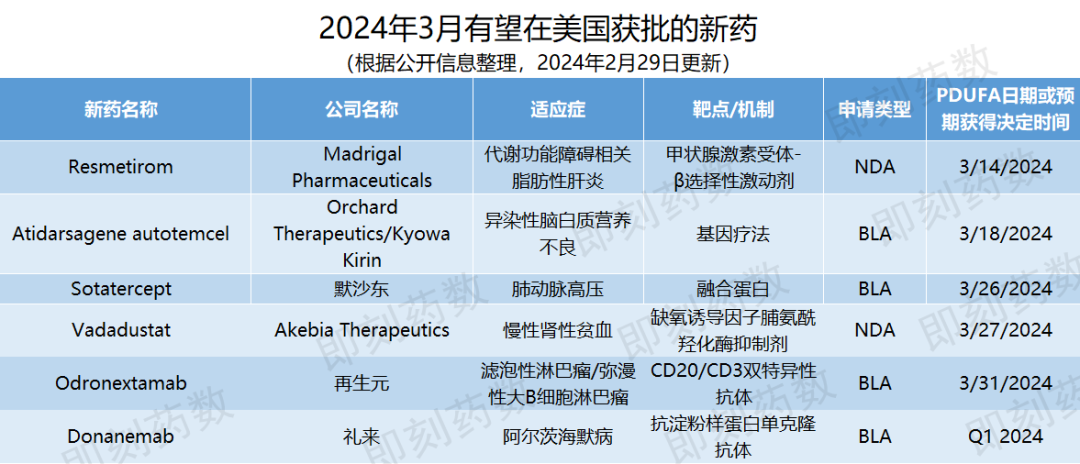
According to the anticipated PDUFA goal date, the U.S. FDA is expected to make regulatory decisions on the approval of six innovative drugs in March. This article will provide relevant introductions to these therapies.
Active Ingredient:Resmetirom
Indications: Metabolic Dysfunction-Associated Steatohepatitis (MASH)
Company Name:Madrigal Pharmaceuticals
Resmetirom is a potential "first-in-class" oral selective agonist of the thyroid hormone receptor (THR)-β, which has been granted Breakthrough Therapy Designation by the U.S. FDA.Thyroid hormones play a central role in liver function by activating β receptors in hepatocytes, influencing a range of health parameters from serum cholesterol and triglyceride levels to pathological fat accumulation in the liver. The role of THR-β receptors in the liver is critical for normal liver function. Resmetirom has high selectivity, avoiding activation of THR-α receptors that mediate thyroid hormone activity outside the liver (including in the heart and bones), and is specifically taken up in the liver. Previous trials have confirmed the safety of resmetirom, showing no activity on THR-α receptors, no impact on skeletal or cardiac parameters, and no effect on other hormones in the thyroid hormone pathway.
The U.S. FDA accepted the New Drug Application (NDA) submitted by Madrigal Pharmaceuticals, Inc. for resmetirom in September 2023 to treat MASH (formerly known as nonalcoholic steatohepatitis, NASH) and granted it Priority Review status.
Published in The New England Journal of Medicine this FebruaryPhase 3 Clinical TrialThe results of MAESTRO-NASH show,Resmetirom met the dual primary endpoints proposed by the FDA, which are considered highly predictive of clinical benefit. These endpoints are the resolution of MASH symptoms without worsening of liver fibrosis, and reduction in liver fibrosis without worsening of the Nonalcoholic Fatty Liver Disease Activity Score (NAS).
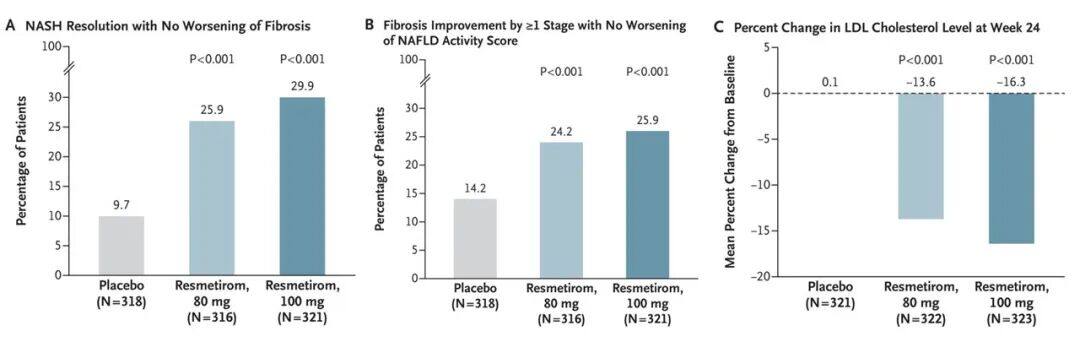
▲Main Results of the MAESTRO-NASH Clinical Trial (Image Source: Reference [1])
Active Ingredient:Atidarsagene autotemcel
Indications:Metachromatic Leukodystrophy (MLD)
Company Name:Orchard Therapeutics/Kyowa Kirin
Atidarsagene autotemcel uses a lentiviral vector to deliver the gene encoding arylsulfatase A.ARSATransgene Introduced into Autologous CD34-Positive Hematopoietic Stem and Progenitor Cells of Patients with Metachromatic Leukodystrophy to Restore Arylsulfatase-A ExpressionThereby, through a one-time treatment, the patient's motor function and cognitive development abilities are continuously preserved.
In September 2023, the U.S. FDA accepted Orchard Therapeutics' Biologics License Application (BLA) for this therapy and granted itPriority Review StatusThe BLA submission is based on data from 39 pediatric patients with early-onset MLD who were enrolled in two prospective non-randomized clinical studies (n=30) or received treatment under an expanded access framework (n=9).Patients treated with atidarsagene autotemcel were compared to natural history data from 49 untreated patients. In clinical trials, this gene therapy preserved motor function and cognitive development in the majority of patients compared to the natural history of the disease., with a follow-up period of up to 12 years (median 6.76 years).
Atidarsagene autotemcel has been approved for marketing by the European Commission under the trade name Libmeldy. In October last year, Kyowa Kirin and Orchard Therapeutics announced that the two companies had reached a definitive agreement under which Kyowa Kirin would acquire Orchard Therapeutics for approximately $387.4 million.Acquisition of Orchard。
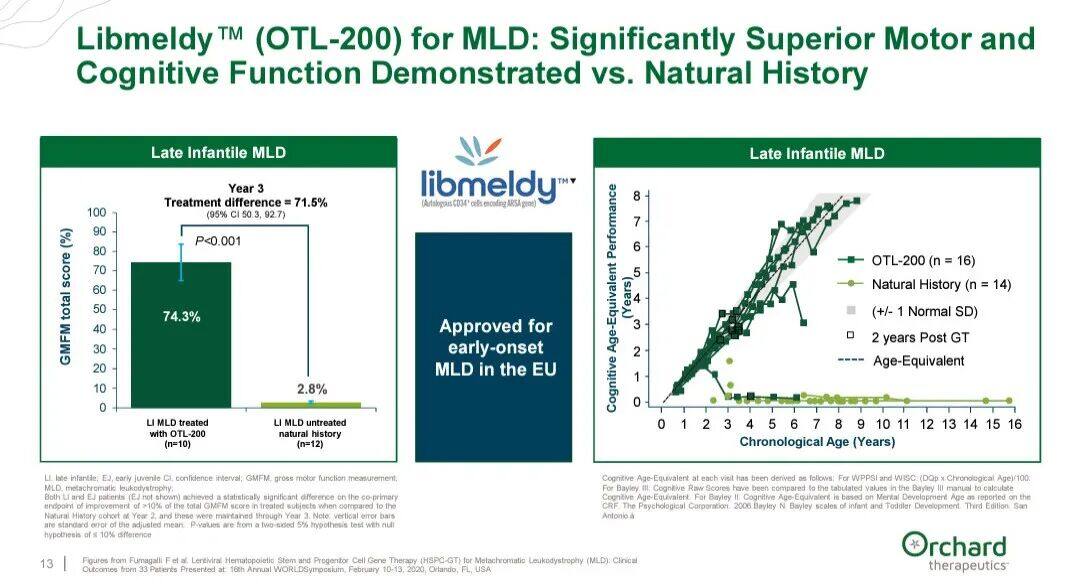
▲Atidarsagene autotemcel Trial Results (Image Source: Reference [2])
Active Ingredient:Sotatercept
Indications:Pulmonary Hypertension
Company Name: MSD
Sotatercept is the key investigational therapy acquired by Merck & Co., Inc. through the approximately $11.5 billion acquisition of Acceleron Pharma.It is a potential “first-in-class” Type IIA activin receptor (ActRIIA) fusion protein.It fuses the modified extracellular domain of ActRIIA with the Fc portion of an antibody. It can block activin from binding to receptors on the cell membrane, thereby reducing activin-mediated signaling. In preclinical experiments, it has been shown to reverse remodeling of the pulmonary arterial wall and right ventricle. It has received Breakthrough Therapy Designation from the FDA, making it the first investigational therapy for pulmonary arterial hypertension to receive such a designation. MSD noted that itHas the potential to become a cornerstone therapy for treating pulmonary arterial hypertension.
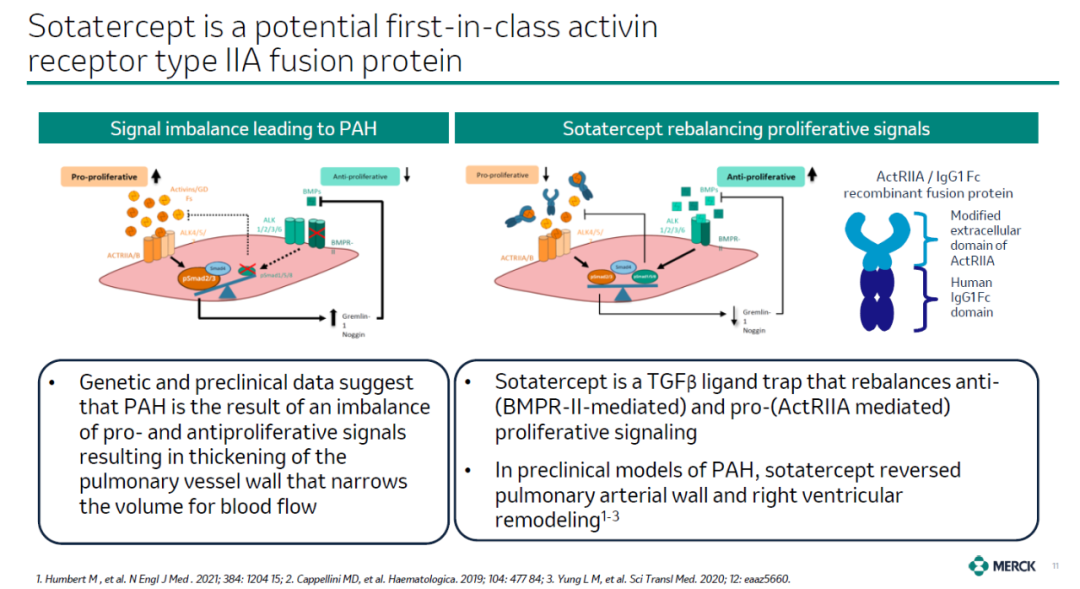
▲Sotatercept adjusts the balance between promoting and inhibiting hyperplasia signals (Image source:MSD Official Website)
In September 2023, the U.S. FDA accepted MSD's Biologics License Application (BLA) for sotatercept and granted it Priority Review designation. This BLA is based on the positive results from the Phase 3 clinical trial STELLAR.Phase 3 clinical trial results showed that after 24 weeks of treatment, patients in the sotatercept group improved their 6-minute walking distance by 40.8 meters (95% CI, 27.5-54.1; p<0.001) compared to baseline.
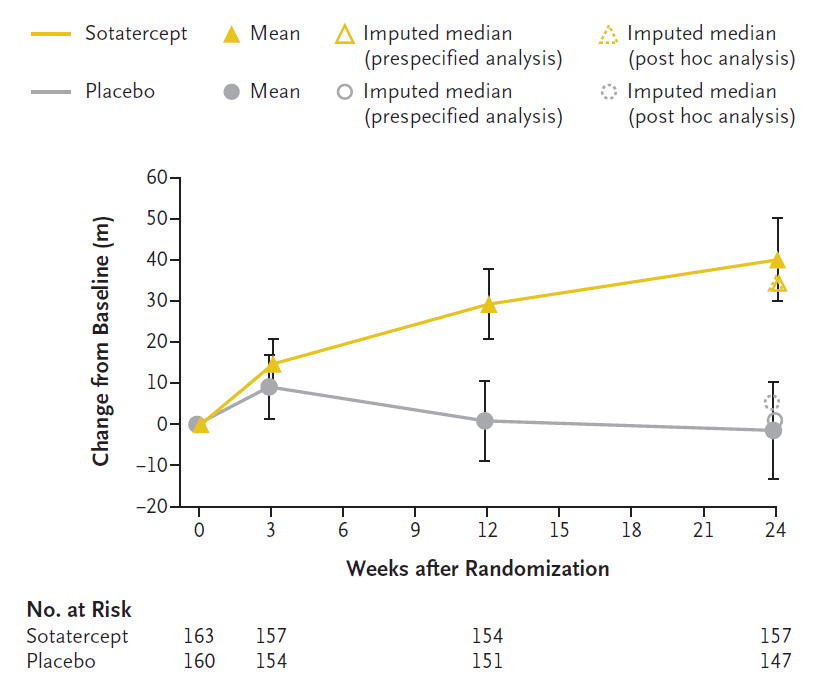
▲Sotatercept Significantly Improves 6-Minute Walk Distance in Pulmonary Arterial Hypertension Patients (Image Source:Reference [4])
In addition, sotatercept provided statistically significant and clinically meaningful improvements in 8 of the 9 secondary endpoints compared to placebo.At a median follow-up time of 32.7 weeks, it reduced the risk of clinical disease worsening or death by 84%.
Active Ingredient:Vadadustat
Indications: Chronic renal anemia
Company Name:Akebia Therapeutics
Vadadustat is an oral hypoxia-inducible factor prolyl hydroxylase inhibitor (HIF-PHI)., aiming to simulate the physiological effects of hypoxia on the body under high-altitude conditions. At high altitudes, the body's response to oxygen scarcity is to increase the production of HIF. HIF regulates the mobilization of iron and the production of erythropoietin (EPO) to stimulate red blood cell generation, thereby improving oxygen transport. Research on the oxygen-sensing signaling pathway has been awarded the Nobel Prize in Physiology or Medicine.
In October 2023, the U.S. FDA accepted Akebia Therapeutics' resubmitted New Drug Application for vadadustat, intended for the treatment of anemia in chronic kidney disease patients undergoing dialysis. Vadadustat has already been approved for marketing in 35 countries and regions.
Active Ingredient:Odronextamab
Indications: Relapsed/Refractory Follicular Lymphoma and Diffuse Large B-Cell Lymphoma
Company Name: Regeneron
Odronextamab is a bispecific antibody targeting CD20 and CD3, which activates T cells to kill tumor cells by recruiting CD3-expressing T cells to the vicinity of CD20-expressing tumor cells.
In September 2023, the U.S. FDA accepted Regeneron's BLA for odronextamab for the treatment of relapsed/refractory follicular lymphoma and diffuse large B-cell lymphoma. The FDA also granted it Priority Review designation.
Active Ingredient:Donanemab
Indications: Alzheimer's Disease
Company Name: Eli Lilly
Donanemab specifically binds to a subtype of amyloid protein known as N3pG. By targeting this subtype, donanemab is able to selectively bind to amyloid plaques in the brain, thereby promoting the clearance of these plaques.
Eli Lilly and Company completed the submission of the donanemab marketing application to the U.S. FDA in the second quarter of 2023. This application was supported by the results of the Phase 3 clinical trial TRAILBLAZER-ALZ 2. Last year, it was published in the Journal of the American Medical Association (JAMA) The full results published onDonanemab significantly slows cognitive and functional decline in patients with early symptoms of Alzheimer's disease and delays disease progression.
The TRAILBLAZER-ALZ 2 trial includes patients with a wide range of cognitive scores and amyloid levels. Participants were divided into low-to-moderate tau groups or high tau groups (a later pathological stage of disease progression) based on their tau levels. All participants were then evaluated over 18 months using scales that measure cognition and function, including the Integrated Alzheimer's Disease Rating Scale (iADRS) and the Clinical Dementia Rating-Sum of Boxes (CDR-SB, with higher scores indicating lower clinical function).
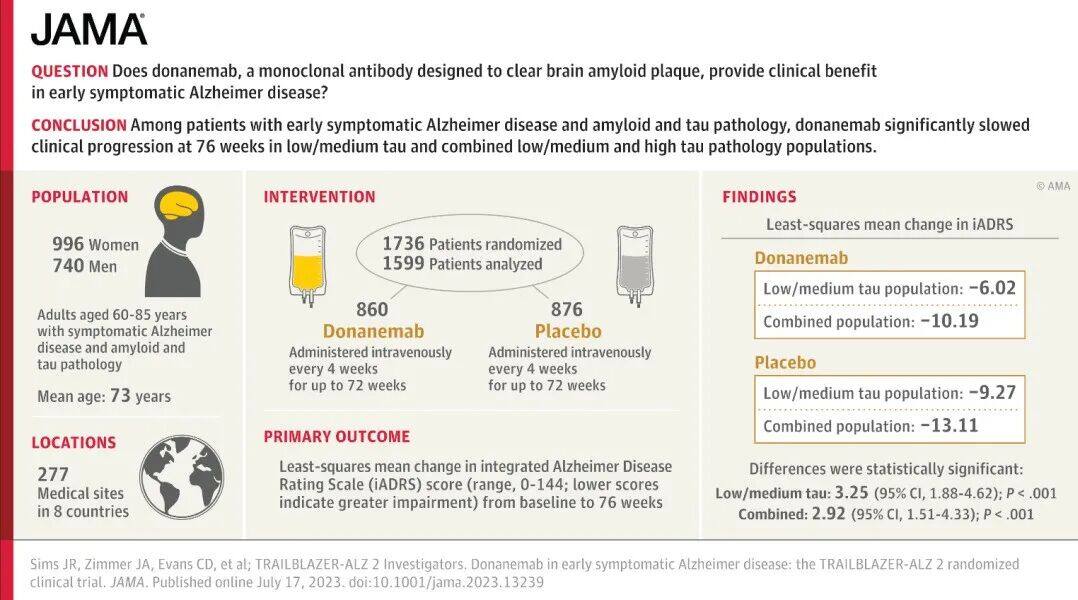
▲Summary of TRAILBLAZER-ALZ 2 Trial Design and Results (Image Source: Reference [6])
The test results showed,Patients in the low-to-moderate tau group (n=1182) experienced a significant slowing of decline in iADRS and CDR-SB scores by 35% and 36%, respectively, after receiving donanemab treatment.In all early symptomatic AD patients positive for amyloid-beta (n=1736), donanemab significantly slowed the decline in iADRS and CDR-SB by 22% and 29%, respectively.

Everyone is watching






▲To learn more about the application of cutting-edge technologies in the biopharmaceuticals industry, please long-press and scan the QR code above to access "WuXi Live Studio" and watch live discussions and exciting replays on related topics.


Share,PointLike,In ViewFocusing on Global Biomedical Health Innovation