

BioAge Labs Files for IPO Following $170M Series D Backed by Eli Lilly and Amgen to Advance AI-Driven Anti-Aging Therapies

BioAge
Drug Discovery Platform Developer
Only nearly two months into 2024, the anti-aging field has already seen a financing deal worth $170 million.
The company that received financing is named BioAge Labs (referred to as BioAge below), a prominent anti-aging company established in 2015, dedicated to...Developing Innovative Drugs to Treat Aging and Age-Related Diseases and Extend Human Healthspan Using AI Technology。
Not long after the company announced the completion of its D-round financing,It also recently announced that it will launch a Phase 2 clinical trial in collaboration with Eli Lilly in mid-2024.To evaluate the efficacy of the combination therapy of BioAge's Apelin receptor (APJ) agonist Azelaprag (BGE-105) and Lilly's GLP-1R/GIPR dual-target agonist Tirzepatide in treating obesity.
Moreover, VCBeat learned that during the trial process,BioAge will also collect aging-related biomarker information from subjects in compliance with relevant laws and regulations, thereby supporting the development of other early-stage clinical aging pipelines at BioAge.。
As of now,BioAge's research on aging focuses on three directions: metabolism and muscle aging, brain aging, and immune aging.At the same time, relying on its unique AI drug discovery platform, BioAge also has multiple pipelines under research and development, with indications including obesity, neuroinflammation, acute muscle atrophy, and other aging-related diseases.
Since its establishment, BioAge has completed five rounds of financing, raising nearly $300 million in total. Investors such as Andreessen Horowitz, Pear Ventures, and AME Cloud Ventures have participated in multiple rounds, and the company has successively reached partnerships with Amgen and Eli Lilly.
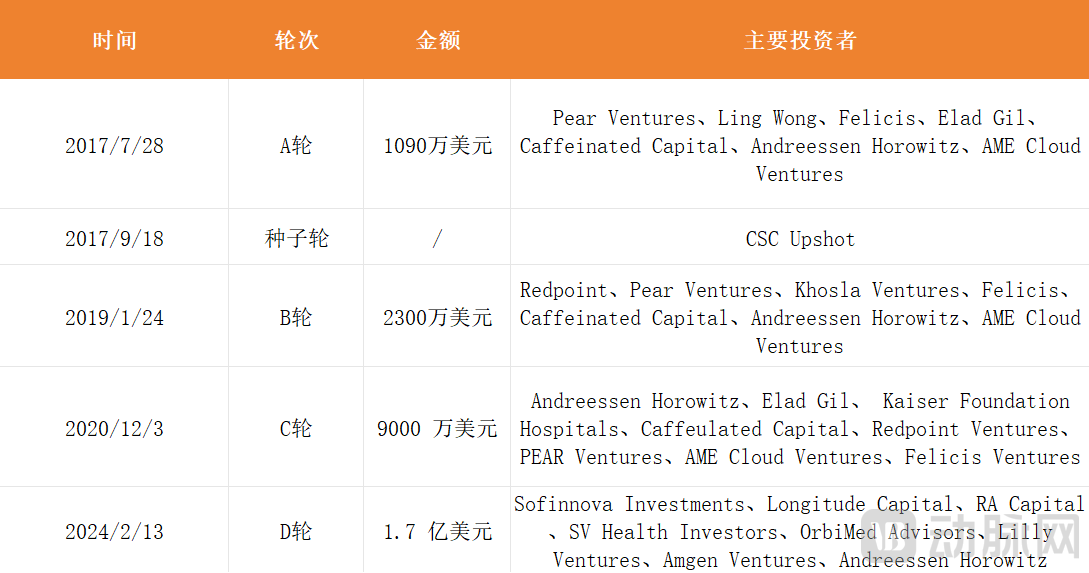
BioAge Financing Process Data Source: crunchbase official website, chart by VCBeat
Behind BioAge's popularity among star capital and renowned enterprises is a core team from companies like Merck, Roche, and Insilico Medicine providing support.
Kristen Fortney, Ph.D., the co-founder and CEO, is an entrepreneur with over 10 years of research experience in bioinformatics. She not only earned her Ph.D. in Bioinformatics from the University of Toronto and completed postdoctoral training at Stanford University but also became a fellow of two renowned aging research institutions—the American Federation for Aging Research (AFAR) and the Ellison Medical Foundation. With a total of 18 published papers, her research areas include computational drug discovery, biomarkers of aging, and genetics related to extending human lifespan.
In addition, Kristen Fortney has served as a consultant for drug research and development companies such as Insilico Medicine, Humanity, Retro Biosciences, and Known Medicine.It is worth mentioning that BioAge's data-driven approach to identifying and targeting the molecular pathways that drive aging was primarily developed under its leadership.。
Moreover, similar to its founder, core team members of BioAge also have a strong background in aging research and systems biology—Eric Morgen, the Chief Operating Officer, has published over 20 papers in fields such as target discovery, aging, and pharmacogenomics; Dr. Paul Rubin, who serves as the Chief Marketing Officer and Executive Vice President, has held key positions in biopharmaceutical companies like MiRagen, Glaxo-Wellcome, and Abbott, and has advanced more than 10 products from clinical development to approval.Including the first 5-lipoxygenase inhibitor approved for clinical treatment of asthma, Zileuton.。
At the same time, BioAge has attracted Dr. Peng Leong to serve as Chief Business Officer and Head of Brain Aging Therapeutics. Dr. Peng Leong previously worked in healthcare investment banking at CIBC World Markets and Piper Jaffray, and has served as Head of Medical Business Development at Merck and Chief Brand Officer at Kazia Therapeutics.
In addition, BioAge's scientific advisory team also provides guidance and support for the company’s development. Key members include Dr. George Hartman, the primary developer of the antiplatelet drug Aggrastat®; Dr. Klaus Klumpp, who previously led the clinical development of antiviral drugs at Roche; and Dr. Elad Gil, who has served as Vice President of Corporate Strategy and Product Manager at Twitter, Google, and McKinsey & Company. Their involvement has provided strong momentum for the advancement of the company’s core pipeline.
In 2019, BioAge announced the completion of a $23 million Series B financing round, which enabled the company to build a high-throughput target identification platform based on AI technology—an AI drug discovery platform. This platform is capable of searching through massive datasets to identify key biological pathways and drug targets that impact human lifespan, and advancing potential targets to the clinical development stage through high-throughput biological validation.
But BioAge is not content with simple retrieval and validation. The company aims to upgrade its existing platform by integrating more AI technologies and database information into an AI-driven technical platform capable of leveraging vast amounts of biological data to discover and validate a broader range of aging pathways and drug targets.
To this end, in 2022, BioAge announced a cooperation agreement with Age Labs, gaining exclusive access to the AgeLabs database. BioAge is able to use the Nord-Trøndelag Health Study (HUNT) biobank samples and health records to identify, develop, and commercialize drug targets for aging-related diseases. Notably, the biological samples collected longitudinally by HUNT from 1995 to the present are suitable for epigenetic, proteomic, and metabolomic analyses.
Based on this, BioAge's AI drug discovery platform can deeply analyze biological samples from longitudinal studies, identify proteins, metabolites, or molecular mechanisms that impact healthy longevity and age-related diseases, and then quickly pinpoint key targets within the aging pathways.
After years of innovative development,BioAge's platform is currently built on a database with longitudinal samples and health records spanning 45 years, containing over 1.5 million clinical data points, more than 64 million molecular data points, totaling over 65.5 million data points, and can evaluate approximately 20 aging pathways annually.Among its advantages, the biggest is leveraging longitudinal data to track patient aging outcomes, thereby identifying new mechanisms and drivers of aging, and recognizing novel targets at the intersection of known and new aging biology.
Azelaprag is precisely the R&D pipeline discovered and advanced by BioAge through its AI platform.In 2021, BioAge entered into a global exclusive license agreement with Amgen, obtaining the rights for the development and commercialization of the drug.After more than two years of research and development, Azelaprag has become an important asset for the company in the fields of metabolism and muscle aging.
Azelaprag is an orally or intravenously administrable APJ agonist that can be used to treat muscle atrophy and restore muscle strength and function by enhancing Apelin signaling activity.
Among them, Apelin is a "myokine" peptide released after exercise. Its endogenous receptor APJ is a G protein-coupled receptor expressed on various organ cells in the body, mainly including the central nervous system and cardiovascular system. It regulates metabolism and promotes muscle regeneration through interactions with skeletal muscle, the heart, and the central nervous system.
Studies show that as the human body begins to age, bone and muscle mass gradually decrease, and risks such as fractures and frailty also increase. For instance, sarcopenia, which commonly occurs in the elderly population, leads to a loss of strength, mobility, and function due to muscle aging, further increasing the incidence of age-related diseases and mortality. Data indicates that functional sarcopenia or age-related musculoskeletal changes affect 7% of individuals aged over 70.1。
BioAge's research also shows that the overall level of Apelin in the human body gradually decreases with the aging process, and people with higher Apelin levels have stronger physical functions and longer lifespans.
Its preclinical studies show,Azelaprag in combination with tirzepatide enhances the overall weight loss effect in tested mice. Compared to tirzepatide alone, the Azelaprag group showed a 2-fold increase in weight loss and was able to restore body composition and muscle function to manageable levels.。
In the Phase 1b clinical trial of Azelaprag, data showed that among 21 healthy subjects aged 65 and above, after receiving Azelaprag or placebo infusion and undergoing strict bed rest for 10 days, Azelaprag demonstrated statistically significant improvements in muscle size, mass, and protein synthesis compared to placebo. No serious adverse effects were observed, showing good safety and tolerability.
Based on positive clinical trial data, BioAge will collaborate with Eli Lilly to conduct a Phase 2 clinical trial evaluating whether Azelaprag can enhance the weight loss effects achieved by GLP-1 drugs. As a drug designed to prevent muscle aging,Azelaprag, when combined with GLP-1 drugs, has the potential to reduce side effects such as gastrointestinal issues and muscle mass loss caused by this class of drugs, promoting healthier weight loss outcomes. Ultimately, it could effectively prevent or delay the progression of various age-related diseases and extend patients' healthy lifespan by treating obesity.。
With the support of an AI platform, BioAge has laid out multiple R&D pipelines targeting different indications in the field of aging. In addition to the core pipeline Azelaprag mentioned earlier, it also includes BGE-100.
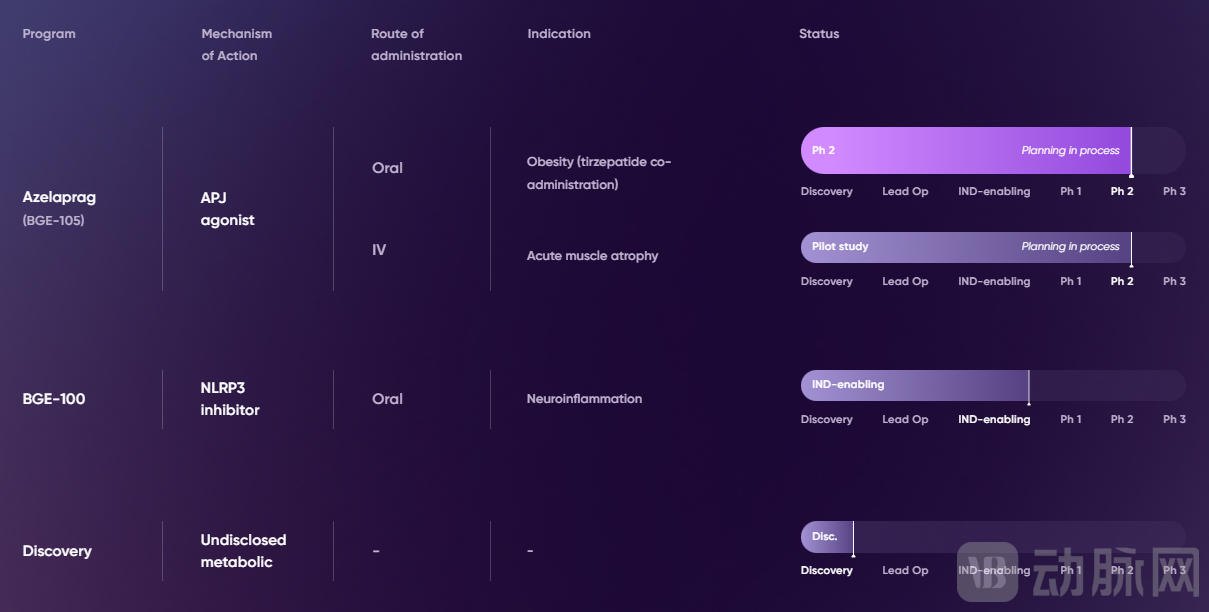 BioAge Pipeline Source: BioAge Official Website
BGE-100 is an NLRP3 (NOD-like receptor pyrin domain-containing protein 3) inhibitor being developed for the treatment of neurodegenerative diseases caused by neuroinflammation, helping to extend patient lifespan. Currently, BGE-100 is in the preclinical toxicology research stage and is expected to enter clinical trials by mid-2024.
Notably, BioAge has also developed two other aging pipelines—BGE-175 and BGE-117. BGE-175 is an inhibitor of the prostaglandin D2 (PGD2) DP1 receptor, being developed to treat various diseases caused by immune aging, aiming to restore the aging immune system. BGE-117 is a hypoxia-inducible factor-prolyl hydroxylase (HIF-PH) inhibitor, being developed to treat various age-related diseases, thereby extending the lifespan of the elderly.
However, BioAge successively abandoned two assets, BGE-175 and BGE-117, in 2021, shifting its focus to BGE-100 and Azelaprag, and gradually expanding its scope from aging to the weight loss field. Regarding this, Kristen Fortney stated,Attention to the field of metabolic diseases will simultaneously promote the company's business development in the field of aging, ultimately advancing the resolution of aging and the treatment of age-related diseases.。
Although the road to innovative drug development is still long, in the future, BioAge's drugs under research may become a hope for patients to get rid of disease troubles and extend healthy life expectancy.
References:
1. Amarya S, Singh K, Sabharwal M. Ageing process and physiological changes[M]//Gerontology. IntechOpen, 2018.