Amlitelimab: A First-in-Class OX40 Pathway Inhibitor Challenges Dupilumab in Atopic Dermatitis

Sanofi
Pharmaceutical R&D Developer
Amlitelimab is a potential "first-in-class" OX40 signaling pathway blocker, with the potential to be administered only once every 12 weeks. With this advantage, it is expected to challenge Dupilumab's position in atopic dermatitis.
OX40 Target:
Antagonists Show Clear Efficacy in the AD Field
Agonists for Cancer Treatment Still Have a Long Way to Go
OX40, also known as CD134, ACT35, and TNFRSF4, was first discovered in 1987 on activated mouse CD4+ T cells and belongs to the TNFR superfamily. The OX40 gene, along with several other molecules of the TNFR family (TNFR2, 4-1BB, HVEM, CD30, GITR, DR3), is clustered on human chromosome 1. OX40 is a type I transmembrane glycoprotein composed of 249 amino acids, with 49 amino acids located intracellularly and 186 amino acids in the extracellular region. OX40 contains three complete cysteine-rich domains (CRDs) and one partial C-terminal CRD.
As an important T cell activation stimulant, both activating or blocking the OX40/OX40L signaling pathway can produce therapeutic effects. On one hand, the therapeutic effect of OX40 antagonistic antibodies on atopic dermatitis (AD) has been relatively well established. When OX40 is activated by OX40L, its downstream signaling pathways promote T-cell division, survival, and cytokine production. In inflammatory diseases such as AD, OX40L activates the OX40 signaling pathway to promote the activation of helper T cells like Th2, thereby facilitating inflammation. Therefore, OX40 and OX40L are expected to become a novel target for the treatment of atopic dermatitis (AD). Rocatinlimab from Amgen/Kyowa Kirin and Amlitelimab from Sanofi/Kymab have both demonstrated favorable safety and efficacy data in treating moderate to severe atopic dermatitis.
On the other hand, enhancing OX40 signaling with an OX40 agonist antibody can boost T cell-mediated anti-tumor immunity, contributing to tumor regression and prolonged survival. OX40 agonists may increase T cell infiltration into tumors and enhance the anti-tumor immune response of conventional CD4 and CD8 T cells, thereby improving survival rates in several preclinical cancer models. However, the therapeutic potential of OX40 agonist antibodies in the field of oncology is still in the proof-of-concept stage. The efficacy of OX40 monoclonal antibodies, which were developed early on by Pfizer, Roche, and BMS for advanced solid tumors, has been relatively limited.
OX40 Competition:
Amgen, Sanofi Lead
Chinese companies and others are following suit.
OX40 has become one of the popular targets in the field of new drug research and development. Currently, multiple OX40 antibodies worldwide have entered clinical stages, among which Amgen's rocatinlimab and Sanofi's amlitelimab are both in phase III clinical trials. In China, OX40 antagonists from Hutchmed/Inmagene Biologics, Bio-Thera Solutions, and Innovent Biologics are in clinical phase I.
OX40 Target Competition Landscape
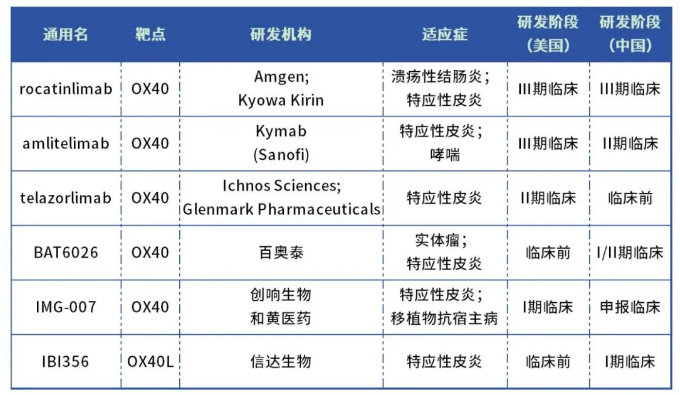
Source: Public data from Pharma Intelligence, corporate announcements, etc.
(1) Rocatinlimab (KHK4083) is an anti-OX40 monoclonal antibody that can inhibit and reduce the number of activated T cells expressing OX40, currently in Phase III clinical trials. In June 2021, Amgen acquired Rocatinlimab for an upfront payment of $400 million and milestone payments of $850 million, obtaining the rights for development, production, and commercialization outside Japan, while Kyowa Kirin retained all rights within Japan.
On October 8, 2023, the Phase III clinical trial ROCKET-ASCEND for Rocatinlimab was initiated in China. The primary objective is to evaluate the long-term safety, tolerability, and efficacy of Rocatinlimab in adult and adolescent patients with moderate to severe atopic dermatitis (AD).
In the previously published Phase II clinical trial (Registration Number: NCT03703102), Rocatinlimab has already met the primary endpoint in the Phase II clinical trial for treating patients with moderate to severe atopic dermatitis. Compared with the placebo, after 16 weeks, patients treated with Rocatinlimab showed statistically significant improvement in the Eczema Area and Severity Index (EASI) score. This Phase 2 randomized, double-blind, placebo-controlled clinical trial demonstrated that patients receiving four different doses of Rocatinlimab achieved statistically significant improvements in EASI scores compared to the placebo group. The EASI score decreased by 57.4% in the 600 mg every two weeks (Q2W) group, 49.7% in the 600 mg every four weeks (Q4W) group, 61.1% in the 300 mg Q2W group, and 48.3% in the 150 mg Q4W group, compared to a 15% reduction in the placebo group (P<0.001 for all dose groups versus placebo). (2) Amlitelimab, originally developed by Kymab, is a monoclonal antibody against OX40L and is currently in Phase III clinical trials. In November 2021, Sanofi acquired Kymab for $1.45 billion. Amlitelimab does not deplete OX40+ activated T cells but instead targets OX40L, blocking its interaction with OX40, thereby preventing the inappropriate activation and proliferation of "pro-inflammatory" effector T cells and promoting the expansion of "anti-inflammatory" regulatory T cells to restore immune system homeostasis. On June 27, 2023, Sanofi announced that the Phase 2b STREAM-AD study of amlitelimab in adult patients with moderate to severe atopic dermatitis had met its primary endpoint. In the Phase 2a clinical study, 89 adult patients with moderate to severe AD were randomly assigned (1:1:1) to receive intravenous treatment with amlitelimab low loading dose (200 mg), high loading dose (500 mg), or placebo. This was followed by three maintenance treatments at 50% of the loading dose at weeks 4, 8, and 12, with follow-up until week 36. The results showed that at week 16, the mean percentage change in EASI from baseline was significantly greater in the low loading dose group (-80.1%) and the high loading dose group (-69.9%) compared to the placebo group (-49.4%). In terms of safety, amlitelimab was well tolerated, with no observed imbalance in fever/chills, oral ulcers, or conjunctivitis across all dose periods.
(3) Telazorlimab is a humanized monoclonal antibody against OX40 developed by Ichnos Sciences. It can block the binding of OX40 to OX40L, thereby inhibiting T cell proliferation. In the Phase 2a clinical study, 62 adult patients with moderate to severe AD were randomly assigned (3:1) to receive 10 mg/kg of telazorlimab or placebo on Day 1 and Day 29. The results showed that by Day 71, the proportion of patients achieving ≥50% improvement from baseline in the Eczema Area and Severity Index (EASI) score was 76.9% (20/26) in the telazorlimab group, significantly higher than 37.5% (3/8) in the placebo group. (4) IMG-007 is a humanized IgG1 monoclonal antibody developed by Inmagene Biologics and Hutchison MediPharma. It specifically binds to the OX40 receptor and blocks the signaling between OX40 and OX40L. Due to bioengineering modifications in its Fc region, it has a longer half-life and lacks antibody-dependent cellular cytotoxicity (ADCC) effects, eliminating potential safety risks caused by ADCC. In August 2023, Inmagene Biologics announced that IMG-007 demonstrated a longer half-life and has the potential for dosing every 12 weeks or less frequently, showing potential as a best-in-class (BIC) candidate. (5) BAT6026 is a fully human anti-OX40 monoclonal antibody without fucosylation developed by Bio-Thera for the treatment of advanced malignant solid tumors and atopic dermatitis. In June 2023, Bio-Thera announced that it had received the "Drug Clinical Trial Approval Notice" issued by the National Medical Products Administration (NMPA), approving the application for conducting Phase I/II clinical trials of its investigational drug BAT6026 injection in patients with atopic dermatitis. (6) IBI356 is a distinctive innovative immunomodulatory molecule targeting OX40L developed by Innovent Biologics. On November 15, 2023, IBI356 received tacit approval for clinical trials in China to develop a treatment for atopic dermatitis. This study is a randomized, double-blind, single and multiple ascending dose Phase I clinical trial with a placebo control. Interestingly, in addition to the placebo, Dupilumab Injection was also selected as a control group, marking the official start of the head-to-head study between OX40 and IL-4.
Summary The development of OX40 has been fraught with challenges. In its early years, many multinational corporations (MNCs) explored the use of OX40 agonists for cancer treatment but encountered repeated setbacks. Currently, the overall development of OX40 agonists has come to a standstill. The remarkable efficacy of OX40 antagonists in atopic dermatitis has breathed new life into the OX40 target. Companies like Amgen and Sanofi were the first to enter this field. The extremely long dosing frequency makes OX40 monoclonal antibodies more advantageous than IL-4 monoclonal antibodies in treating atopic dermatitis. In China, Bio-Thera Solutions, Hutchmed, and Innovent Biologics are following closely behind, with promising clinical data eagerly anticipated. References: Corporate announcements, PharmaGo data, and other public sources

Editorial Responsibility: Sanqi
Disclaimer: The views expressed in this article are solely those of the author and do not represent the position of Yaozhi Network. We welcome your comments and suggestions for discussion. If you wish to reproduce this article, please be sure to acknowledge the author and source. If there are any issues related to the content, copyright, or other aspects of the article, please leave a message on this platform or contact wugaofen@yaozh.com, and we will address it promptly.