

AstraZeneca Partners with Zhongshan Hospital to Tackle Liver Cancer Early Screening: What's the Strategic Play?

AstraZeneca
Biopharmaceutical Manufacturer
Currently, China's cancer prevention and treatment efforts have entered a new era of high-quality development, steadily advancing towards the primary goals set in the "Healthy China Action - Cancer Prevention and Treatment Implementation Plan (2023-2030)" issued by the National Health Commission, the National Development and Reform Commission, and 11 other departments in November 2023. Under this fundamental guidance and action blueprint, leading multinational pharmaceutical companies, as key forces, are making significant progress by focusing on major cancer types, further elevating cancer prevention and treatment in China to new heights.
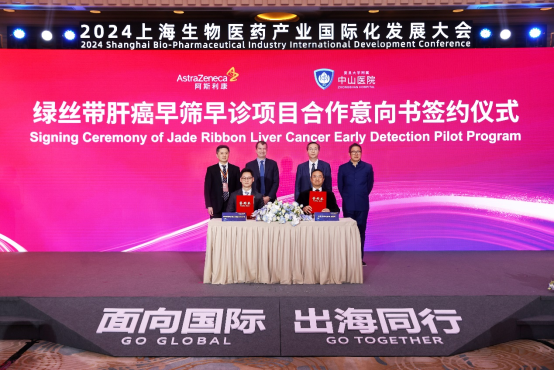
At the recently concluded 2024 Shanghai Biomedical Industry International Development Conference, AstraZeneca announced that Shanghai has become its fifth global strategic center, which has been widely discussed in the industry. At the same time, its collaboration with Zhongshan Hospital of Fudan University to launch the "Green Ribbon Liver Cancer Early Screening and Diagnosis Program" (referred to as the "Green Ribbon Program") has also drawn industry attention. The program will make full use of Shanghai's clustering advantages in biomedicine to promote the value transformation of medical science and technology achievements, creating a model for modern diagnostic and treatment ecosystems.
It is reported that the program will be led by Zhongshan Hospital Affiliated to Fudan University, with Fan Jia, Academician of the Chinese Academy of Sciences and President of Zhongshan Hospital Affiliated to Fudan University, and Zhou Jian, Vice President of Zhongshan Hospital Affiliated to Fudan University, as the main leaders. It aims to comprehensively promote liver cancer high-risk population screening, validation of new technologies for early liver cancer screening, promotion of standardized diagnosis and treatment of liver cancer, and public education on disease awareness, contributing to the achievement of China's key prevention and control goals for overall cancer.

Liver Cancer Is Highly "Characterized by Chinese Features"
Early Diagnosis and Early Treatment Are the Key to Solving the Problem
As we all know, China is a country with a high incidence of liver cancer. According to the "Guidelines for the Diagnosis and Treatment of Primary Liver Cancer (2022 Edition)" issued by the National Health Commission, the number of new cases and deaths from liver cancer in China accounts for nearly 50% of the global total each year.[1]。According to the latest statistics from the National Cancer Center of China, in 2022, there were 367,700 new cases of liver cancer in China, ranking fourth among all malignant tumors, with 316,500 deaths, second only to lung cancer and ranking second.[2]。
It is important to note that liver cancer in China differs significantly from that in Europe and the United States in terms of etiology and biological behavior. Unlike nonalcoholic steatohepatitis-related liver cancer in the U.S. and hepatitis C-related liver cancer in Japan, hepatitis B-related liver cancer accounts for a larger proportion in China. Data released by the Chinese Center for Disease Control and Prevention show that China has nearly 90 million hepatitis B virus carriers, of which about 28 million are hepatitis B patients.[3],The large population base of hepatitis B carriers has become one of the main reasons for the high incidence of liver cancer in China.
"The Expert Consensus on Primary Prevention of Liver Cancer in China (2018)" also pointed out that liver cancer has clear causes and risk factors, such as hepatitis B virus (HBV) infection, hepatitis C virus (HCV) infection, alcohol (ethanol), etc.[4]。Zhou Jian, Deputy Dean of Zhongshan Hospital Affiliated to Fudan University, reminded that the evolution of liver cancer is a relatively long-term process, and many liver cancer patients experience the progression from hepatitis to cirrhosis, and then from cirrhosis to liver cancer.
According to the "Expert Consensus on Early Screening Strategies for Liver Cancer in China," due to the insidious onset of liver cancer and low early diagnosis rate, 70%-80% of patients are diagnosed at a locally advanced stage or with distant metastasis.[5], this group of patients faces challenging treatment, short survival periods, and poor quality of life. Data shows that from 2012 to 2015, the five-year survival rate for liver cancer in China was only 12.1%.[6], significantly lower than the overall cancer survival rate and other gastrointestinal cancers[7]。Moreover, approximately 55% of liver cancer patients are diagnosed at an advanced stage.[8], while this figure is only about 1 in the United States and Japan.5%[9]And 5%[10]。
Zhou Jian stated that liver cancer patients in countries like South Korea and Japan are generally in the early stages, and after receiving treatment, the outcomes are better. Therefore, early diagnosis and treatment of liver cancer are very important. "In fact, as early as the 70s and 80s, China placed great emphasis on the prevention and treatment of liver cancer. Many liver cancer experts proposed a seven-character guideline for preventing liver cancer: improve water quality, prevent mold, and prevent hepatitis. Now, the goal of the Healthy China Action also proposes that by 2030, the overall five-year survival rate for cancer in China should reach 46.6%."[11], liver cancer cannot lag behind either."

Creating a "Shanghai Model" for Early Liver Cancer Screening
"The Green Ribbon Initiative" Emerges
It can be seen that at this stage, liver cancer has become one of the major diseases that seriously threaten public health and life, and its risks cannot be underestimated. Against the backdrop of the current disease landscape, early screening and early diagnosis, along with efforts to promptly intervene at various stages of early liver cancer, are key to improving the quality of liver cancer prevention and treatment in China. This is the profound practical significance embodied by the "Green Ribbon Initiative."
According to Academician Fan Jia, the "Green Ribbon Liver Cancer Early Screening and Diagnosis Program" will comprehensively promote screening for high-risk groups of liver cancer, validation of new technologies for early liver cancer screening, promotion of standardized liver cancer diagnosis and treatment, and public education on disease awareness. It aims to explore moving the checkpoint of standardized liver cancer treatment forward, shifting from "emphasizing treatment" to "emphasizing screening," creating an "early liver cancer screening model in Shanghai." This effort actively responds to the call of "Healthy China 2030" and supports the achievement of key national goals in cancer prevention and control.

Fan Jia, Academician of the Chinese Academy of Sciences and President of Zhongshan Hospital Affiliated to Fudan University
As a leading institution in the field of liver cancer, Fudan University Zhongshan Hospital has achieved multiple "firsts" in liver cancer diagnosis and treatment. These include Academician Tang Zhaoyou's first proposal of the concept of "subclinical liver cancer," his leadership in the "early diagnosis and early treatment" of liver cancer, and the creation of a new situation in liver cancer diagnosis and treatment, transforming liver cancer from untreatable to partially treatable, among others. This time, the "Green Ribbon Plan" led by Fudan University Zhongshan Hospital is of extraordinary significance and impact.
Zhou Jian said that Zhongshan Hospital has many medical associations, including numerous communities and hospitals. It will leverage the outreach of these communities and hospitals, as well as collaborate with other hospitals and communities in Shanghai, to carry out this work. "We will first launch liver cancer screening for residents in Shanghai to see if the five-year survival rate improves significantly. This will help establish an early screening model in Shanghai, which can then be promoted across China."

Professor Jian Zhou, Vice President of Zhongshan Hospital Affiliated to Fudan University
Currently, the "Green Ribbon Initiative" is already in the planning and operational stage. As a supporting participant with a long history of dedication to the oncology field, AstraZeneca stands out as a key highlight of the project. David Fredrickson, Executive Vice President of AstraZeneca and Head of Oncology, stated that approximately half of the world's confirmed cases of liver cancer occur in China. China pays significant attention to the field of liver cancer, which is closely related to the goals of "Healthy China 2030." Therefore, the "Green Ribbon Initiative" is highly important, and China also has exceptional experts in liver cancer treatment. "The 'Green Ribbon Initiative' aims to raise awareness about liver cancer. At the same time, we hope that through early screening and diagnosis, we can provide patients with the best treatment options. This project is also an important practice of our innovative partnership model, and we are very honored to collaborate on this initiative with Academician Jia Fan."
Speaking of the opportunity to participate in and support the "Green Ribbon Initiative," David Fredrickson recalled that he and several colleagues came to China for work last September. At that time, they visited Academician Fan Jia and Fudan University Zhongshan Hospital, which allowed him to personally learn about their series of highly innovative efforts surrounding liver cancer treatment. "We hope that by screening high-risk liver cancer patients, we can treat those diagnosed with liver cancer earlier, thereby helping to build an 'early liver cancer screening model in Shanghai.' If this model succeeds, we will have the opportunity to further explore its promotion in other regions of China."

Focus on Innovative Therapies for Key Tumor Types
Continuously Consolidate Market Reputation Status
As the multinational pharmaceutical company that consistently tops the revenue rankings in the Chinese market, AstraZeneca's emphasis on the oncology field is self-evident. According to its 2023 financial report, AstraZeneca's total annual revenue reached $45.81 billion, representing a 6% year-on-year increase, with revenue from the Chinese market amounting to $5.876 billion, accounting for 13%. In 2023, AstraZeneca's oncology business revenue grew by 21% to reach $18.45 billion, with significant contributions from the Chinese market.[12]。
David Fredrickson stated that one of AstraZeneca's primary focuses as a company has been its investment in the oncology field, striving to address cancer types of significant global importance. "Among these, gastrointestinal tumors are particularly crucial, especially within Asia, which is one of our key focus areas." It is understood that in critical areas such as liver cancer and gastrointestinal tumors, AstraZeneca is advancing the clinical development of related product pipelines, expanding its global market presence, demonstrating its commitment to these fields with tangible investments, and helping to improve treatment outcomes and prognoses for relevant patients.

David Fredrickson, Executive Vice President of AstraZeneca Global and Head of Oncology Business
Moreover, David Fredrickson revealed that AstraZeneca is currently in discussions with health authorities around the world regarding the approval of significant clinical studies. "None of these would be possible without the participation and support of outstanding researchers in China." The industry generally believes that as Shanghai becomes AstraZeneca's fifth global strategic center, and with the positive progress of the "Green Ribbon Initiative" that it supports, AstraZeneca will leverage its strengths to play a more leading role in areas such as liver cancer and other oncology fields.
As Zhou Jian said, Shanghai has first-class medical facilities and an excellent medical team. It also has many top research institutions and laboratories in the field of medical science, and is accelerating its development into a research center with global influence. "In particular, the treatment standards at hospitals like Zhongshan Hospital and the Hepatobiliary Surgery Hospital are leading both domestically and internationally, especially in terms of survival rates. Taking Zhongshan Hospital as an example, over the past 5 to 10 years, the five-year survival rate for patients who have undergone liver resection for liver cancer has reached 64%. If early diagnosis and treatment can be achieved, the five-year survival rate after surgical resection can exceed 80%."
David Fredrickson believes that China has become a globally significant source of innovation. This conference has highlighted the importance of Shanghai to China's biopharmaceutical industry and demonstrated that Shanghai will exert a broader influence on the global stage. Industry insiders note that as one of the first multinational pharmaceutical companies to enter the Chinese market, AstraZeneca continues to focus on the development trends of China’s pharmaceutical industry. Based in Shanghai, an innovation hub, the company aims to further solidify its reputation and authority in the oncology field.
*This material is intended for disease education purposes only. If you have any questions, please consult a healthcare professional.
[1] Office of the National Health Commission, Guidelines for the Diagnosis and Treatment of Primary Liver Cancer (2022 Edition).
[2] National Cancer Center of China, Cancer incidence and mortality in China (2022)
[3] Chinese Center for Disease Control and Prevention, https://www.chinacdc.cn/
[4] Infection-related Tumor Prevention and Control Group of the Tumor Prevention and Control Committee of the Chinese Preventive Medicine Association, Chronic Disease Prevention and Control Branch of the Chinese Preventive Medicine Association, Health Communication Branch of the Chinese Preventive Medicine Association. Expert Consensus on Primary Prevention of Liver Cancer in China (2018) [J]. China Cancer, 2018, 27(9): 660-669.
[5] Expert Group of the National Multicenter Prospective Early Warning and Screening Project for Very Early-Stage Liver Cancer, Expert Consensus on Early Liver Cancer Screening Strategies in China, Chinese Journal of Hepatology, 2021, 26(8): 825-831.
[6] Zeng, Hongmei et al. Changing cancer survival in China during 2003-15: a pooled analysis of 17 population-based cancer registries. The Lancet. Global health vol. 6,5 (2018): e555-e567.
[7] National Cancer Center of China, Cancer incidence and mortality in China (2015).
[8] Zhong JH, Peng NF, You XM, et al. Tumor stage and primary treatment of hepatocellular carcinoma at a large tertiary hospital in China: A real-world study. Oncotarget. 2017 Mar 14;8(11):18296-18302.
[9] Fassio E, Díaz S, Santa C, et al. Etiology of hepatocellular carcinoma in Latin America: a prospective, multicenter, international study. Ann Hepatol. 2010 Jan-Mar;9(1):63-9
[10] Kudo, Masatoshi et al.,Liver Cancer Working Group Report, Japanese Journal of Clinical Oncology, 40(Supplement 1)i19–i27
[11] National Health Commission of the People's Republic of China, et al., Healthy China Initiative—Cancer Prevention and Treatment Action Implementation Plan (2023–2030)
[12] AstraZeneca Annual Report and Form 20-F Information 2023
Editor:Allen




www.yyjjb.com.cn
Insight into Industry Trends

"Pharmaceutical Economy Newspaper"
Academic Official Account
Focusing on the Frontiers of Oncology Academia

Terminal Official Account