

Battle for First-to-File Enzalutamide Tablet: Kelun, Qilu Clash Again as ZhenDong, Qingfeng, Humanwell Eye $4.8B Blockbuster

Kelun
Innovative Pharmaceutical R&D Company

Qilu Pharmaceutical
Specialty Formulations and Active Pharmaceutical Ingredients (API) Developer
Racing for the first generic version of a new formulation of a blockbuster product worth billions, Kelun Pharmaceutical and Qilu Pharmaceutical, these old rivals, are "at odds" again.
Recently, the official website of the National Medical Products Administration (NMPA) showed that the marketing application for Enzalutamide Tablets submitted by Sichuan Kelun Pharmaceutical Co., Ltd. has been accepted by the CDE.
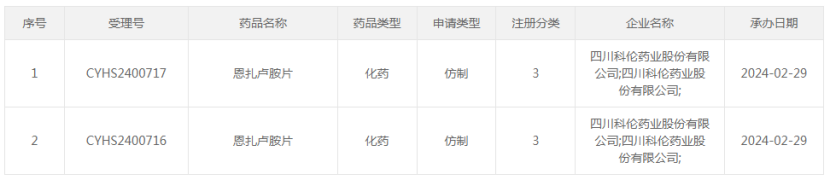
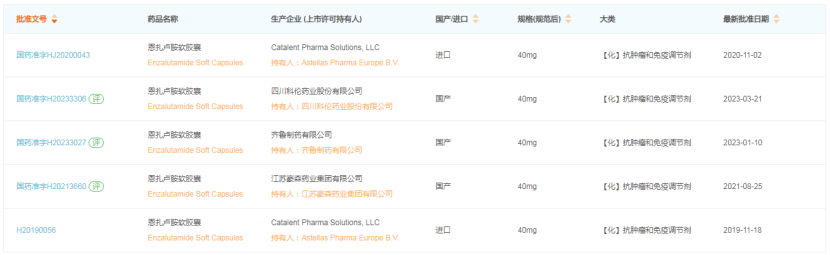
As a preferred treatment drug for anti-prostate cancer, enzalutamide is currently only available in the Chinese market in the form of soft capsules. The original research pharmaceutical company Astellas, along with generic drug companies Kelun, Qilu Pharmaceutical, and Jiangsu Hengrui, hold production licenses. However, no company in China has been approved for enzalutamide tablets. Only Qilu Pharmaceutical and Kelun have submitted applications for the production of this dosage form as a Category 3 generic drug, and the first generic version of this formulation is expected to be launched by one of these two companies.
Data shows that in 2023, a total of 723 drugs passed the generic drug consistency evaluation, of which 245 were the first to pass, and 103 key first-to-market generic drugs were approved. Leading Chinese pharmaceutical companies such as Kelun, Nanjing Chia Tai Tianqing, Qilu Pharmaceutical, Yangtze River Pharmaceutical, and CSPC performed exceptionally well in the research, development, and approval of first-to-market generics, maintaining their leading positions in the industry.
As China's centralized procurement policy advances, the price of generic drugs has been significantly reduced, causing low-level and repetitive generics to gradually lose market competitiveness. In contrast, high-quality first generics, hard-to-copy innovative drugs, and improved new drugs have become the new favorites in the market. Previously, Kelun and Qilu Pharmaceutical have competed multiple times in the race for first generics of products such as Apalutamide Tablets, Olaparib Tablets, and Avatrombopag Maleate Tablets. This time, whoever secures the first generic version of Enzalutamide Tablets may disrupt the competitive landscape of this blockbuster product.
The Rise of the "King of Prostate Cancer Drugs"
Old Rivals Step Up Efforts in the First-to-Market Competition for New Formulations
Prostate cancer is one of the most common malignant tumors in the urinary and male reproductive systems. According to the global cancer statistics report published by the WHO International Agency for Research on Cancer, there were over 1.467 million new cases of prostate cancer worldwide in 2022, accounting for 7.3% of all malignant tumors, with an incidence rate second only to lung cancer, breast cancer, and colorectal cancer, ranking 4th; more than 397,000 deaths from prostate cancer occurred, accounting for 4.1% of all malignant tumors, with a mortality rate ranking 8th.
Data show that treatment options for prostate cancer are often comprehensively selected based on disease staging, risk of progression, and life expectancy. Common clinical treatments include surgery, radiation therapy, androgen deprivation therapy (ADT), and androgen receptor (AR) antagonist therapy, among others. In traditional treatment approaches, if male patients still respond effectively to drugs or surgical treatments that lower testosterone levels, they are considered hormone (or castration) sensitive. However, the median survival time for male patients with metastatic hormone-sensitive prostate cancer (mHSPC) after starting androgen deprivation therapy (ADT) is only about 3-4 years.
However, the introduction of Enzalutamide, jointly developed by Astellas and Pfizer, has changed this treatment landscape. Enzalutamide is one of the representative drugs of second-generation AR antagonists. It not only blocks the binding of androgens to their receptors but also inhibits the transfer of receptors into the cell nucleus and the binding of androgen receptors to DNA. Therefore, Enzalutamide is not only an antagonist of the androgen receptor but also inhibits the androgen signaling pathway. Currently, the combination of Enzalutamide and androgen deprivation therapy is one of the preferred treatment options for mHSPC and a first-line treatment option for castration-resistant prostate cancer. It has been widely recommended by authoritative guidelines both domestically and internationally, including China’s "Prostate Cancer Diagnosis and Treatment Guidelines (2022)" and the American NCCN’s "Prostate Cancer Clinical Practice Guidelines (2023.V1)."
Data shows that in 2022, the market size of prostate treatment drugs in China reached approximately 19.372 billion yuan, with patients still having significant unmet clinical needs. According to clinical data from 2022, the drug with the highest market share in China's prostate cancer treatment is Leuprorelin (31.34%), followed by Goserelin (27.74%). Both of these drugs belong to ADT therapy, as the mainstream treatment in China is still predominantly ADT-based, resulting in relatively higher market shares. In contrast, the primary drugs used abroad are second-generation AR antagonists represented by Enzalutamide, which is hailed as the "blockbuster drug" in the field of prostate cancer.
Some viewpoints indicate that second-generation AR drugs entered the Chinese market relatively late, and first-generation AR drugs still dominate in China’s prostate cancer diagnosis and treatment. In contrast, Enzalutamide is still in its infancy in the Chinese market, presenting broad development prospects, which has prompted major domestic pharmaceutical companies to enter the field. In March 2023, Kelun announced that its Enzalutamide soft capsules had been approved for production as a Category 4 generic drug, considered as having passed the quality evaluation, making it the third China-produced company for this product, following Jiangsu Hengrui and Qilu Pharmaceutical.
In the competition for enzalutamide tablets, in August 2023, Qilu Pharmaceutical's enzalutamide tablets were the first to be submitted for production approval as a Category 3 generic drug and accepted by the CDE. With Kelun Pharmaceutical’s recent submission for production approval also being accepted, it will continue to engage in a new round of competition with Qilu Pharmaceutical. There is no doubt that whichever company first taps into the new dosage form market will further solidify its competitive edge and strengthen its market influence.
Targeting major varieties and focusing on the first-to-market generic drug track, Kelun is an undisputed leader in the industry. According to statistics, in addition to the recently filed Enzalutamide Tablets, Kelun's extensive portfolio includes a total of 15 varieties such as Siponimod Tablets, Sodium Valproate Sustained-Release Tablets (I), Avatrombopag Maleate Tablets, Regorafenib Tablets, and Dydrogesterone Tablets. These products cover anti-tumor drugs and immunomodulatory agents, neurological drugs, cardiovascular drugs, blood and hematopoietic system drugs, as well as reproductive, urinary system, and sex hormone medications.
Notably, since 2024, Kelun Pharmaceutical has received approval for the market launch of three products: Eltrombopag Ethanolamine Tablets, Olaparib Tablets, and Piracetam Injection, all of which are considered to have passed quality evaluations. Among them, Eltrombopag Ethanolamine Tablets are the first domestically produced generic in China, while Olaparib Tablets are the second domestically produced generic. Olaparib is the world's first approved PARP inhibitor, with global sales of the original drug exceeding $2.6 billion in 2022. Eltrombopag is the world’s first approved small-molecule non-peptide TPO-R agonist, with global sales of the original drug surpassing $2 billion in 2022.
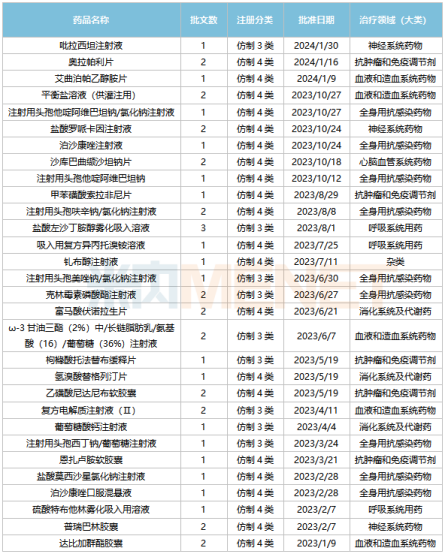
Products Approved for Kelun Pharmaceutical from 2023 to Present
Industry insiders point out that the domestic generic drug market in China has always been in fierce competition and is also a key area for the majority of Chinese pharmaceutical companies. With the implementation of policies such as volume-based procurement, the generic drug market has become highly competitive, putting pressure on the shrinkage of related businesses. Therefore, the new norm for drug approvals in China often involves competition to be the first to launch a generic version and break patents. It remains to be seen whether Kelun will successfully add Enzalutamide Tablets to its list of first-to-market generics.
Facing the "Patent Cliff" in 2026
Multiple pharmaceutical companies in China are poised for action.
Enzalutamide is an androgen receptor inhibitor originally developed by Astellas. In October 2009, Medivation and Astellas entered into a commercial agreement to jointly develop and commercialize enzalutamide in the United States. Astellas is responsible for production worldwide, submission of all additional regulatory approval documents, and commercialization of the product outside the United States.
In August 2012, Enzalutamide was approved by the U.S. FDA for marketing to treat advanced castration-resistant prostate cancer. In August 2016, Pfizer acquired Medivation for $14 billion, successfully bringing this blockbuster drug under its wing. In the international market, since its approval, Enzalutamide officially became a "billion-dollar molecule" drug in 2015. Global sales exceeded $4 billion in 2020, and reached $4.897 billion in 2022, ranking 8th in the global TOP100 pharmaceutical sales list.
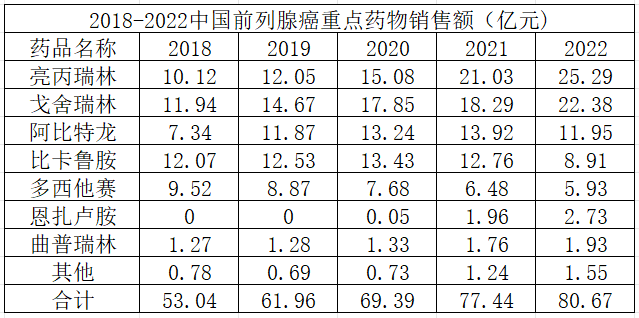
In November 2019, enzalutamide, jointly developed by Astellas and Pfizer, was approved for marketing in China. In December 2020, enzalutamide soft capsules entered the Class B medical insurance catalog with a price reduction of 78% through medical insurance negotiations, dropping from 321 yuan/40mg to 69.6 yuan/40mg. In 2023, enzalutamide soft capsules have been transferred to the regular medical insurance catalog. After entering the medical insurance, enzalutamide rapidly increased in sales volume. According to data from Menet, enzalutamide's terminal sales in Chinese urban public hospitals, county-level public hospitals, urban community health centers, and township health centers exceeded 100 million yuan in 2021, approximately 270 million yuan in 2022, representing a year-on-year increase of 84.88%.
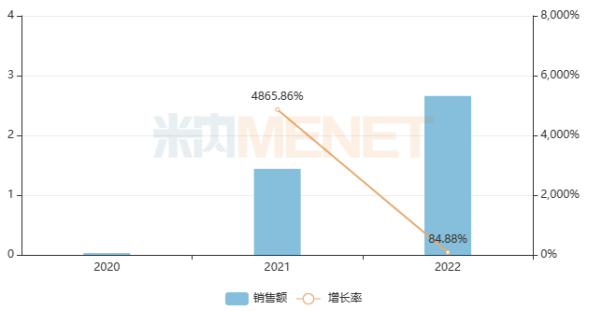
Sales of Enzalutamide in Chinese Public Medical Institution Terminals in Recent Years (Unit: Billion Yuan)
Currently, the indications for enzalutamide approved in China are for the treatment of adult patients with metastatic castration-resistant prostate cancer (CRPC) who are asymptomatic or have mild symptoms and have not received chemotherapy after the failure of androgen deprivation therapy (ADT), as well as for adult patients with non-metastatic castration-resistant prostate cancer (nmCRPC) at high risk of metastasis. Facing this key product, enzalutamide, Astellas is still continuously unlocking its market potential. In September 2023, Astellas announced that the CDE had accepted the new indication marketing application for enzalutamide soft capsules for the treatment of metastatic hormone-sensitive prostate cancer (mHSPC). This marks the third application for enzalutamide to be accepted in the field of advanced prostate cancer treatment in China.

Given that enzalutamide has demonstrated significant commercial value in the prostate cancer market, domestic generic drug companies in China have been actively challenging its patents even before its approval in China to pave the way for its replication. Previously, three invalidation requests were filed against enzalutamide. In 2018, the core compound patent of enzalutamide (CN101222922B) was declared invalid during an invalidation request by Shanghai Fosun Starry Medical and Wei Zhao. Subsequently, Astellas and Medivation initiated administrative litigation. Ultimately, in 2022, the Beijing Intellectual Property Court concluded the case, revoking the invalidation decision made by the China National Intellectual Property Administration and upholding the patent rights of enzalutamide.
However, the compound patent of Enzalutamide in China will expire in 2026, facing the "patent cliff." Data from MiNe Network shows that, apart from the three domestically produced drug companies that have already been approved—Kelun, Qilu Pharmaceutical, and Jiangsu Hengrui—five other pharmaceutical companies, including Zhendong Pharmaceutical, Qingfeng Pharmaceutical, Yichang Renfu Pharmaceutical, Shenyang Hongqi Pharmaceutical, and India's Dr. Reddy's Laboratories, have submitted market applications for related products, all of which are currently under review and approval. It can be foreseen that Enzalutamide, this blockbuster drug, will face unprecedented competition in the domestic market.




www.yyjjb.com.cn
Insight into Industry Trends

"Pharmaceutical Economy News"
Academic Official Account
Focus on the Frontier of Oncology Academia

Terminal Official Account