Roche Submits Clinical Trial Application in China for OSMRβ Monoclonal Antibody Vixarelimab

Genentech
Pharmaceutical R&D Manufacturer

Roche
Oncology Drug Research, Development, and Manufacturing
Today (March 6), according to the CDE official website, the clinical trial application for Vixarelimab Injection from Genentech, a subsidiary of Roche, has been accepted. It is reported that the drug has entered Phase II clinical trials overseas.

Source of the image: CDE official website
1. Received FDABTD
Overseas Clinical Trials Accelerating…
Oncostatin M Receptor β (OSMRβ) can mediate signal transduction between Oncostatin M (OSM) Receptor Type II and Interleukin-31 (IL-31) Receptor. These two cytokines are considered to be associated with diseases such as pruritus, inflammation, and fibrosis. Moreover, studies suggest that signaling triggered by OSM also has the potential to inhibit cancer cell growth.
Vixarelimab (RG6536) is a fully human monoclonal antibody targeting OSMRβ developed by Kiniksa. It was licensed by Roche and its subsidiary Genentech in 2022. Previously, the U.S. FDA granted Vixarelimab Breakthrough Therapy Designation for the treatment of pruritus associated with prurigo nodularis. Additionally, Vixarelimab is also being investigated for the treatment of moderate to severe ulcerative colitis.
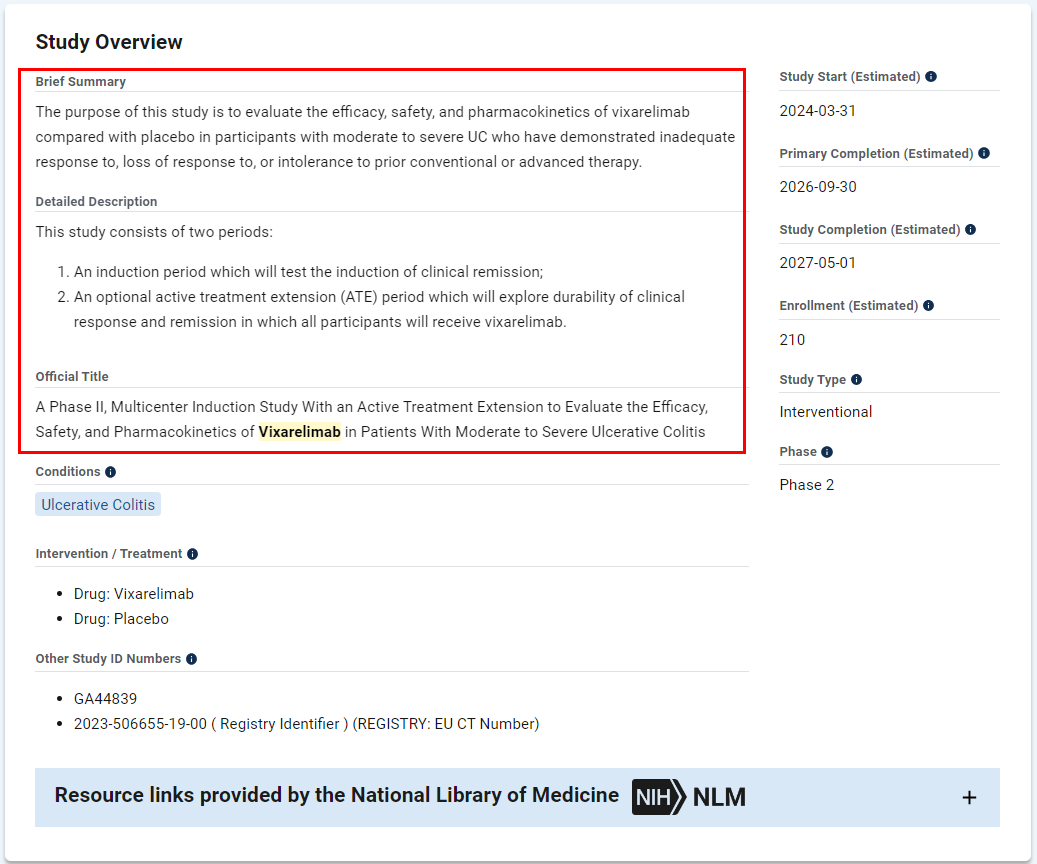
Image Source: clinicaltrials.gov
Vixarelimab's clinical application submission in China is expected to bring new therapies to the field of inflammatory diseases.
2. Tumors, Immunity, Infections…
Comprehensive Pipeline Layout in Progress
In early February this year, Roche released its 2023 financial report, showing pharmaceutical division revenue reached 44.612 billion Swiss francs (approximately 50.452 billion US dollars), a year-on-year increase of 6%. Among this, the oncology segment, as Roche's main pillar, contributed annual sales of 19.087 billion Swiss francs. Additionally, Roche’s performance in areas such as ophthalmology and neurology was also impressive.
At the same time, Roche is accelerating the construction of its subsequent pipeline, with research projects covering multiple disease areas such as oncology, immunology, and infectious diseases.
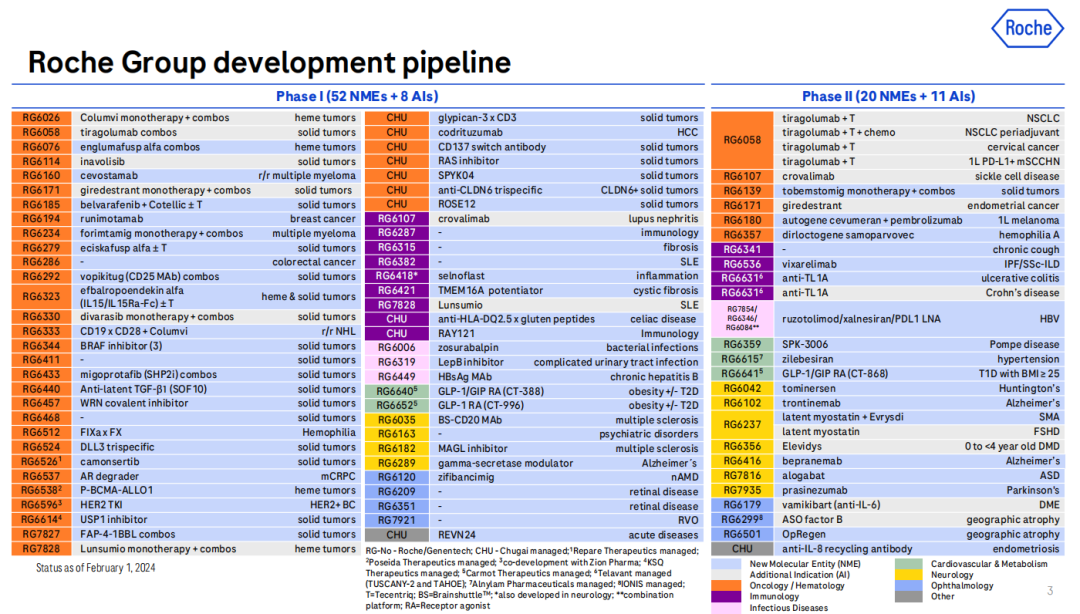
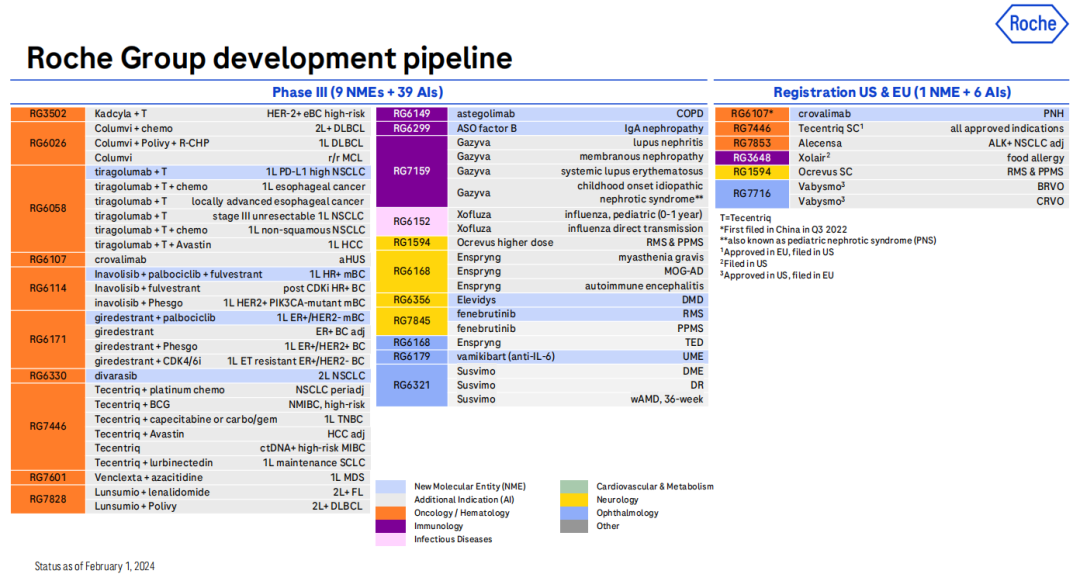
Image Source: Roche
Since the beginning of 2024, significant progress has been made in the clinical research or marketing authorization process of multiple drugs by Roche.
Covalemonab
In early February, the National Medical Products Administration announced the approval of Roche's Crovalimab for marketing through the priority review and approval process. It is indicated for adult and adolescent (≥12 years) patients with paroxysmal nocturnal hemoglobinuria who have not received complement inhibitor treatment. Paroxysmal nocturnal hemoglobinuria has been included in China’s first list of rare diseases. According to reports, Crovalimab is a humanized anti-complement protein C5 monoclonal antibody, developed globally with its first market launch in China.

Image Source: NMPA Official Website
Zilebesiran
Zilebesiran is a subcutaneously injectable RNAi therapeutic drug targeting angiotensinogen (AGT), with the potential to maintain blood pressure reduction for half a year with a single injection, and is referred to as the "therapeutic vaccine in the field of hypertension." On March 5, Roche and Alnylam jointly announced that the Phase II KARDIA-2 study of Zilebesiran for the treatment of hypertension had met its primary endpoint. The study evaluated the efficacy and safety of Zilebesiran (600mg, once every 6 months, subcutaneous injection) as an add-on therapy to standard treatment in adult patients with mild to moderate hypertension, ultimately achieving a clinically and statistically significant reduction in average systolic blood pressure.
Cevostamab
On February 28, the clinical trial application for Roche's FcRH5×CD3 bispecific antibody Cevostamab was approved by the CDE for the indication of multiple myeloma. According to relevant studies, Cevostamab can bind to the membrane-proximal domain of FcRH5 on myeloma cells and CD3 on T cells, promoting T-cell activation through dual binding, thereby effectively killing myeloma cells.

Source of the image: CDE official website
Roche CEO Dr. Thomas Schinecker once looked ahead to the future, stating that crovalimab and inavolisib are expected to receive regulatory approval in 2024. The former has already been approved for marketing by the NMPA in February, while the latter, intended for the treatment of patients with hormone receptor-positive (HR+), human epidermal growth factor 2-negative (HER2-) locally advanced or metastatic breast cancer, is expected to be approved for marketing this year.
3. Conclusion
By accelerating the global layout of its R&D pipeline, Roche is expected to reap more innovative results in the coming years.

Editor: Bai Ji
Disclaimer: This article is a reprint from PharmNet. The images and text are the original works of the author, and the purpose of the reprint is to convey more information. It does not represent the views of this platform. If there are any issues regarding content, copyright, or other problems, please leave a message on this platform, and we will address it promptly.