Bayer Reports Decline in 2023 Revenue and Net Profit, Announces Strategic Overhaul

Bayer
Pharmaceutical Product R&D Developer
On March 5, Bayer released its financial report: revenue for 2023 was €47.637 billion, compared to €50.739 billion in 2022, a year-on-year decrease of 6.1%; EBITDA excluding special items was €11.706 billion, compared to €13.513 billion in 2022, a year-on-year decrease of 13.37%.
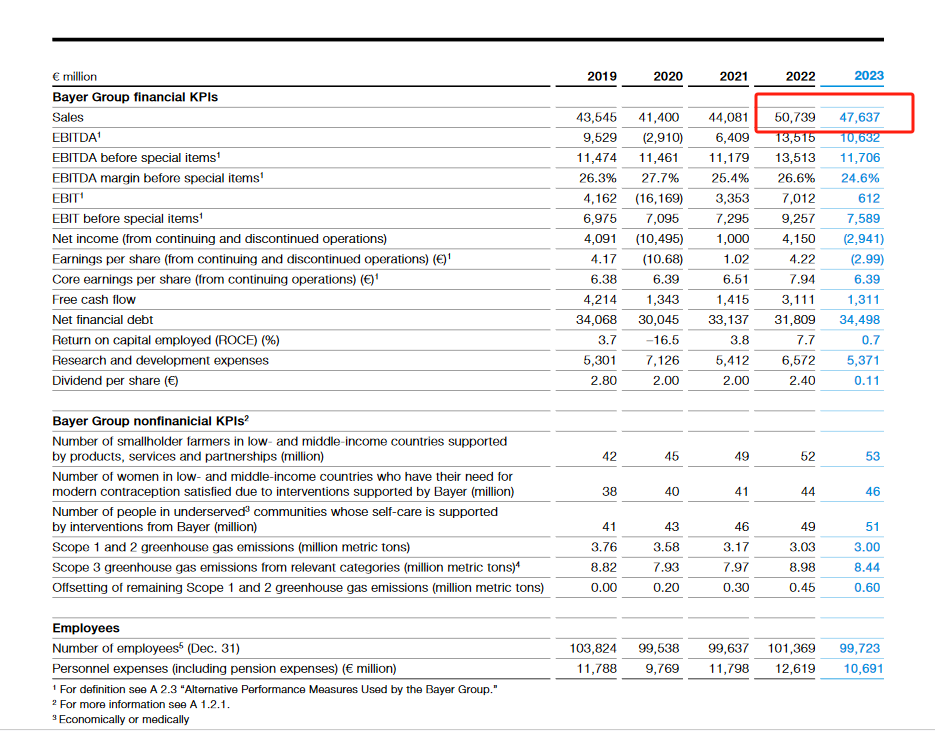
Source of the image: Bayer 2023 Annual Report
Facing consecutive declines in Bayer's performance in 2023, newly appointed CEO Bill Anderson expressed that the 2023 results are unacceptable. Once a pharmaceutical giant with a market value of $130 billion, Bayer AG now has a market value of only $27.7 billion (as of March 5), and under this dimming spotlight, how to adjust its strategy has become an issue that Bayer must take seriously.
Decline in Performance Across Multiple Business Segments
According to Bayer's official website, Bayer AG has three divisions: Pharmaceuticals, Consumer Health, and Crop Science (Animal Health operates as a separate business unit). The Crop Science division, which once propped up Bayer’s revenue, saw a decline in 2023: sales reached 23.27 billion euros, marking a year-on-year decrease of 3.7%.
Although the performance of the Prescription Pharmaceuticals Division does not compare to the Crop Science Division, it once supported the company's revenue with its blockbuster product, aspirin. However, in 2023, the division's performance also declined: Prescription Pharmaceuticals sales amounted to 18.081 billion euros, a year-on-year decrease of 6.08%.
Looking solely at the prescription drug division, the majority of performance is driven by Xarelto (Rivaroxaban) and Eylea (Aflibercept). However, fierce competition from generic drugs has led to a continued decline in Xarelto's (Rivaroxaban) sales. Meanwhile, although Eylea (Aflibercept) shows positive growth compared to last year, the growth is slow. Notably, on January 25, 2024, the drug was submitted for marketing approval in China, and 2024 might become Bayer's top-selling drug.
Moreover, it is not difficult to see from the figure below that the drugs with a relatively large proportion of positive growth are Nubeqa (darolutamide) and Kerendia (finerenone). Darolutamide was approved for a new indication in China on March 16, 2023 — combination therapy for metastatic hormone-sensitive prostate cancer. Finerenone, on the other hand, received approval for an extended indication in China on May 17 of the same year — early stages of chronic kidney disease associated with type 2 diabetes. Although their sales are rising sharply, there is still a long way to go before they can shoulder the responsibility of becoming the "top-selling" product.
2023 Bayer Prescription Drug Sales Amount
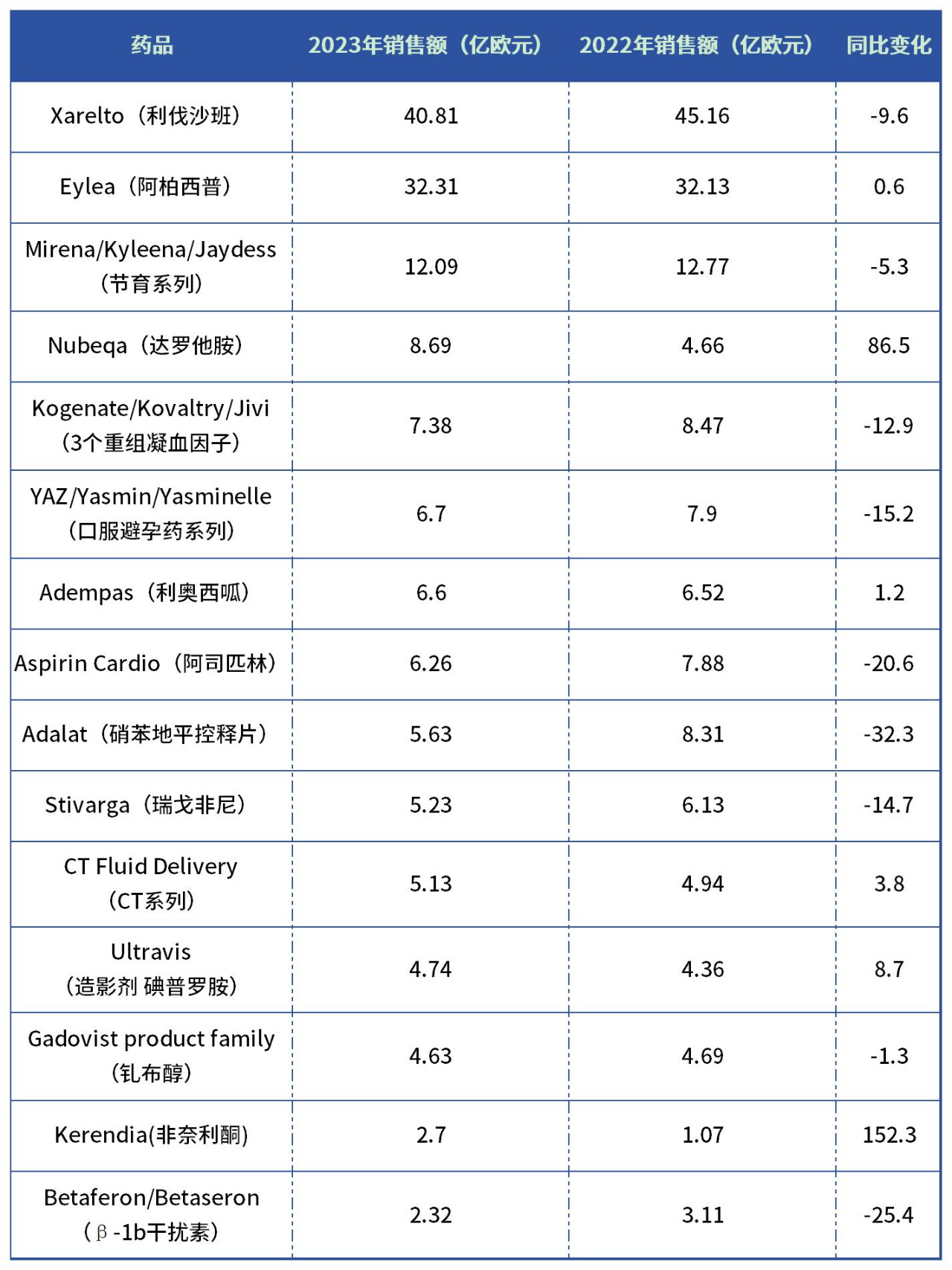
Data source: Bayer 2023 Annual Report
In regional revenue, there was also a uniform downward trend. Among them, revenue in the China region was 3.624 billion euros, compared to 4.259 billion euros in 2022, representing a year-on-year decline of 14.91%.
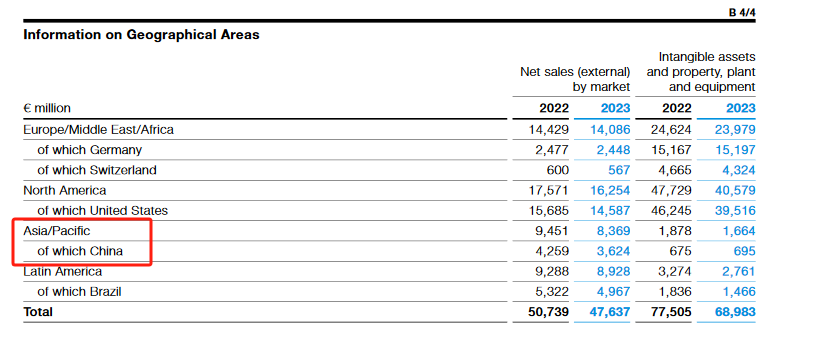
Source of the image: Bayer 2023 Annual Report
Another noteworthy point is that Bayer's decline in 2023 was not only in revenue but also in R&D investment, which fell by 18.3% year-on-year to 5.371 billion euros. However, on March 4, Bayer entered the cardiovascular rare disease field with a $310 million investment, acquiring the significant product Acoramidis. The exclusive European rights to this key product may address the crisis posed by the impending expiration of the patent protection for Rivaroxaban in Europe.
Layoffs, Transformation...
Bayer Reforming Operations with New Model
In fact, as early as the announcement of Bayer's Q3 performance in 2023, or even earlier in September, news had emerged that Bayer was seeking a transformation, considering options such as a spin-off, significant layoffs, and management restructuring.
However, the trigger for this series of events leading to a downturn began with the $620 billion acquisition of Monsanto.
After the high-priced acquisition, a series of lawsuits drained Bayer's coffers: continuous litigation losses against Monsanto, with parent company Bayer paying $10.9 billion in 2019; on November 17, 2023, Bayer lost again and paid $1.56 billion...
In response to this crisis, Bayer's layoffs have quietly begun. In February 2023, Bayer launched the "Voluntary Separation Program" in California, USA, targeting 55 employees aged 55 and above with over 10 years of service. In August of the same year, the cell therapy division BlueRock Therapeutics laid off 50 employees, including those in Cambridge, New York, and Toronto. This wave of layoffs has intensified, with the "axe" even hanging over the heads of management.
At the beginning of 2024, Bayer initiated a management layoff plan. Barbara Gansewend, Chair of the Executive Committee of Bayer's Supervisory Board, stated: Bayer’s announced organizational restructuring plan will "sacrifice the interests of many managers." According to informed sources, Oliver Kohlahaas, Bayer's strategy head, is one of the laid-off executives.
Bayer stated that the layoffs will begin in the coming months and conclude by 2025, but did not provide specific figures regarding the number of positions affected. However, according to Bayer, the large-scale layoffs will primarily focus on the Group companies located at its headquarters in Germany.
The figure for layoffs is also visible in the annual report. Bayer currently has 99,723 employees, a decrease of 1,646 compared to 2022. The data shows that the region with the largest reduction in staff is the Asia-Pacific region, and the positions most affected are in marketing and sales.
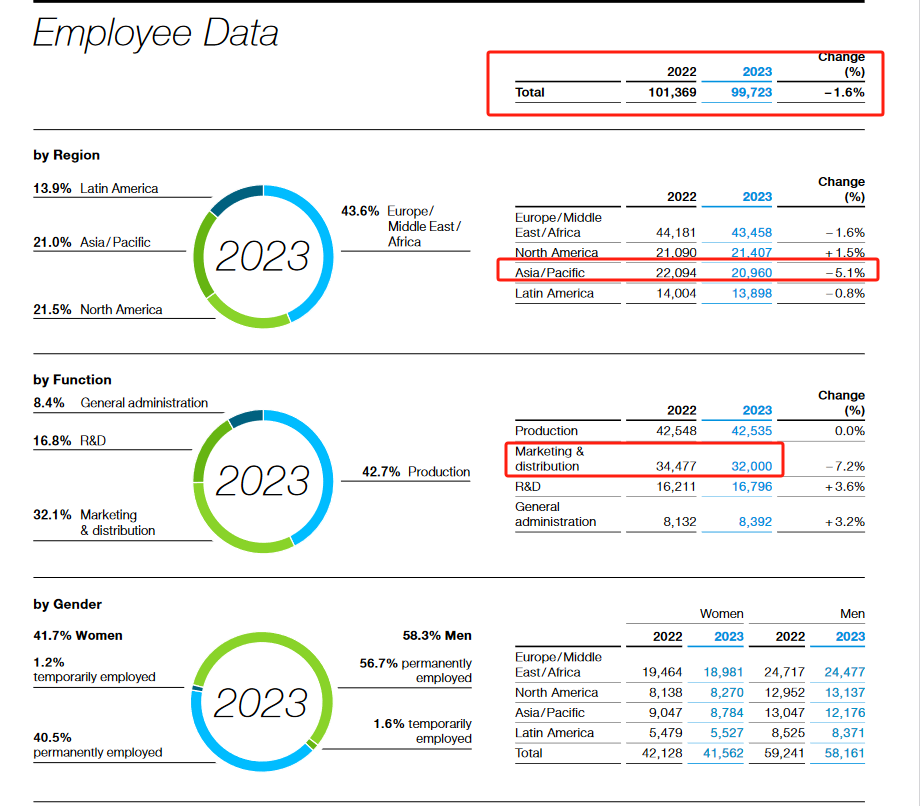
Source of the image: Bayer's 2023 Annual Report
Conclusion
Bayer CEO Anderson Outlines Path Forward: Over the Next 24 to 36 Months, Company to Focus on Building a Strong Pharmaceutical Pipeline, Resolving Litigation, Reducing Debt, and Overhauling Operating Model (New Model Dubbed Dynamic Shared Ownership, or DSO).
Current CEO Anderson, former CEO of Roche, is fortunate to highly value Bayer's current situation and has devised a new plan for sweeping reforms. The focus is on building a new model for the company. Anderson pointed out that these measures will reduce organizational costs by 2 billion euros annually starting from 2026. It is hoped that under this experienced CEO, Bayer can dust off its tarnish and shine again.
References:
1. Bayer 2023 Financial Report
2. "Bayer Launches Management Layoffs! First Time in 27 Years" Pharma Intelligence Headlines
3. "Bayer Confirms Consideration of Spin-off! Can Massive Layoffs and Management Adjustments Lead to a Rebirth?" Pharmaceutical Economy News
4. Public Information

Editor: Mu Mian
Disclaimer: The views expressed in this article are solely those of the author and do not represent the position of Pharma Intelligence Network. We welcome exchanges and supplements in the comment area; if you need to reproduce this article, please be sure to indicate the author and source. If there are any issues regarding the content, copyright, or other aspects of the work, please leave a message on this platform, and we will handle it promptly.