

Semaglutide Gains Momentum with Positive FLOW Trial Results and New Regulatory Filings
Novo Nordisk
Insulin Developer and Manufacturer

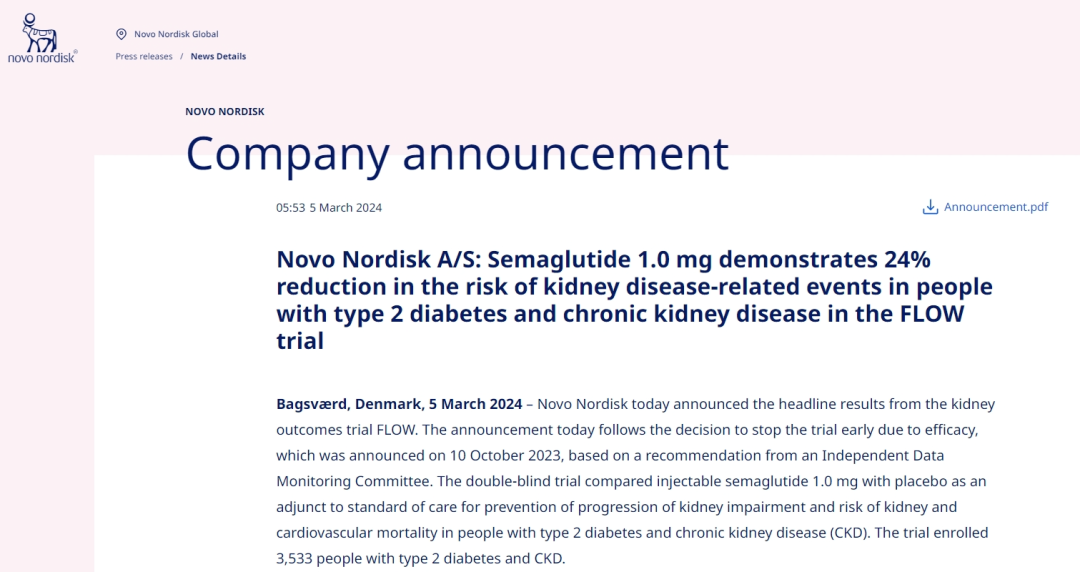
The key objectives of the FLOW trial are primarily demonstrated through several composite endpoints: a sustained decline in eGFR1 of ≥50% compared to baseline, and a sustained eGFR1 of <15 mL/min/1.73.m2The time to initiate chronic kidney replacement therapy (dialysis or kidney transplantation), mortality due to kidney disease or cardiovascular disease in patients with type 2 diabetes and chronic kidney disease. Key secondary endpoints include the annual rate of change in eGFR, major adverse cardiovascular events (non-fatal myocardial infarction, non-fatal stroke, cardiovascular death), and all-cause mortality risk. The trial protocol stipulates an interim analysis upon reaching a pre-specified number of primary endpoints.
The final published results showed that the trial met its primary endpoint, with a 24% statistically significant reduction in the risk of kidney disease progression and cardiovascular and renal death in the semaglutide group compared to the placebo group. Meanwhile, the results also indicated that both the CKD and cardiovascular components of the composite primary endpoint contributed to the risk reduction, and in terms of confirmatory secondary endpoints,1.0mgThe superiority of semaglutide over placebo has also been confirmed. In terms of safety,1.0mgSemaglutide demonstrated good safety and tolerability, consistent with previous trial results.
Regarding the results, Novo Nordisk's Executive Vice President for Development, Martin Holst Lange, stated: "We are very excited about the FLOW results, which confirm that1.0mgSemaglutide can reduce the risk of kidney disease progression. Approximately 40% of patients with type 2 diabetes suffer from chronic kidney disease. Therefore, the results of the FLOW study indicate that semaglutide has the potential to become the first GLP-1 treatment option for patients with type 2 diabetes and chronic kidney disease.
Novo Nordisk is expected to submit the extension application for semaglutide (Ozempic) in the United States and the European Union in 2024.
In addition to the excellent clinical outcome data of FLOW, last August, a small milestone event in the exploration of new indications for semaglutide occurred — the outstanding results of the cardiovascular outcomes trial SELECT. According to Novo Nordisk's disclosure, the SELECT trial achieved its primary objective: compared with placebo, patients receiving semaglutide (2.4 mg) treatment showed a 20% reduction in MACE, which was statistically significant and superior. In terms of safety, semaglutide demonstrated a consistently favorable safety and tolerability profile consistent with previous trials. Based on these results, Novo Nordisk stated at the time that it would submit an extension application for semaglutide 2.4 mg (Wegovy) in the United States and the European Union as soon as possible.
In addition, the research on whether semaglutide has efficacy for Alzheimer's disease has also attracted attention in the industry. A relevant literature review in 2022 pointed out that GLP-1 receptor agonists, including semaglutide, can reduce neuroinflammation and oxidative stress, which are the most common reactions in Alzheimer’s disease, and provide neurotrophic effects in animal models of Alzheimer’s disease. The authors noted that these conclusions need to be confirmed through clinical trials.
It is reported that Novo Nordisk launched the Phase III clinical trials named EVOKE and EVOKE Plus in 2021 to study the efficacy of semaglutide in 3,700 patients with early-stage Alzheimer's disease. The trials are expected to conclude in September 2025, and Novo Nordisk has currently declined to disclose any details regarding the study.
Once endorsed by Elon Musk, semaglutide has rapidly become a "super网红" globally over the past two years, bringing Novo Nordisk sales figures that other companies could only dream of. In 2022, the entire range of semaglutide products generated 77.237 billion Danish kroner (approximately $112.53 billion USD at the latest exchange rate) in revenue for Novo Nordisk. Just one year later, the performance doubled; in 2023, semaglutide contributed 145.811 billion Danish kroner (approximately $212.45 billion USD at the latest exchange rate) to Novo Nordisk. This means that semaglutide has officially entered the "20 billion blockbuster club."
As the weight loss market continues to expand, Semaglutide will undoubtedly experience faster market growth. According to a Morgan Stanley research report, by 2030, the global weight loss drug market size could reach $77 billion, over $20 billion higher than the initial forecast.
Text | MedValley
Recommended Reading
《Searching for China's Medical Device "Future Stars"》

Fully Open for Business, Welcome to Visit >>




For advertising, conference cooperation, corporate communication, etc., please contact 400-689-7892.