

Gilead Strikes $1.5B Deal to Co-Develop Trispecific Cancer Antibodies with Merus Following $5B Magrolimab Setback

Merus
Antibody Therapy Developer

Gilead Sciences
Antiviral Drug Developer
On March 6, Gilead Sciences announced a research license agreement with Dutch biotechnology company Merus N.V. to jointly develop trispecific antibodies targeting novel dual tumor-associated antigens (TAA). The collaboration will utilize Merus' proprietary Triclonics platform alongside Gilead’s expertise in oncology to research and develop multiple independent preclinical programs.
According to the agreement, Merus will lead the early research activities for two programs and has the option to initiate a third program. After the selected research activities are completed, Gilead will have the right to obtain a license for the co-development programs. If Gilead exercises its option, it will be responsible for additional research, development, and commercialization activities for the programs.
According to the terms of the deal, Merus is entitled to receive a $56 million upfront payment and a $25 million equity investment. Across all potential programs, Merus is also eligible to receive up to $1.5 billion (approximately 10.796 billion yuan) in payments, including additional near-term and option exercise fees, potential development and commercialization milestone payments, as well as sales royalties. For the third potential program, Merus may opt for a 50/50 split with Gilead instead of future milestone and royalty payments.
Gilead Sciences Shows Strong Determination in Expanding Oncology Portfolio. Following the announcement earlier this year to terminate the Phase III ENHANCE-3 trial of magrolimab for AML, which was acquired for nearly $5 billion, Gilead couldn't resist making another move in the oncology field.
Merus: 8 Pipelines Enter Clinical Trials, Partnerships Established with Betta, Simcere, and Others
Merus is a clinical-stage oncology company focused on developing innovative full-length polyclonal antibodies based on the Multiclonics technology platform (including the Biclonics and Triclonics platforms), with eight pipeline programs currently in clinical stages.
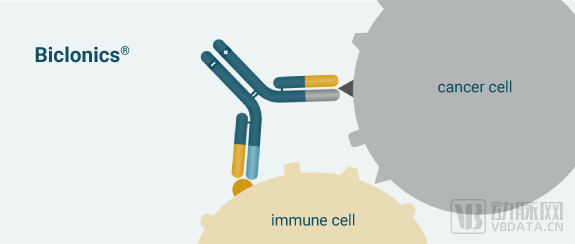
Biclonics® employs a common light chain to prevent mispairing of the light and heavy chains in bispecific antibodies. Additionally, to prevent the two heavy chains from forming homodimers, amino acid mutations are introduced in the CH3 regions of the two heavy chains to create positive and negative charges (DEKK mutation: D351 and E368 mutations on one heavy chain, and K351 and K366 mutations on the other heavy chain). After this charge modification, the purity of the bispecific antibody can reach 99%. Following the modification, the Tm value of the bispecific antibody Fc decreases to 69.5°C, while the Tm values of the Fc regions of antibodies from the ZW (Zymeworks) and EW-RVT platforms are around 80°C, close to that of natural antibodies.
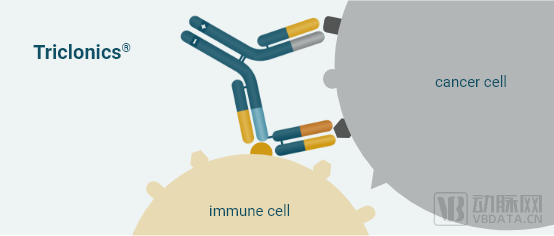
Based on the Biclonics® platform, Merus scientists have further developed the Triclonics™ platform, which can bind to three targets in either a 2+1 or 1+1+1 format. Similar to the bispecific antibody platform, this platform also employs a common light chain to prevent heavy-light chain mispairing and uses DEKK mutations to avoid heavy chain mispairing.
This collaboration with Gilead is the first external partnership based on the Triclonics™ platform. Previously, Merus has established pipeline or technology platform collaborations with Loxo Oncology (under Lilly), Incyte, and Chinese pharmaceutical companies Betta and Simcere, all of which were developed based on Biclonics®.
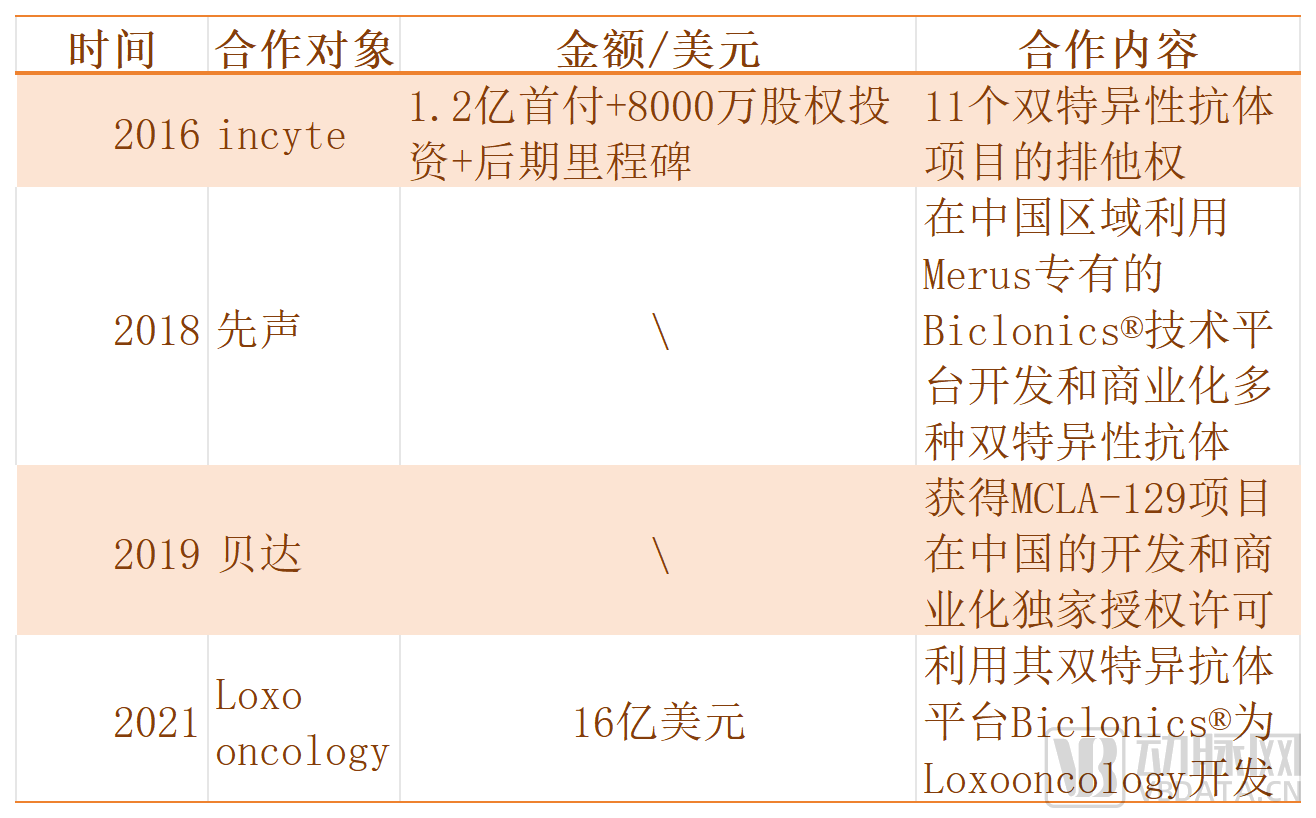 Merus External Cooperation: Incomplete Statistics
Gilead Sciences: If at first you don't succeed, try again
Gilead Sciences has a broad research scope, including human immunodeficiency virus (HIV)/acquired immune deficiency syndrome (AIDS), liver diseases (such as hepatitis B and hepatitis C), cancer, inflammation and respiratory diseases, as well as cardiovascular diseases. Its well-known drugs include Truvada for HIV treatment, Harvoni for hepatitis C treatment, and Kymriah for cancer treatment. In addition to direct acquisitions and collaborations, Gilead also engages in the development of cancer immunotherapies through its subsidiary, Kite Pharma, Inc. (Kite).
However, Gilead Sciences' "pioneering" journey in the oncology field has indeed encountered some setbacks.
In 2020, Gilead Sciences acquired Forty Seven for $4.9 billion, obtaining Magrolimab and establishing itself as a leader in the CD47 target field. However, after entering Phase 3 clinical trials, Magrolimab faced significant challenges. In January 2022, the FDA halted its clinical study due to safety concerns, followed by ongoing issues related to treatment inefficacy and insufficient safety.
At the beginning of this year, while announcing its 2023 performance, Gilead Sciences also announced the termination of the Phase III clinical trial ENHANCE-3 for magrolimab in treating AML (Acute Myeloid Leukemia) and MDS (Myelodysplastic Syndromes), and the FDA has requested a hold on all clinical studies of magrolimab for the treatment of AML and MDS.
The press release pointed out that the reason for the above decision was that the Independent Data Monitoring Committee (IDMC) evaluated the key data of the interim analysis of overall survival (OS) in the ENHANCE-3 trial. It was found that magrolimab + azacitidine + venetoclax showed no treatment effect (original term used: futility) and increased the risk of death mainly caused by infections and respiratory failure.
Prior to this, in 2023, Gilead Sciences had already terminated two clinical trials of magrolimab for hematological tumors. In July 2023, Gilead announced the termination of the Phase 3 ENHANCE study of magrolimab combined with azacitidine for the treatment of high-risk MDS, due to insufficient efficacy and an increased risk of patient mortality. Subsequently, in September 2023, Gilead again announced the termination of the ENHANCE-2 study of magrolimab for AML patients with TP53 mutations, for similar reasons.
Based on the results of the three clinical trials, Gilead stated in a press release that it will no longer further develop magrolimab for the treatment of hematologic malignancies.
However, this is not the first "failure" either. In 2015, Gilead Sciences entered into a global R&D collaboration with Galapagos, a ten-year deal worth up to $5 billion, which may also be defined as a "failure" over the past decade.
In 2020, Gilead Sciences spent a total of $27 billion on oncology drug development. However, apart from the antibody-drug conjugate (ADC) Trodelvy acquired through the purchase of Immunomedics, none of the other acquisition deals have yet resulted in marketed products.
However, these "tumbles" have absolutely not made Gilead feel defeated. Gilead Sciences' 2023 annual report shows that the sales of its oncology division reached $2.9 billion in 2023, with 60% coming from cell therapy.
At the same time, Gilead Sciences is still advancing deals in the oncology field. In addition to the recent transaction with Merus, Gilead has increased its collaboration with Arcellx by $285 million, expanded its equity stake in Arcus Biosciences with an additional $320 million, acquired XinThera, a biotech company founded by Chinese entrepreneurs, for nearly $1 billion, and purchased Tmunity Therapeutics, a cell therapy company founded by the "Father of CAR-T."