

Over $10 Billion and Counting: MNCs Double Down on AI-Driven Drug Discovery

Bain & Company Inc.
A global business consulting firm

Isomorphic Labs
AI Drug Developer
Sanofi
Pharmaceutical R&D Developer
Cost reduction is almost the current focus of all pharmaceutical companies—whether through cutting sales expenses, closing production bases or even research and development centers, and conducting mass layoffs.A recent survey by Bain & Company targeting pharmaceutical companies shows that 40% of executives have already factored anticipated savings into their 2024 budgets, while 60% have set goals to reduce costs or improve productivity.
The IRA bill also impacts the decision-making of pharmaceutical companies.According to a provision in the IRA, biologics will not be subject to price negotiations for 13 years after approval, while small molecules will only have a grace period of 9 years. The industry believes that this unbalanced system will reduce the motivation to pursue new breakthroughs and explore new uses for existing small molecule drugs, as well as decrease investment in promising R&D candidates for small molecule drugs. A few days ago, Pfizer stated that the proportion of small molecule drugs in its oncology business will drop from 94% in 2023 to 35% by 2030.
Against this backdrop, the role of AI in drug development, manufacturing, and commercialization, along with the potential benefits it may bring, has once again come under the spotlight.Particularly in the past year's surge of generative AI, the market has reignited investment enthusiasm for AI pharmaceutical companies: the total financing amount of the Top 10 AI pharmaceutical companies in 2023 was approximately $1.53 billion, a 65% increase from $926 million in 2022, with more involvement in cutting-edge fields such as generative AI protein drugs, mRNA vaccines, gene editing, and non-coding RNA.
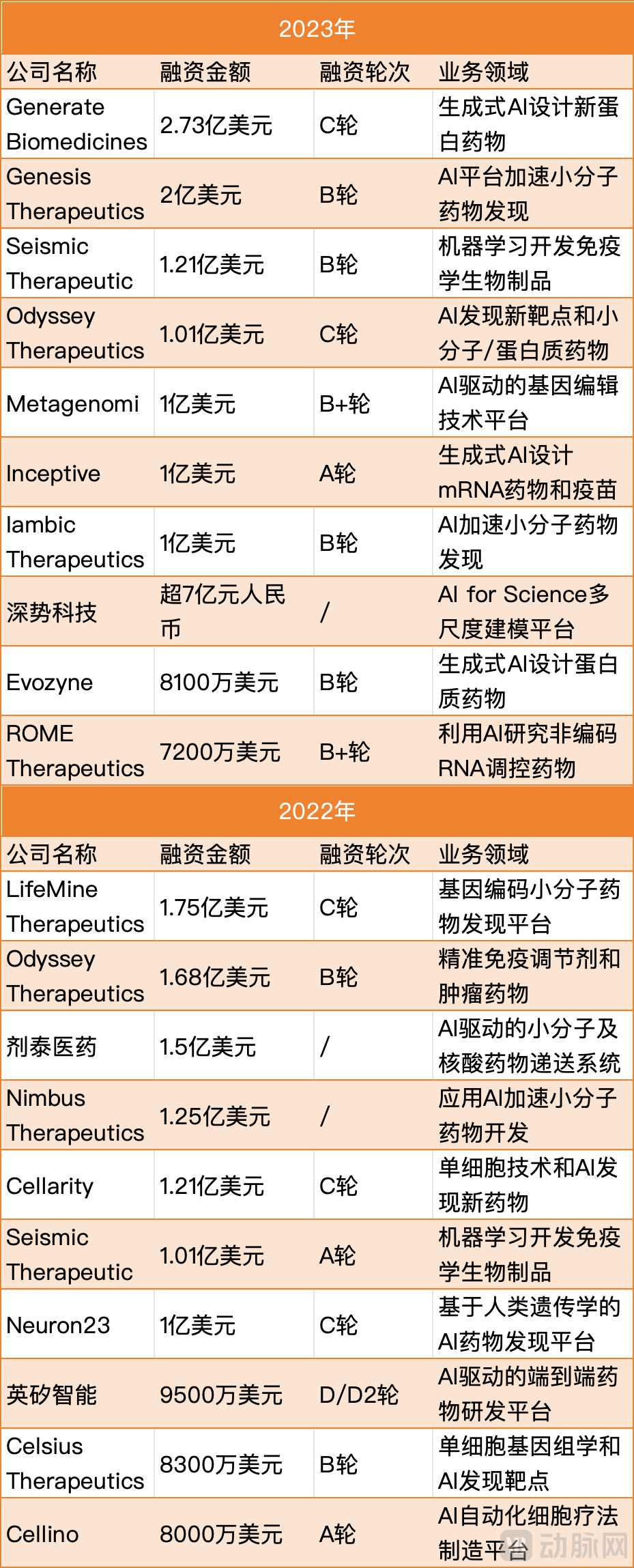
Top 10 AI Drug Discovery Financing Amounts in 2023 & 2022
But no matter how generative AI is seen as a major opportunity for the pharmaceutical industry to improve efficiency or even achieve breakthroughs in diagnostic and treatment models, ultimately, the ones who will pay for AI drug development and apply it to actual development and commercialization will still be MNCs.So,Are MNCs Really Paying for AI Drug Development?
Average collaboration amount is $840 million, but MNCs are demanding more
At the JP Morgan Healthcare Conference earlier this year, Isomorphic Labs, an AI biotechnology company under Alphabet, Google's parent company, announced two major deals worth nearly US$3 billion with Eli Lilly and Novartis. The deals announced during the JP Morgan Healthcare Conference are considered key indicators and barometers of the industry.
Last month, Sanofi CEO Paul Hudson stated that the core AI model adopted by Sanofi in the project has a prediction accuracy rate of up to 80%. Ninety percent of disease targets have been certified through single-cell genomics, and 75% of small molecule projects are achieved through AI and machine learning compound design.
Sanofi announced the "All in AI" strategy last year, and Paul Hudson aims to make this MNC the first pharmaceutical company to be driven by AI on a large scale. The company's official recruitment information also shows that there are more than 100 positions actively recruiting AI talents, with far fewer traditional medicinal chemistry analysis positions required compared to AI drug discovery roles.
In fact, MNCs are "quite enthusiastic" about collaborating with AI pharmaceutical companies.From 2023 to early this year, almost every large pharmaceutical company has publicly cooperated with AI pharmaceutical companies. Compared to the basic compound screening in the early years, the cooperation content between the two parties is now richer:
- AI applications cover multiple aspects of drug research and development, from target identification, candidate compound screening, molecular optimization to clinical data management, etc.
- A number of collaborative projects have targeted major disease areas with unmet medical needs, such as oncology, neurology, immunology, and inflammatory diseases.
- Multiple collaborations mentioned utilizing multimodal databases and integrating molecular data for drug target identification, reflecting that multi-omics data-driven AI drug discovery is becoming a trend.
- Collaborations specifically targeting mRNA drugs and gene-editing therapies for target identification show that AI is aiding the development of novel treatment approaches.
- There are also efforts involving the use of AI to streamline the management and review processes of clinical trial data, indicating that AI is extending into the later stages of clinical development.
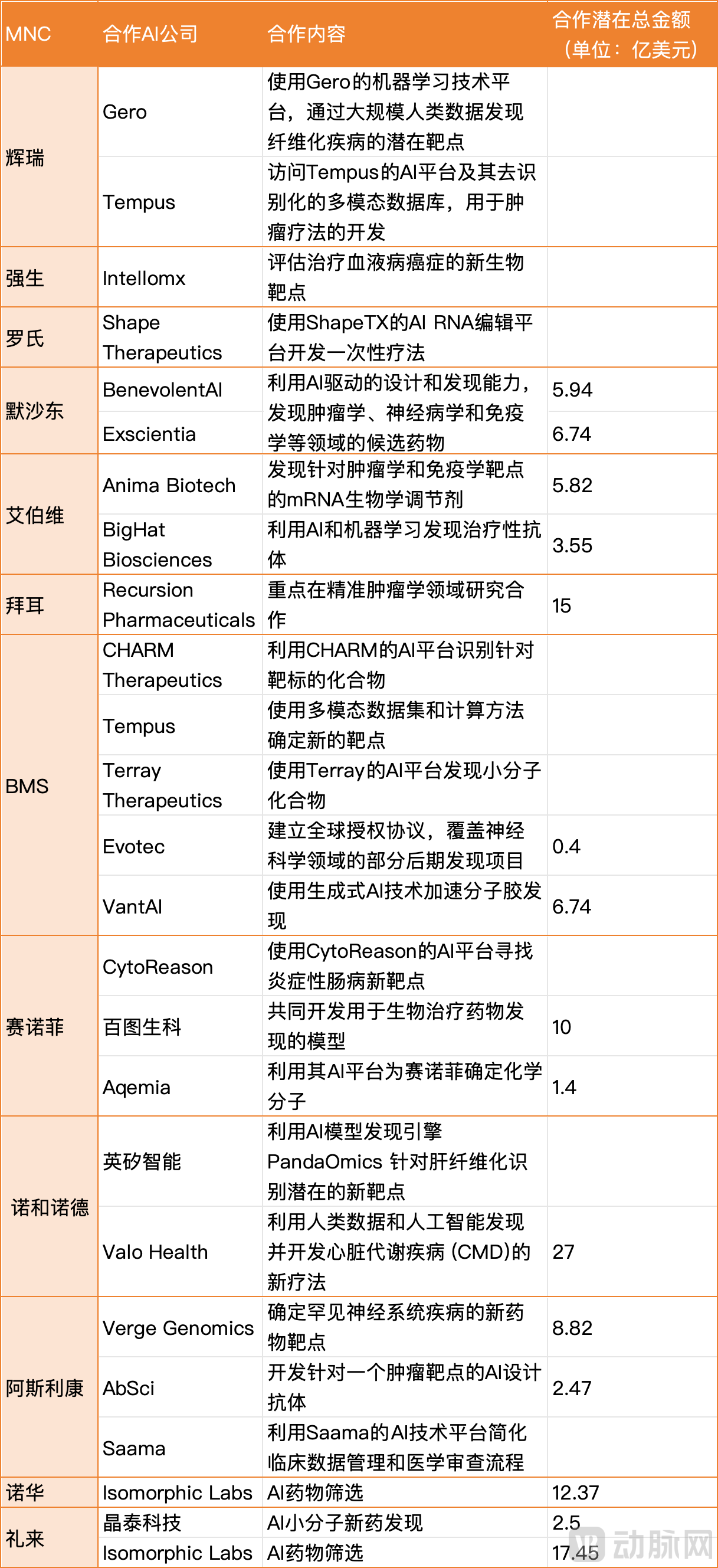
MNC and AI Pharmaceutical Company Cooperation Projects from 2023 to February 2024
"MNCs have funds, data, and extensive experience in drug development, but they generally do not develop all tools themselves. In most cases, they prefer to use tools developed by specialized companies."Dr. Xie Xin, founder of Yaosu Technology, explained the phenomenon of MNCs extensively collaborating with AI drug development platforms.VelociTech is a novel TechBio company that combines computer vision with AI and high-throughput organoid chips to empower new drug development and precision medicine. It is participating in the standard formulation of the "Next-Generation Preclinical Compound Hepatotoxicity Testing" project, which is a collaboration between the FDA, multiple MNCs, and biotech companies, and is also engaged in close communication and cooperation with several MNCs.
For AI pharmaceutical companies, collaboration with MNCs is often seen as an opportunity to acquire necessary resources, accelerate drug development, and expand business scope. From the whole year of 2023 to February 2024, the total potential value of publicly disclosed projects between MNCs and AI pharmaceutical companies exceeded 12 billion US dollars, with an average of 840 million US dollars.
"AI pharmaceutical companies often excel in a specific technology or disease area. If an AI pharmaceutical company can offer unique technology to address the pain points of MNCs and help them understand the technical advantages of the AI pharmaceutical platform, it will often be favored. MNCs generally have a positive outlook on the application of AI in drug development, viewing it as a key tool to improve efficiency, reduce costs, and accelerate time-to-market for drugs—they are unwilling to miss this wave."
Who Can Truly Taste the Sweetness of AI Drug Discovery?
AI's speed advantage in drug screening and compound design is relatively easy to demonstrate, as well as using AI to design molecules—this is currently the main application of AI in drug development. The molecules designed by AI are comprehensive and have more balanced drug-like properties, a level that only senior human experts could achieve in the past.
However, whether AI can improve the success rate of drug development remains to be tested.
After entering clinical trials, many AI-designed molecular drugs have progressed slowly or failed, with effects falling short of expectations. Clinical projects by multiple AI pharmaceutical companies have been suspended or withdrawn. For instance, Ulotaront, a schizophrenia drug candidate developed by Sumitomo Pharma and PsychoGenics using the SmartCube platform, failed in Phase III clinical trials.
For the few successful pipelines, the contribution of AI is limited. For instance, Takeda's $6 billion acquisition of the TYK2 inhibitor TAK-279 (previously known as NDI-034858) was once hailed as an "AI-driven drug discovery," but in reality, it was developed by Schrödinger and Nimbus referencing a molecular structure published by BMS and optimized through FEP (Free Energy Perturbation) calculations. FEP calculations can be used to predict relative binding free energy changes of homologous compounds and have become a mainstream method for studying free energy in drug design, benefiting from the rapid advancement of computer performance in recent years.
Schrodinger views the role of AI with caution: machine learning can only build predictive models based on knowledge learned from training data, covering an "extremely small fraction" of the total number of potentially developable molecules. The key to drug discovery lies in understanding biological mechanisms and defining clinical indicators; asking the right questions is more important than algorithms. Generative AI can only combine what it already knows in new ways, rather than producing entirely novel outputs.
"Insufficient AI-driven drug discoveries have entered the clinical stage, and existing failure cases are not enough to evaluate the impact of AI on clinical trial success rates. The failure of AI-driven drug pipelines is a natural part of the R&D process and should be viewed as an opportunity for learning and improvement. Failures can reveal limitations of AI models, data quality issues, or the complexity of specific disease areas, offering valuable insights for future research. Such failures also lay the groundwork for integrating high-quality wet-lab data, high-throughput automated laboratories, and other technologies and tools in the industry, enabling positive feedback loops and closed-loop systems for AI and data. Through this approach, further industrialization and digitization of drug discovery can be achieved," said Dr. Xie Xin.
Another "criticized" aspect of AI drug development is the poor performance of several Biotech companies in the capital market, which were issued at high prices a few years ago. Whether it is Recursion, which had its moment of glory last year due to an investment by Nvidia, or Exscientia, which has partnerships with multiple MNCs, these companies faced overly high expectations before demonstrating tangible results, leading to lackluster stock performance.
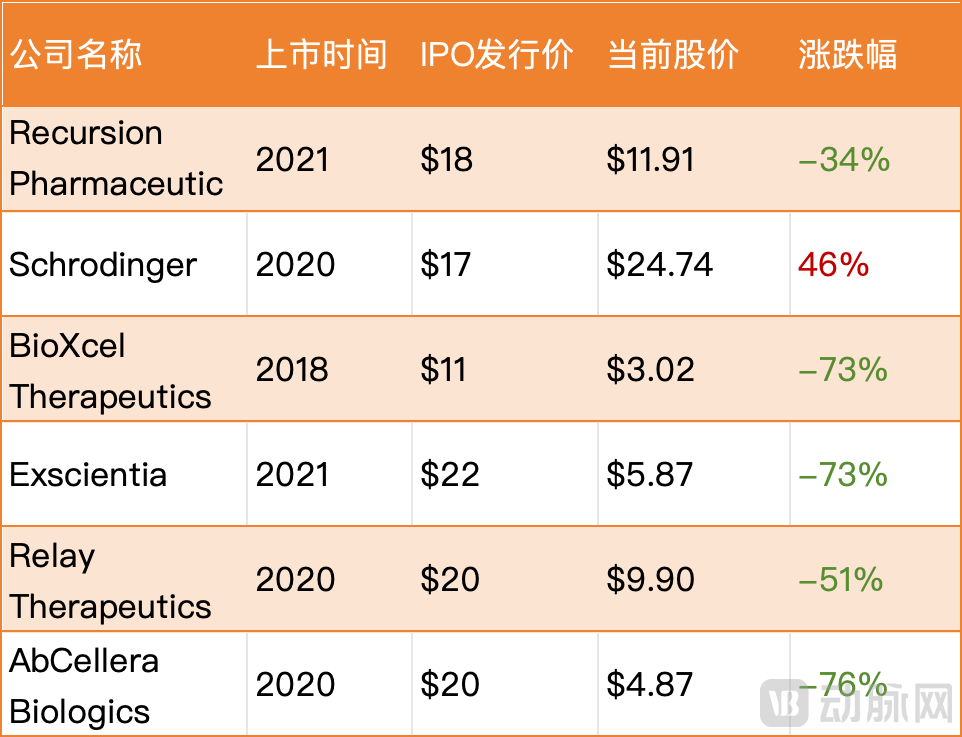
NASDAQ-listed AI pharmaceutical companies' stock price changes, with the current stock price as of the closing price on March 5, 2024.
Moreover, early AI pharmaceutical companies relied too heavily on data-driven approaches to accelerate drug discovery. However, in situations where data is scarce, this method may lead to compounds that are either similar to known drugs or repeat previously failed ones, which once made AI drug discovery disappointing.But now, AI pharmaceutical companies are also adjusting their strategies, shifting towards personalized treatment or addressing more fundamental issues in drug target selection, rather than focusing solely on drug optimization.
In the 1980s, CADD, which had just emerged, was not highly regarded, but now it has become a standard feature in large pharmaceutical companies. Technological development has never been linear; even chatGPT took 30 years to evolve from the initial RNN model to what it is today. Some industry experts believe that the current issue with AI drug discovery lies in having too high data dimensionality and too little data. However, if high-throughput measurement and data collection technologies can catch up, this field will become one where AI excels.
"AI is a huge variable, and large models have the potential to become a game changer in the field of new molecule generation, creating drugs for some targets that traditional methods cannot solve. However, it is still uncertain whether the large models we want can be generated based on the current data, especially in biopharmaceutical R&D, where there is multimodal data. How to effectively normalize and integrate this data, as well as the problem of data silos in different companies' R&D, and generating high-quality data from scratch also takes time," said Dr. Shen Yuan of BlueRun Ventures to VCBeat.
Perhaps more patience should be given to AI pharmaceuticals. As Paul Hudson, CEO of Sanofi, summarized, AI heralds a great era for drug discovery that could fundamentally transform medicine—but only if we can make it happen.