

Bayer Reports 1.2% Sales Decline in FY 2023 and Confirms No Immediate Plans for Business Split

Bayer
Pharmaceutical Product R&D Developer

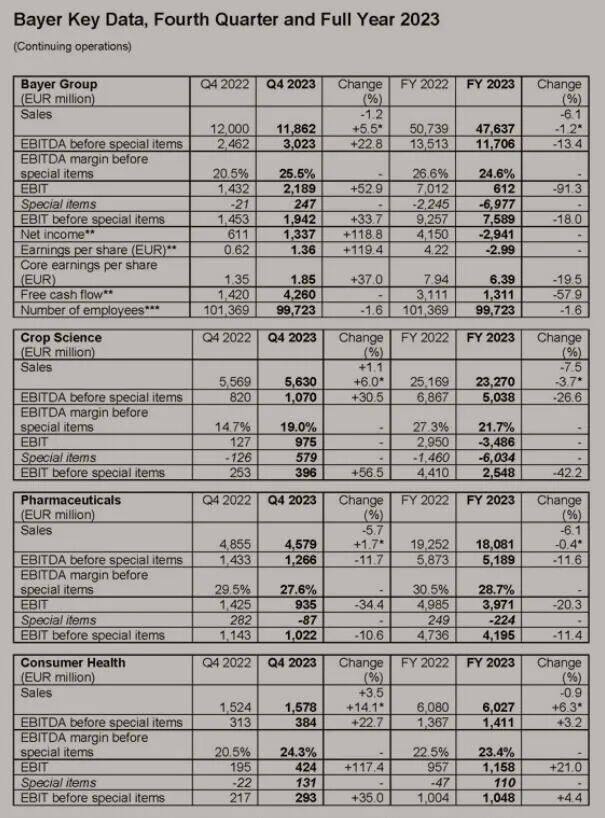
On March 5 local time, German pharmaceutical and biotechnology giant Bayer AG released its latest financial report.The financial report shows that Bayer AG's sales revenue for the fiscal year 2023 was 47.637 billion euros, a year-on-year decrease of 1.2% (after adjustment for exchange rates and portfolio changes).EBITDA (Earnings Before Interest, Taxes, Depreciation, and Amortization) excluding special items was 11.706 billion euros, a year-on-year decrease of 13.4%.Core earnings per share were €6.39, a decrease of nearly 20% year-over-year.
According to the financial report, as of December 31, 2023, Bayer's net financial debt amounted to 34.498 billion euros, representing an 8.5% increase year-on-year. This has led some analysts to conclude that a capital increase may be necessary. The company stated that it aims to reduce its net financial debt by 1 to 2 billion euros this year.
Bayer AG Chairman and CEO Bill Anderson pointed out that the performance of Bayer's three divisions varies significantly:Sales and earnings in the Crop Science division declined significantly year-on-year, while the Consumer Health division continued to show positive business performance.In pharmaceuticals, sales adjusted for currency and portfolio effects were level year on year, while earnings decreased significantly.
Crop Science Division Sales Decrease Year-on-Year
Earnings show that sales in Bayer's agricultural business (Crop Science Division) fell by 3.7% to 23.27 billion euros.This decline was mainly due to a significant drop in glyphosate product prices caused by the decrease in generic drug prices, resulting in a 26.0% decline in herbicide sales.
However, the sales of corn seeds and traits business increased strongly by 13.8%, mainly benefiting from product innovation and the rise in commodity prices. The sales of soybean seeds and traits business grew by 5.5%, primarily driven by the increase in licensing income in Latin America. Moreover, the sales of fungicides business rose by 8.8%, mainly due to growth in Europe/Middle East/Africa as well as increased sales volume in Latin America and North America.
Earnings show that the EBITDA (Earnings Before Interest, Taxes, Depreciation, and Amortization) of the Crop Science Division, excluding special items, fell by 26.6% to 5.038 billion euros, mainly due to a significant drop in glyphosate product prices.
No plans to split the business for now
Anderson announced on March 5 that he plans to address four major challenges facing Bayer over the next two to three years: a weak product pipeline in the pharmaceuticals division, litigation in the United States, high debt levels, and bureaucracy.
Regarding the issue of the company structure and a potential spin-off of the group, Anderson said: "Our answer is 'not now', and it should not be misunderstood as 'never'."
"Of course, we will keep an open mind," he added. Given the company's very limited room for maneuver, "our top priority is to address the challenges, improve performance, and create strategic flexibility. We believe this approach is the best for Bayer."
The company stated that in the next 24 to 36 months, it will seek to strengthen its drug development pipeline, resolve litigation, reduce debt, and accelerate management decision-making. Anderson noted that from 2026 onward, these measures will save the company €2 billion annually in organizational costs.
With the launch of the new strategy, Bayer expects sales to reach between 47 billion and 49 billion euros (currency-adjusted) in 2024.Moreover, the company expects EBITDA (Earnings Before Interest, Taxes, Depreciation, and Amortization) excluding special items to be between €10.7 billion and €11.3 billion (adjusted for exchange rates), core earnings per share to be €5.10-€5.50, and free cash flow to be €2 billion - €3 billion.As of 2024At the bottom, the net financial debt is expected to reach 32.5 billion euros to 33.5 billion euros.


ClickRead the Original Text Learn More