▎Edited by the WuXi AppTec content teamOn March 8, the official website of the Center for Drug Evaluation (CDE) of the China National Medical Products Administration announced that the combination therapy of cemdisiran injection and pozelimab injection, submitted by Regeneron, has been approved for clinical trials to treat patients with signs of active disease and hemolysis.Adult male and female patients with Paroxysmal Nocturnal Hemoglobinuria (PNH)。Public information shows that cemdisiran is aSubcutaneous injection, targeted C5 complement small interfering RNA (siRNA) therapy drug,pOzelimab is aA New Generation of C5 Complement Inhibitors.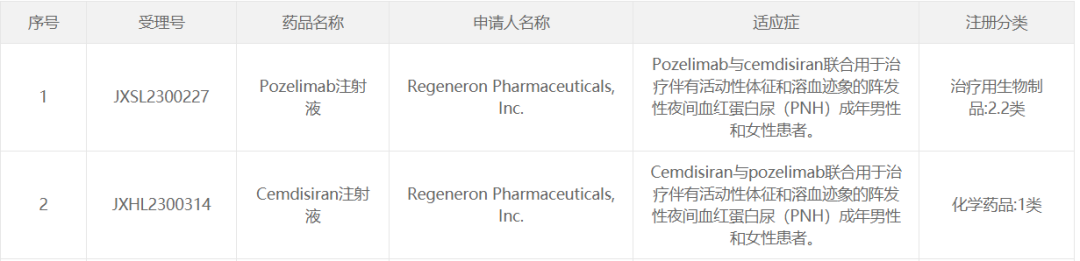 Screenshot source:CDE Official Website
PNH isA rare and life-threatening syndrome, patients are prone to fatigue, bone marrow failure, hemoglobinuria,Anemia,Symptoms such as thrombosis.Inhibition of complement C5 is the standard treatment for PNH patients with significant clinical symptoms.Complement protein C5 is at the terminal end of the complement cascade; therefore, targeting this protein can modulate complement signaling activated through all three different pathways. In various complement-mediated immune diseases,Complement-mediated immune responses attack the patient's own healthy tissues and cells, leading to damage in different tissues and organs.Inhibiting the activity of C5 complement can suppress this autoimmune attack, thereby alleviating disease symptoms.Cemdisiranis Regeneron andCo-developed by Alnylam PharmaceuticalsOne kind ofRNAi Therapeutic Targeting C5 Complement. ItAfter entering the cell, it binds to the target mRNA, leading to mRNA degradation and preventing the production of functional proteins.Pozelimab is a new generation C5 complement inhibitor developed by Regeneron., with high affinity for both wild-type and mutant human complement C5 protein. This product was approved by the U.S. FDA in August 2023.Listed, for the treatment of adult and pediatric patients aged 1 year and older with CD55-deficient protein-losing enteropathy (CHAPLE).According to Regeneron's public informationMaterials, the company is developingC5 Inhibitor""Antibody + siRNA" Combination Therapy for the Treatment of Complement-Mediated Diseases, such as PNH, myasthenia gravis, etc. Among them, cemdisiran can reduce the production of C5, and pozelimab can block the function of the remaining C5. Together, they inhibit terminal complement activity.The advantage of this combination therapy lies in its ability to achieve complete and sustained C5 inhibition at a lower dose, reduce dosing frequency, and offer convenient subcutaneous administration for clinical application.。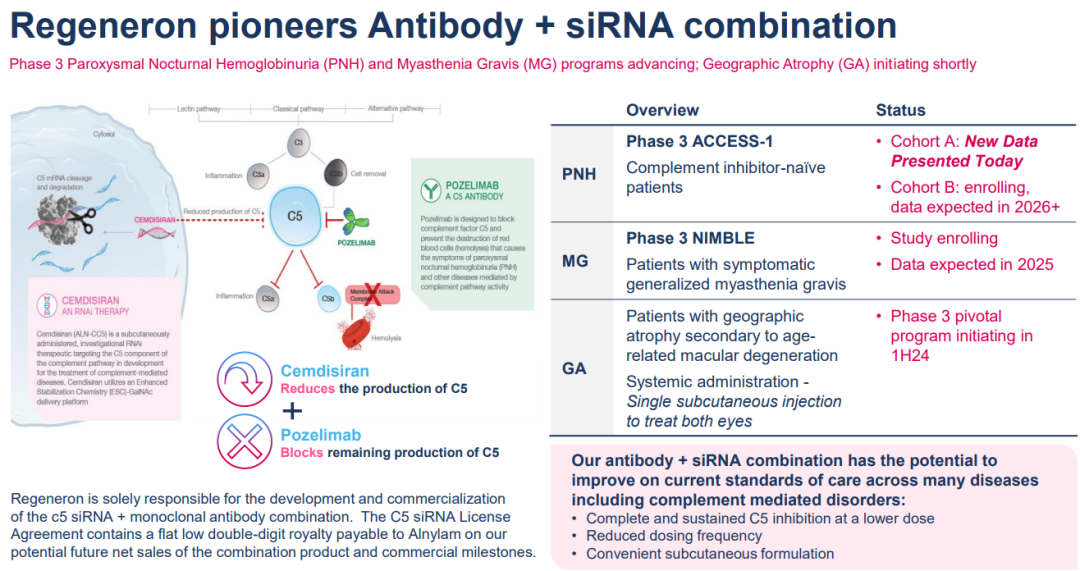
Source of screenshot: Reference [3]
According to clinical data published by Regeneron in 2023, in the pivotal Phase 3 clinical study for treatment-naïve PNH patients, the combination therapy of pozelimab and cemdisiran nearly eliminated symptoms in all patients.Lactate Dehydrogenase (LDH)Level. Prior to this, no other therapies could reduce and maintain the average LDH level within the normal range.In the study's primary endpoint, the combination therapy reduced LDH levels to 0.8x the upper limit of normal (ULN), compared to 1.2x ULN in the control group. From week 8 to week 26,91% of patients receiving combination therapy maintained adequate LDH control., while 73% of the patients receiving the control drug.
ClinicalTrialsThe official website information shows that, internationally, Regeneron's pOzelimab and Cemdisiran Combination TherapyTwo ongoing trials are targetingPhase 3 Study for PNH Indication:A study to evaluate the combination therapy in adult patients with PNHLong-termSafety, Tolerability, and Efficacy (ACCESS-EXT); another one is to evaluate the combination therapy inPreviously or recently not treated with complement inhibitorsEfficacy and safety in adult patients with PNH (ACCESS-1). This CDE clinical implication permission means that the combination therapy will also be clinically tested in China.[1] Website of the Center for Drug Evaluation (CDE) under the National Medical Products Administration (NMPA) of China. Retrieved Mar 8, 2024, fromhttps://www.cde.org.cn/main/xxgk/listpage/9f9c74c73e0f8f56a8bfbc646055026d[2] Richard Kelly, Nicola Houghton, Talha Munir, et al. (2022) A Phase 2, Open-Label Study Evaluating
the Safety and Efficacy of Combination Pozelimab and Cemdisiran Therapy in
Patients with Paroxysmal Nocturnal Hemoglobinuria Who Switch from Eculizumab. Blood. https://ashpublications.org/blood/article/140/Supplement%201/8174/488847/A-Phase-2-Open-Label-Study-Evaluating-the-Safety[3] American Society of Hematology 2023 Investor Event. Retrieved Dec 4, 2023, from https://investor.regeneron.com/static-files/cb093452-9e37-41b0-9d52-c53b9275e99eThis article is from the content team of WuXi AppTec. Individuals are welcome to share it on their WeChat Moments, but unauthorized republication by media or organizations in any form to other platforms is prohibited. For reprint authorization, please leave a message on the "MedView" WeChat Official Account to contact us. For other collaboration inquiries, please contact wuxi_media@wuxiapptec.com.
Disclaimer: The content team of WuXi AppTec focuses on introducing the research progress in global biopharmaceuticals and health. This article is for information exchange only, and the views expressed in the article do not represent the position of WuXi AppTec, nor does it indicate that WuXi AppTec supports or opposes these views. This article is not a recommendation for treatment plans. If you need guidance on treatment options, please visit a regular hospital.