

Global Pharma CEO Pay Report 2023: GSK Soars 51%, Sanofi Marks Third Straight Year of Declines, Bayer, Roche, and AbbVie’s New CEOs Face Early Tests

GSK
Pharmaceutical R&D Manufacturer

Sanofi
Pharmaceutical R&D Developer

Bayer
Pharmaceutical Product R&D Developer

Roche
Oncology Drug Research, Development, and Manufacturing

AbbVie
Innovative Drug Developer
As the annual report season comes to an end, the 2023 compensation of many MNC giant chief executive officers (CEOs) has also come to light.
According to incomplete statistics, as of March 8, seven multinational pharmaceutical companies have disclosed the 2023 compensation of their respective CEOs. Among them, the annual salaries of the CEOs from Bayer, GSK, Novo Nordisk, Novartis, and AstraZeneca increased year-on-year; whereas the annual salaries of the CEOs from Sanofi and Roche declined, albeit for different reasons.
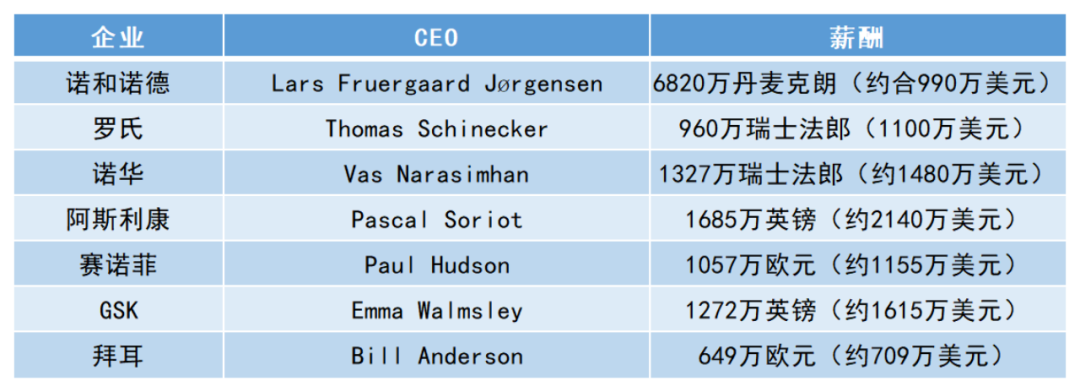
Industry insiders indicate that CEO compensation is primarily reflected in corporate performance and equity incentives, with most salary increases being tied to improvements in company results. Newly appointed CEOs may experience stagnant or decreased pay, mainly due to their work outcomes not yet being evident. Overall, the level of multinational pharmaceutical enterprises' CEO compensation is closely related to their performance during their tenure.
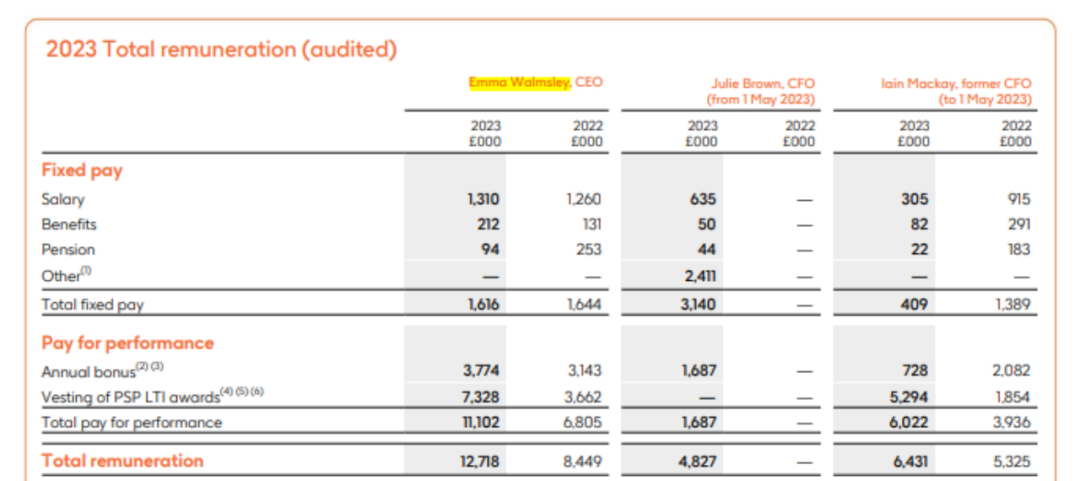
Whether the CEO's salary increases or decreases is closely related to the actual business conditions of the company.On March 1, GSK revealed in its 2023 annual report that the annual salary of its CEO, Emma Walmsley, was £12.718 million (approximately $16 million), a sharp increase of 51% compared to 2022.Specifically, Emma Walmsley's fixed salary was £1.616 million, her 2023 annual bonus was £3.774 million; and her long-term incentives amounted to £7.328 million, which included equity awards granted in 2020 and 2021.
In fact, GSK's development had once hit a bottleneck, with weak innovation, an aging product pipeline, and revenue mainly supported by mature products, OTC drugs, and health supplements, posing significant challenges. Since 2017, Emma Walmsley has served as the CEO of GSK. Her leadership has brought new vitality to GSK, and after several years of transformation, GSK's development outlook has greatly improved.
GSK's strong performance has also brought Emma Walmsley substantial compensation. In its governance report, GSK explained that Emma Walmsley's bonus was based on the company doubling its target sales growth rate of 7% (excluding COVID-19 revenue) and exceeding internal profit growth targets.
In 2023, AstraZeneca CEO Pascal Soriot also achieved the ambitious goal of $45 billion in revenue that he set for the company back in 2014, with a total annual income of $45.8 billion, while successfully fending off Pfizer's acquisition offer.In the industry's view, Pascal Soriot has demonstrated "very strong" commercial execution capabilities and a "steady" level of manufacturing and supply operations since taking office. In terms of innovation, more than one-third of AstraZeneca's pipeline has adopted new models; in commercial deals, obtaining the license for Eccogene's weight-loss drug and collaborating with CinCor Pharma and Gracell Biotechnologies have enabled AstraZeneca to achieve continuous growth in cell therapy and cancer fields.
In this regard, AstraZeneca's Remuneration Committee highly praised Soriot. Specifically, Pascal Soriot's 2023 compensation reached £16.85 million (approximately $21.4 million). His salary increase was mainly driven by the long-term incentive portion, rising by £1.983 million (+19%) from the previous year to reach £12.288 million.
Novo Nordisk CEO Lars Fruergaard Jørgensen Also Earns High Pay Due to Strong Corporate Performance. According to reports, the total compensation for this "leader" in 2023 was 68.2 million Danish kroner (approximately $9.9 million), a 13% increase from 60.1 million Danish kroner the previous year. Driven by the strong performance of GLP-1 weight-loss drugs, Novo Nordisk's revenue grew by 36% in 2023, reaching $33.7 billion. In its remuneration report, Novo Nordisk stated that the CEO had met their "high expectations" for 2023. Therefore, in addition to a fixed salary of 20 million Danish kroner, Lars Fruergaard Jørgensen’s incentive pay totaled 48.2 million Danish kroner.
Moreover, Novartis CEO Vas Narasimhan's compensation in 2023 reached 13.27 million Swiss francs (approximately 14.8 million U.S. dollars), a 21% increase from the previous year. The reason for the raise also stems from Novartis' impressive "report card." The latest financial report shows that Novartis’ total revenue for 2023 was $45.44 billion, a year-on-year increase of 10%; net profit was $8.572 billion, a year-on-year increase of 62%.
Notably, in terms of strategic development, Novartis spun off its generics manufacturer Sandoz in October last year, becoming a pure innovative drug company; it signed 15 business development and M&A deals. However, facing the "patent cliff" that more than 10 core products will encounter within three years, Vas Narasimhan still faces considerable challenges.
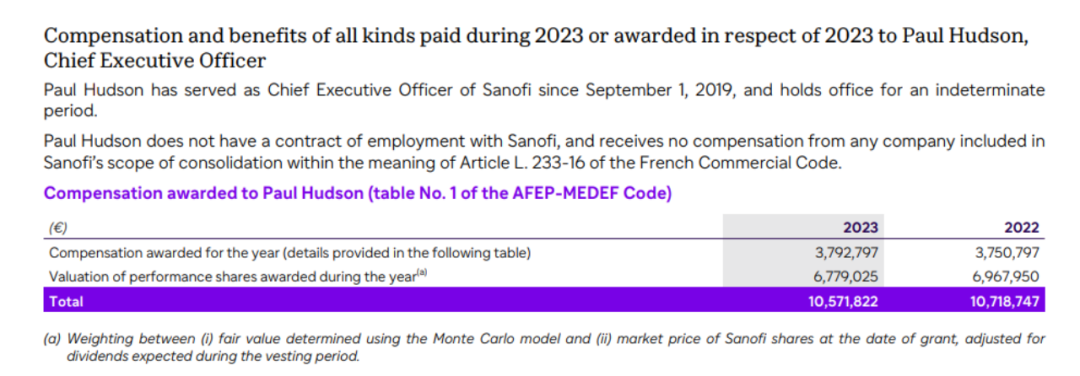
While most CEOs are celebrating a salary increase, some CEOs have seen their salaries decrease year-on-year. According to Sanofi's financial documents, its CEO Paul Hudson's compensation in 2023 was 10.57 million euros, a year-on-year decrease of 1.4%. It is reported that the decrease in Paul Hudson's compensation is mainly reflected in the performance share bonus, which was 6.779 million euros in 2023, a decrease of 189,000 euros year-on-year.
Notably, this marks the third consecutive year of缩水 (reduction) in Paul Hudson's compensation. Public records indicate that Paul Hudson left Novartis to join Sanofi as CEO in September 2019. His total compensation in 2020 was 11.34 million euros, followed by a slight decrease each subsequent year: 10.98 million euros in 2021, 10.72 million euros in 2022, and 10.57 million euros in 2023.
Besides the impact of the overall revenue increase or decrease of the company, the changes in the remuneration of the "leaders" are also closely related to the timing of their appointments.
Bill Anderson, who has been in the position of Bayer CEO for less than a year, has an annual salary 19% higher than his predecessor, totaling 6.49 million euros, with the majority being additional benefits. It is reported that Bill Anderson's annual salary is mainly divided into three parts: basic salary of 1.832 million euros, additional benefits of 3.985 million euros, and pension contributions of 675,000 euros.
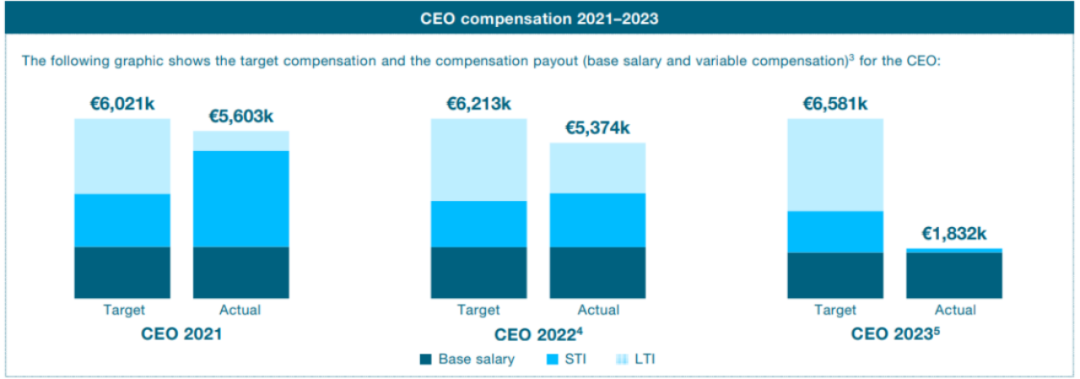
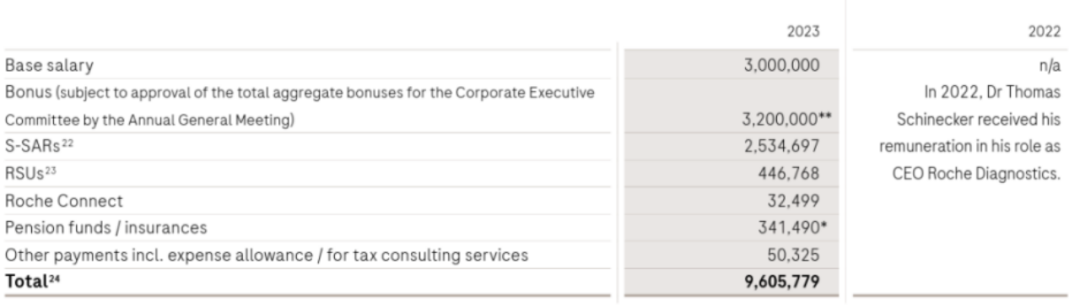
The newly appointed "leader" of Roche also experienced a change in compensation. In March 2023, Thomas Schinecker was promoted from the head of Roche Diagnostics to Group CEO. In his first year on the job, he received total compensation of 9.6 million Swiss francs (11 million US dollars), which was less than the 11.5 million Swiss francs earned by former CEO Schwan in his final year.
In addition to industry impacts, Roche also experienced frequent personnel changes in 2023, with both the diagnostics and pharmaceuticals divisions welcoming new leaders. Specifically, Matt Sause, head of Roche Diagnostics North America, took over the diagnostics division, while the former head of the pharmaceuticals division, Bill Anderson, left at the end of 2022 to join Bayer as CEO. Teresa Graham, previously Roche's Global Head of Product Strategy, assumed leadership of the pharmaceuticals division.
The CEO of AbbVie is always a key highlight in the annual global pharmaceutical executive compensation comparison. In March 2023, AbbVie disclosed in a Securities and Exchange Commission filing that its then-CEO Richard A. Gonzalez earned $26.3 million in 2022, marking a 10% increase from 2021. His base salary remained unchanged, while stock option awards increased by approximately $3.2 million. However, as of now, AbbVie has not disclosed the compensation details for Gonzalez, who has already retired, for the year 2023.
In February 2024, AbbVie announced that its board unanimously elected current President and Chief Operating Officer Robert A. Michael to succeed Gonzalez as the company's CEO. Public information shows that Robert A. Michael’s career began at Abbott, where he served as a member of the financial development program and eventually held positions such as division director, head of the nutrition supply chain, and head of molecular diagnostics. Since AbbVie’s separation from Abbott in 2013, Robert A. Michael has grown with AbbVie, successively serving as Vice President of Financial Planning and Analysis, Chief Financial Officer, Vice Chairman of Finance and Business Operations, and Vice Chairman and President.
At present, AbbVie is striving to address significant challenges as its blockbuster drug Humira has lost the top position of "the world's best-selling drug" and is facing fierce competition from generic drugs. However, during Gonzalez’s tenure, AbbVie not only held Humira in its portfolio but also became one of the largest biopharmaceutical companies within a decade. Its market value increased several-fold, rising from an initial $54 billion to over $300 billion today.
Today, Gonzalez has successfully stepped down, and Robert A. Michael has taken over the baton, which can be considered as taking up the challenge in a time of crisis. It is clear that one of Robert A. Michael's key tasks during his tenure is to find a new "blockbuster drug" to offset the losses from Humira. In this regard, Gonzalez once stated that it is a good time to hand over the CEO position to Robert A. Michael. AbbVie’s pipeline contains several highly promising candidates that will sustain the company's future growth. Whether the new CEO can live up to the expectations of the former CEO remains to be seen.
Overall, the salaries of CEOs from multinational pharmaceutical giants have generally increased and remain out of reach for ordinary pharmaceutical professionals. Although factors such as timing of their appointments, business adjustments, and fluctuations in revenue can influence these "leaders'" incomes, short-term changes have not significantly impacted their annual compensation. These top global pharmaceutical companies, with their strong cross-cycle survival capabilities, continue to be highly desirable workplaces within the industry.




www.yyjjb.com.cn
Insight into Industry Trends

"Pharmaceutical Economy Herald"
Academic Official Account
Focus on the Frontier of Oncology Academia

Terminal Official Account