
Friday, March 8, 2024, is destined to be an extraordinary day.First, Eli Lilly's highly anticipated new Alzheimer's drug Donanemab was delayed from FDA approval, which convened an advisory committee to discuss the drug’s safety and efficacy. The timeline remains uncertain (possibly a few more months), and Eli Lilly's stock price dropped by 2.31%.Following the failure of Amylyx's phase III clinical trial for its marketed ALS drug AMX0035, Amylyx's stock price plummeted by 82.29%. The company will subsequently communicate with the FDA, including the possibility of a voluntary withdrawal from the market.The R&D path of innovative drugs is much like opening Pandora's box, searching for "slim hope" amidst "curses."And as the opener of the Pandora's box —— "inevitably scientific and fair" regulatory authority, the FDA极力BalancingOn the balance, "Long-term Patient Benefits" vs. "Short-term Patient Benefits."
"Radical”Post-"Conservative”TheRegulatory StyleDonanemab (Drug D)'s approval process has not been smooth sailing. After the failure to gain accelerated approval in early 2023, the originally planned market launch by the end of last year was postponed to this year. Now, at this crucial moment, the Expert Advisory Committee has unexpectedly intervened.The FDA's such "conservative" move stands in stark contrast to the highly controversial approval of "Aducanumab" (Drug A).It should be noted that Drug D has long been considered by the industry as the most promising Alzheimer's disease (AD) drug to be marketed after Lecanemab (Drug L). Its approval is not a question of "if" but "when."Nowadays, the FDA has two main concerns about blocking Drug D again:(1) Safety. This approval is based on the large Phase III clinical trial TRAILBLAZER-ALZ 2 study data, in whichThree patients experienced ARIA (Amyloid-Related Imaging Abnormalities) related death.Death;While Drug L in the CLARITY AD study (which the FDA fully approved based on these results) althoughThere were 6 deaths.However, the investigators believed that the patient's death was unrelated to drug treatment and ARIA.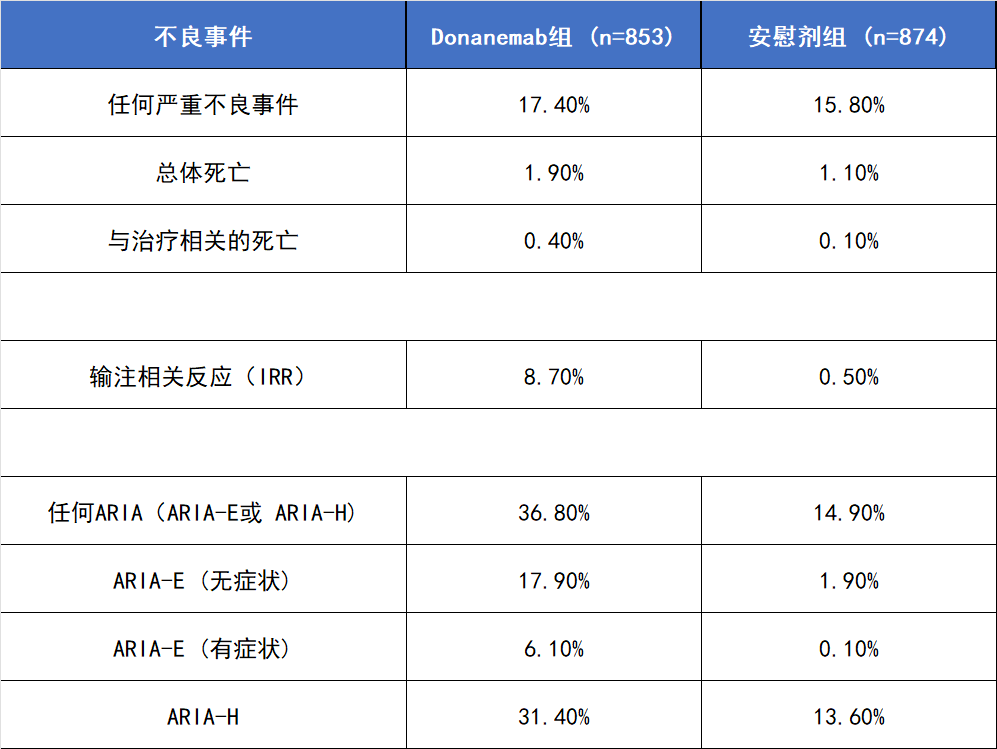
TRAILBLAZER-ALZ 2 Safety Data (PharmTimes Table)Dr. Zhou Xianbo, founder and CEO of Asnovo, commented: Currently, mainstream media in the U.S. are beginning to question the entire AD field, especially regarding blood tests, the definition of AD, and the clinical safety of Aβ antibody drugs. These fatalities...MayAmplified Concerns.(2) Interference of trial design with efficacy. First, the clinical trial designs of Drug D and Drug L are not the same. The primary endpoint of CLARITY AD is the Global Cognitive and Functional Scale, namely, the Clinical Dementia Rating-Sum of Boxes (CDR-SB). Compared with the placebo,L Drug Group treatment slowed the decline of CDR-SB by 27% at 18 months.However, the CDR-SB was only a secondary endpoint in the TRAILBLAZER-ALZ 2 study, with the primary endpoint being the Integrated Alzheimer's Disease Rating Scale (iADRS). Compared with placebo,In the D drug group, the decline rate of iADRS score slowed down by 35% and the decline rate of CDR-SB score slowed down by 36% at 18 months of treatment.Secondly, in the TRAILBLAZER-ALZ 2 study, participants were grouped based on brain tau deposition levels. However, "low tau" is actually a characteristic of early AD patients. Furthermore, the time-limited treatment approach allows patients to complete treatment based on the evaluation of amyloid plaque.If the subject's amyloid levels are sufficiently reduced, they can be switched to a placebo.Prior to this, the approval of Drug A was based on imaging changes (reduction in β-amyloid protein) rather than clinical efficacy data. Despite an overwhelming vote from the expert advisory committee of 1 in favor, 8 against, and 2 abstentions, the FDA decided to push forward with Drug A against all opposition.From the perspective of regulators, this is a game between "short-term benefits for patients" and "long-term benefits for patients." On the surface, the authority of the regulatory agency has been undermined. Even though after Drug A was launched, its high price and complicated diagnostic requirements led to widespread non-acceptance by doctors and patients alike. In Biogen’s 2023 financial report, the company quietly announced the "withdrawal" of Drug A from the market.In fact, the current enthusiasm for the development of Drug D and more AD drugs, does it really align with "the long-term interests of patients"?Perhaps for the FDA, what is needed is merely a "superficial yet timely" victory, at a time when the AD treatment landscape is completely blank.
Today, the "predicament" of AMX0035 is so similar to Drug A: the expert advisory committee opposed it in vain, the FDA resolutely approved it despite objections, but it failed to gain market recognition and eventually quietly came to an end...When the soil of innovation is fertile, it's time to pick the "juiciest" fruits.The market will choose, and the FDA also needs to choose.Later entrants need to understand that the excuse of "huge unmet clinical needs" really doesn't apply anymore.Dr. Zhou Xianbo stated that the completion and approval of Drug L has made the FDA more inclined towards higher clinical value and safety. The key to whether Drug D can be approved lies in the ratio of risk to benefit.
TauRx Pharmaceuticals, the leader of the Tau protein hypothesis, announced on March 7 that its new AD drug HMTM achieved long-term benefits.According to the latest data, early Alzheimer's patients receiving 16mg/d HMTM treatment continued to show significant improvement from baseline at 18 months.Only returning to baseline levels after 24 months.It is important to note that the sustained benefits of Drug D are also quite good. In the TRAILBLAZER-ALZ 2 study,Approximately 47% of patients showed no clinical progression after 1 year of treatment.It is worth mentioning that the primary endpoint of TauRx is a biomarker of neurodegeneration, namely, the change in the level of neurofilament light chain (NfL) in the blood. Although this case-related biomarker is non-specific, there is an urgent clinical need for more effective and affordable biomarkers.Although ADAS-cog was previously considered the gold standard, antibody drugs focus on clearance and CDR-SB.Note that before using L medication, it is necessary to confirm the presence of pathological Aβ in the patient, obtain brain magnetic resonance imaging (MRI) data within the past year to evaluate pre-existing amyloid-related imaging abnormalities (ARIA), and conduct MRI tests before the 5th, 7th, and 14th administrations to provide supportive recommendations for subsequent treatment.Currently, apart from HMTM, Eli Lilly's "backup" Remternetug and AbbVie's ABBV-916 might also alter their "life trajectories" due to the FDA's stance. Regarding this,Dr. Zhou Xianbo believesThere are already drugs that have been fully approved for marketing, and the approval criteria may return to normal standards.Back in China,“AD in China is now flourishing with diverse developments. Our pipeline, based on neuroplasticity and neuroimmunology in the preclinical stage, and the introduced peptide — the world's only product that has completed Phase I clinical trials overseas and takes effect in the gastrointestinal tract via the vagus nerve-brain-gut axis — is highly anticipated. The innovative product targeting the forgetting mechanism from Beijing Zhuokai is also worth looking forward to.”Dr. Zhou Xianbo said,“Making medicine should return to its essence: safe, effective, and quality controllable.”Yes, if we truly focus on patients, do not cross the "data falsification" red line, and do not confuse the identities of "researchers" and "businesspeople," the scales will tip...

Cover image source:pixabay
Copyright Statement/Disclaimer
This article is an original piece by the team.
This article is for informational exchange only and does not provide any commercial, medical, or investment advice.
The images, videos, fonts, music and other materials in the article are either authorized genuine works purchased by Yaoshidai or from the WeChat public image library.Or obtained from the company's official website/Internet, some materials used under the CC0 protocol, copyright belongs to the owner, PharmTimes tries its best to cite the source.
If you have any questions, please contact us.
Sincere thanks!
DrugTimes Official Website: www.drugtimes.cn
Contact Information:
Phone: 13651980212
WeChat: 27674131
Email: contact@drugtimes.cn

 Click here to enjoy more exciting content!