AbbVie Terminates Collaboration with MacroGenics on ADAM9-Targeting ADC IMGC936 Due to Suboptimal Clinical Safety and Efficacy

MacroGenics
Developer and Manufacturer of Cancer Drugs for Immune Diseases

AbbVie
Innovative Drug Developer
▎Traceability
On March 7, 2024, MacroGenics mentioned in its earnings report,AbbVie Terminates Development of IMGC936 Due to Failure to Meet Expected Safety and Efficacy Goals
IMGC936 is an ADAM9 ADC that utilizes site-specific conjugation with a tripeptide L-Ala-D-Ala-L-Ala linker. It has a DAR value of DAR2, and its toxin is DM21-C. The metabolite is DM51, which, after undergoing S-methylation, forms the related byproduct DM50. Both DM51 and DM50 can bind to tubulin, inhibiting its function and leading to tubulin depolymerization. The antibody portion is modified with YTE to extend its half-life. However, based on current outcomes, this design has failed to demonstrate superior clinical efficacy and did not meet expectations.
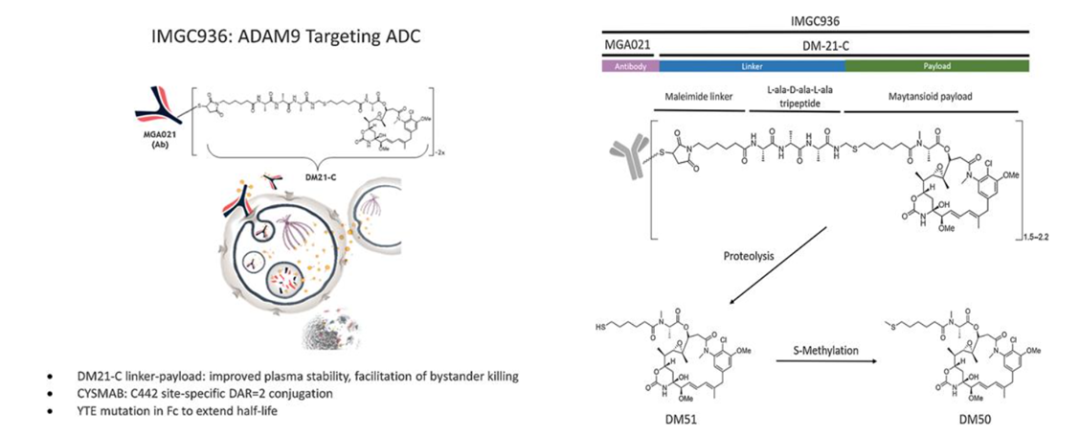
However, MacroGenics did not abandon the development of the ADAM9 target and has developed a second ADAM9 ADC, designated MGC028, utilizing Synaffix's glycan-based site-specific conjugation technology, with the payload being a topoisomerase inhibitor.Enzyme I Inhibitor.
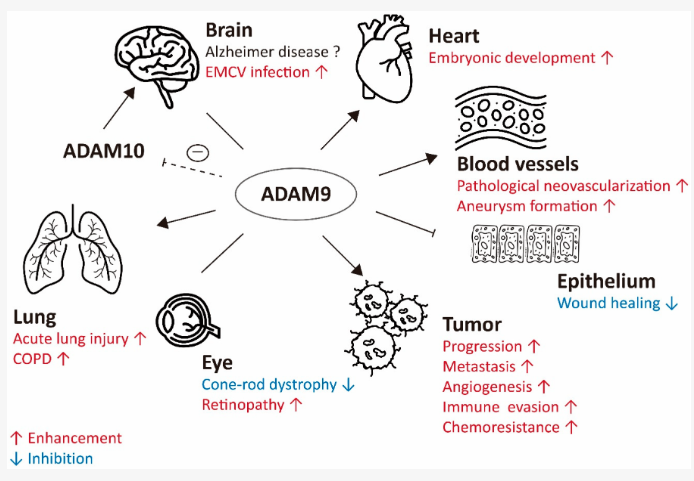
ADAM9, as a member of the ADAM family, has been found in publicly published articles to be associated with cancer prognosis.There is a clear positive correlation, and it is overexpressed in numerous cancers, including non-small cell lung cancer, pancreatic cancer, gastric cancer, breast cancer, ovarian cancer, and colorectal cancer. However, the expression of ADAM9 is relatively widespread, including in monocytes, macrophages, neutrophils, keratinocytes, and fibroblasts, as well as in various organs such as the lungs, colon, kidneys, vascular smooth muscle, nervous system, and reproductive system. Meanwhile,ADAM9Possessing numerous functional possibilities, it is associated with development, inflammation, and tumorigenesis.But MacroGenThe expression of ICS isADAM9Expressed limitedly in normal tissues, more analysis of this target is needed.RelevantADC Data Disclosure.
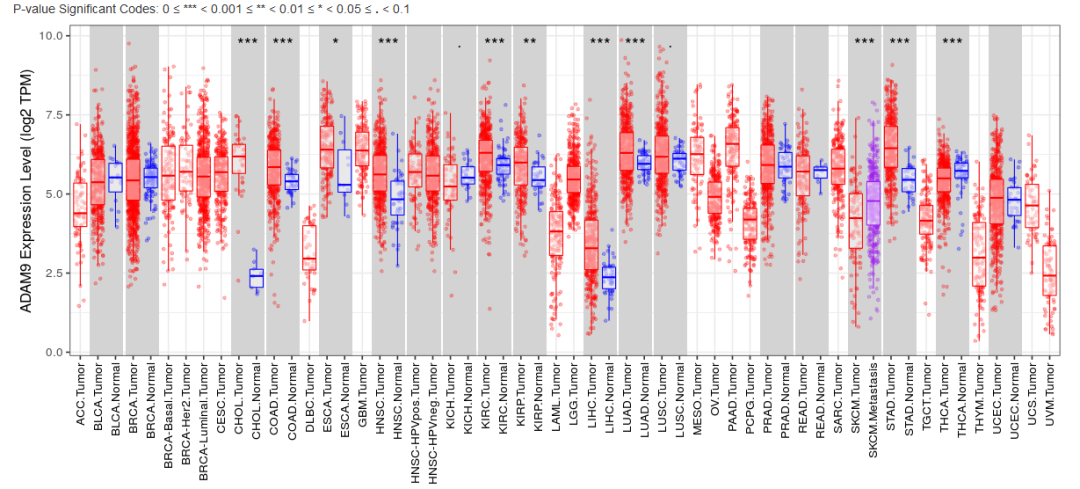
Through its mRNA analysis, ADAM9 has shown certain development potential, particularly in the fields of lung cancer, gastric cancer, colorectal cancer, and triple-negative breast cancer.
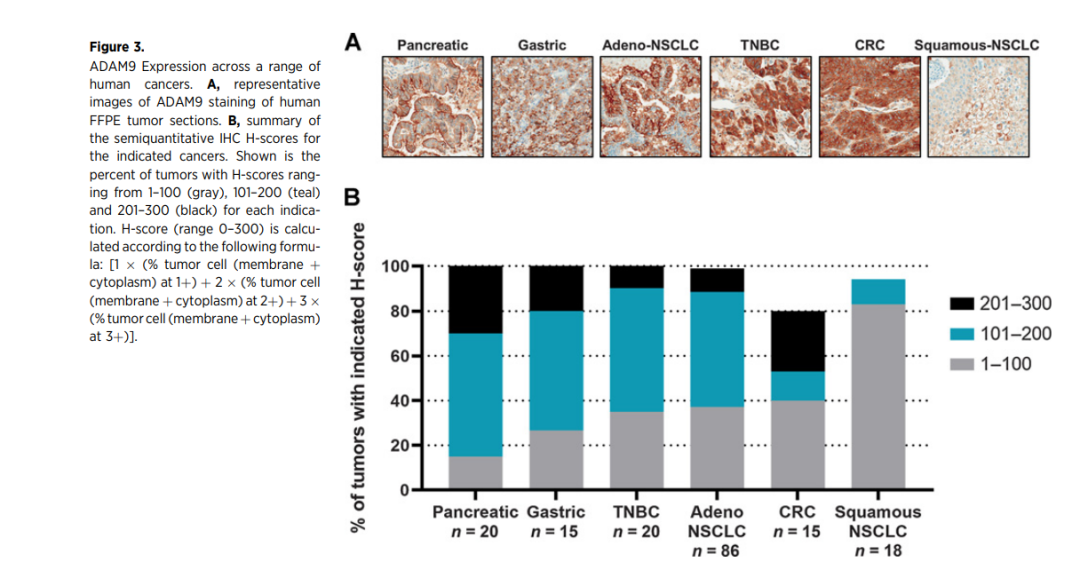
In tissue testing,Most cancers show ADAM9 positivity, particularly in pancreatic cancer, gastric cancer, NSCLC adenocarcinoma, and triple-negative breast cancer (TNBC), where over 60% of tumor samples in each indication display an H-score greater than 100, and 10% to 30% have an H-score greater than 200.But it is also expressed in normal tissues to a certain extent.
Based on in vitro experimental analysis, the data for IMGC936 does not look promising. One possible reason could be the relatively weak toxin, and another possibility is that the target itself may not be highly expressed in these tumor cells.
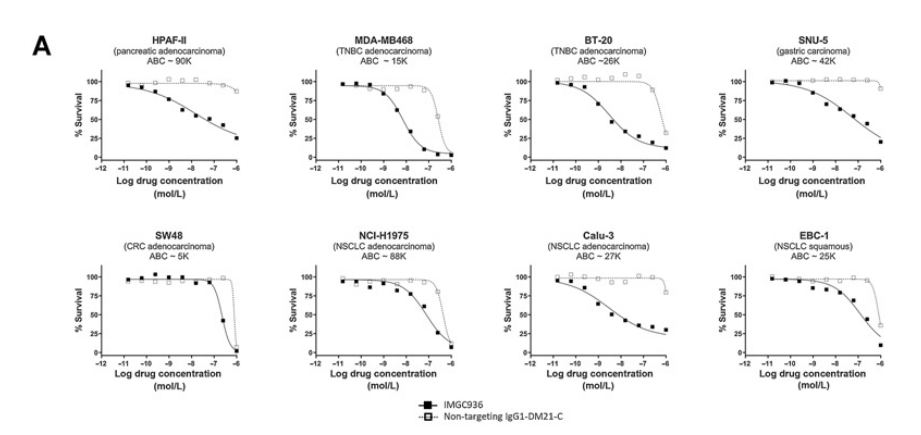
But sometimes, poor in vitro effects do not mean that development is impossible, because for toxins with moderate to low toxicity, achieving excellent in vitro data requires tumor cells to have particularly high target expression. However, most tumor cells do not meet the standard of extremely high target expression, but this does not prevent good in vivo effects. For example, ADCs with DXD as the payload may show unsatisfactory in vitro efficacy in many targets, but their in vivo effects are not hindered. This indicates a certain conflict between in vivo and in vitro data in ADC development. At the same time, better cytotoxicity does not necessarily mean better drugability. MMAE performs better than DXD in many in vitro models, but DXD outperforms MMAE in most in vivo models. Therefore, data from different sources should be viewed with caution. ADC development can be quite misleading, especially for new toxins.
In the development of ADCs, widespread target expression does not necessarily mean that development is impossible. The key is whether a reasonable therapeutic window can be achieved. If the target is highly expressed in tissues with strong regenerative capacity, this may, to a certain extent, affect the development of the target into an excellent ADC product. TROP2 falls into this category.
The failure of one type of toxin does not mean the failure of this target. During my years working on ADCs, I have found that different toxins have a significant impact on ADCs. Meanwhile, DXd has greatly enhanced the druggability of antibody targets that were previously considered undruggable. Therefore, it is still worth encouraging that MacroGenics is developing a second-generation ADAM9 ADC based on a topoisomerase I inhibitor. However, further observation of target toxicity is needed. After all, the reason AbbVie terminated the collaboration may be related to “did not achieve pre-established clinical safety"Character" appears.