

Roche Enters the CGM Market with AI-Enhanced Glucose Monitoring System Amid Strategic Push into Metabolic Health

Carmot Therapeutics
Developer of New Drugs for Metabolic Diseases and Cancer

Dexcom
Blood Glucose Monitoring System Developer

Roche
Oncology Drug Research, Development, and Manufacturing

Abbott
Diagnostic and pharmaceutical product manufacturers
CGM Welcomes Diagnostic Giant Roche: Roche Plans to Compete with CGM "Powerhouses" Abbott and Dexcom for the Expansive CGM Market.
In December 2023, Roche announced the acquisition of Carmot Therapeutics, a biotechnology company focused on incretin-based drugs, for $2.7 billion in cash and $400 million in milestone payments. All three of Carmot's core products are GLP-1-based drugs. At the same time, Roche also announced that it would discontinue eight drugs in the clinical stage to pave the way for the development of GLP-1.
It is not difficult to see that Roche is heavily investing in GLP-1, focusing on CGM in diagnostics, and advancing on two fronts: weight loss and metabolism.
And the two "gold mines" of GLP-1 and CGM are fields that Roche once missed.In addition to tirzepatide, another landmark GLP-1 drug, orforglipron, in Eli Lilly's portfolio was licensed from Chugai Pharmaceutical, a subsidiary of Roche, in 2018. At that time, Chugai Pharmaceutical received only $50 million as an upfront payment. Now, Roche has returned to this track with a 60-fold premium.
In addition to losing GLP-1, Roche also missed out on the historically most successful medical device, CGM.Roche Diagnostics is one of the major players in the global traditional blood glucose meter (BGM) market, having started production of home blood glucose meters 40 years ago. The diabetes business is one of Roche Diagnostics' five core businesses, contributing 1.367 billion Swiss francs in revenue in 2023, accounting for about 10% of the total diagnostic business revenue. China's in-hospital blood glucose monitoring market has long been dominated by the four giants: Roche, Johnson & Johnson, Abbott, and Bayer.
But in the development of CGM over the years, Roche has consistently focused on advancing BGM, believing that BGM offers greater cost advantages and that more people can afford BGM products.
With the CGM market growing at 25% annually, Abbott achieved $5.7 billion in revenue with its FreeStyle Libre series in 2023, while Dexcom reached $3.62 billion. Roche has finally begun to enter the CGM market. Roche Diagnostics' entry into the CGM market will directly compete with Abbott and Dexcom.
Roche, turning its focus to CGM, has high hopes for CGM products as the core growth driver in the diabetes field over the next few years. The product is expected to be commercialized in 2024 and is currently applying for CE certification. Recently, Roche Diagnostics unveiled details of its CGM, which can be worn for 14 days, requires fingerstick calibration, and features a blood glucose prediction algorithm with up to two hours of forecasting.
Although late to the game, Roche boasts a comprehensive solution encompassing blood glucose meters, insulin pumps, and CGM, while its pharmaceutical division is also researching diabetes and obesity-related products. Can the synergy between these products help Roche ride the wave and push forward?
Why Missed in Succession
GLP-1 and CGM
Roche has been involved in weight loss and metabolism business for a long time and once sparked a revolution in the diabetes field.
In 1983, when the predecessor of Roche Diabetes Care, Boehringer Mannheim, launched its first blood glucose meter for self-monitoring on the market, it brought about a revolutionary change, allowing patients to measure their blood glucose levels anywhere. However, innovation since then has mainly focused on the miniaturization and intelligent enhancement of BGM products.
In 2017, Abbott launched the first self-calibrating CGM product, FreeStyle Libre, and in 2018, Dexcom launched the G6. In China, CGM products from companies such as Silicon-based Biomimetics, Yuyue Medical, MicroTech Medical, Sinocare, and Jiunuo have been approved.
Why Has Roche Been Slow to Act Despite Witnessing How CGM Transforms Lives?
On Roche's official website, the introduction to its diabetes-related business states: "Roche Diabetes Care has always been committed to providing the most innovative and differentiated solutions, bringing genuine relief to people with diabetes around the world."
However, achieving this goal is not only about the latest technology. Diabetes is one of the most expensive chronic diseases in the world, and with the continuous increase in the number of people with diabetes, effective treatment management is more important than ever before. BGM provides a simple solution to this complex challenge—a technological solution that is affordable for most people around the world.
But the market development differs from Roche's prediction.
In terms of sales revenue, CGM has already become one of the most successful medical device products in history and is still maintaining rapid growth.
In 2023, Abbott achieved $5.7 billion in annual sales with its CGM series products, recording year-over-year growth of over 20% for multiple quarters. In the fourth quarter of 2023, sales reached $1.4 billion, representing a year-over-year increase of 25.5%.
In terms of market growth potential, the global CGM penetration rate remains relatively low, indicating significant room for growth. The United States represents the most mature diabetes market, with CGM penetration rates in 2020 at 25.8% for Type 1, 9% for Type 2, and 4% for gestational diabetes, which is still low compared to the over 90% penetration rate of fingerstick blood glucose testing. Meanwhile, CGM penetration in other regions around the world is only about 10%, or even lower. Overall, the global CGM market presents vast opportunities.
Inclusion in US and European medical insurance drives rapid expansion of the CGM market. In the US and European markets, where CGM penetration is relatively high, the insurance systems are well-developed, personal costs for residents are low, and willingness to purchase CGM is strong. Taking the US as an example, by May 2023, Medicare further expanded its reimbursement coverage for CGM, allowing most diabetes patients to pay only 20% out-of-pocket when purchasing a CGM, significantly reducing treatment costs.
Traditional blood glucose meter businesses, on the other hand, are facing growth pressures as the blood glucose monitoring market shifts from BGM to CGM. From 2015 to 2020, the share of CGM in the global blood glucose monitoring market increased from 9.8% to 21.3%, gradually expanding its market share year by year. Due to the significant advantages of CGM over other blood glucose monitoring methods, the market for CGM is expected to further expand. According to CIC Consulting, by 2030, CGM will account for 49.5% of the global blood glucose monitoring market, with the market gradually entering the CGM era. Currently, the overall market growth rate for BGM globally has slowed to around 5%.
Roche Diagnostics' diabetes care business revenue is also declining. In 2023, Roche Diagnostics' diabetes business revenue was 1,367 million Swiss francs, compared to 1,598 million Swiss francs in 2022. As continuous glucose monitoring (CGM) continues to erode the blood glucose meter market, the pressure on the traditional blood glucose meter business will increase.
Missing GLP-1 was in 2001, when Roche announced a $1.6 billion acquisition of 50.1% of Japan's Chugai Pharmaceutical Co., Ltd., and merged the original Roche Japan branch with Chugai Pharmaceutical.
In 2018, Chugai Pharmaceutical Co., Ltd. entered into a transaction with Eli Lilly, under which, according to the terms of the agreement, Eli Lilly obtained global development and commercialization rights for OWL833 (Orforglipron).
Roche paid $2.7 billion upfront in 2023 to acquire Carmot Therapeutics and enter the obesity market. GLP-1 and GLP-1/GIP incretins face a significant issue: muscle loss. Roche hopes that the three acquired GLP-1 products will complement its in-house anti-myostatin drug under research, addressing the muscle loss problem associated with GLP-1.
Roche AI Algorithm CGM,
But still needs calibration
What are the advantages of Roche's first-generation CGM product in competing with Abbott and Dexcom?
From the advantageous perspective, Roche's newly launched CGM product features an algorithm capable of predicting the risk of nocturnal hypoglycemia.
Roche's CGM product comes with two apps: one displays current blood glucose data, and the other features AI algorithm-based predictive functions. One of the algorithms predicts the risk of hypoglycemia when the user falls asleep, which Roche believes can address nighttime anxiety affecting some diabetes patients. Another algorithm forecasts changes in blood glucose levels within the next two hours.
Abbott's and Dexcom's apps can only predict blood glucose level changes within the next 15 and 30 minutes respectively, which is the biggest advantage of Roche's product compared to existing ones. This algorithm can make predictions without requiring users to input information such as carbohydrate intake and insulin dosage. If users provide this information, the algorithm performs even better. Roche believes that extending blood glucose prediction to two hours can reduce the fear of hypoglycemia in both type 1 and type 2 diabetes patients.
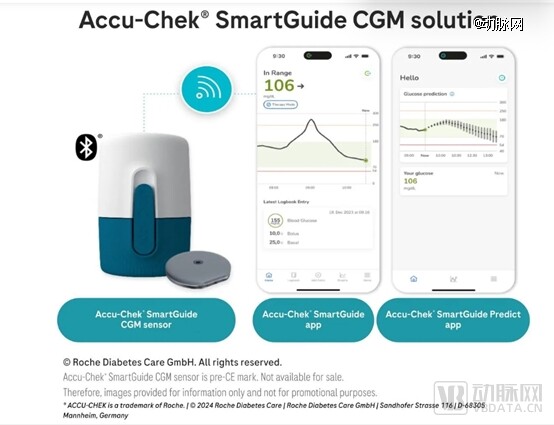
Roche Product Illustration
In the long term, another major potential advantage for Roche in competing with Abbott and Dexcom for the CGM market is its integration with insulin pumps.Roche is one of the key players in the global insulin pump market. The main competitors in this market include Medtronic, Insulet, and Roche, among others. Both Insulet and Roche offer patch insulin pumps, with Roche’s patch insulin pump having a validity period of four months, which is shorter compared to the tubing-based insulin pumps from Medtronic and Tandem. Microtech Medical, a leading company in China’s patch insulin pump sector, also follows a similar strategy of independent product development, creating a closed-loop product combination of insulin pumps and CGM to compete in the global market.
In terms of disadvantages, the shortcoming of Roche's CGM lies in the continued need for fingerstick calibration. Compared with Abbott and Dexcom products, the initial requirement to use fingertip calibration for CGM devices is considered a "drawback." J.P. Morgan analysts further informed investors, "The global market has completely moved away from fingerstick calibration, and we believe going backward is entirely unfeasible. While algorithm improvement is an important feature, it remains unclear whether consumers will be willing to pay for it."
In terms of pricing, analysts at JPMorgan Chase believe that due to the scale and sales volume of Abbott and Dexcom, Roche Diagnostics has little chance of selling its products at a lower price than Abbott and Dexcom.
In the future, Roche will need to continuously iterate its products and reduce costs through economies of scale if it wants to gain more market share in the CGM sector.
New Market Landscape in the CGM Field
In addition to Roche Diagnostics, CGM has been incorporated into the strategic plans of several giants, and existing giants have also updated their products and strategies.
The biggest product strategy change for Dexcom and Abbott is to expand the market and extend their sensor technology to a broader population.
Last week, Dexcom launched an over-the-counter product to explore a broader Type 2 diabetes market. Last week, the FDA approved the first over-the-counter CGM, Dexcom Stelo, which can be purchased and used by all adults aged 18 and above.
Dexcom CGMG7 is positioned as a high-end medical product, while Stelo is positioned as a health product. Although built on the same sensor platform, Stelo reduces medical attributes such as hypoglycemia alerts and shifts its focus to personal health monitoring, particularly for early diabetes screening. Stelo will not have the hypoglycemia alarms or software functions required by Type 1 diabetes patients.
In the past, Dexcom's CGM products were mainly used by patients with type 1 diabetes. The penetration rate of CGM products among type 1 diabetes patients exceeds 50%. It is expected that most of the future growth of CGMs in the United States will come from type 2 diabetes patients who use insulin. However, typically, insurance companies do not cover these devices for people who do not take insulin.
Abbott is also gradually penetrating Dexcom's area of expertise. In March 2023, Abbott’s FreeStyle Libre 2 and Libre 3 continuous glucose monitors can now be integrated with automated insulin delivery systems. Abbott is collaborating with insulin pump manufacturers Insulet and Tandem for the integration.
Similar to Dexcom, Abbott is also in the process of transitioning its CGM products from a medical attribute to a health attribute.
Previously, Abbott launched a wearable device called Lingo to help non-diabetic individuals track their blood sugar peaks and valleys. Based on the Libre CGM platform technology, Abbott is developing a new product line tailored for the health and wellness market. The current Lingo device can only measure blood glucose, but more monitoring functions are expected to be added in the future. At present, Abbott is working on a product that can simultaneously measure glucose and ketones to help people with diabetes avoid diabetic ketoacidosis, a serious complication where the body produces excessive ketones.
It can be seen that both Abbott and Dexcom are developing products that cover a wider population, expanding from providing care for diabetes patients to metabolic health.
Another major player, Medtronic, is also catching up.
Medtronic's diabetes business includes a complete set of solutions such as CGMS, insulin pumps, insulin pens, and data management systems, with the goal of creating a leading closed-loop artificial pancreas. However, Medtronic's sensor technology and the form factor of its tubular pumps have consistently lagged behind competitors. Coupled with regulatory issues that Medtronic has faced, its U.S. diabetes business has been declining since 2019, despite growth in international sales. Currently, it is in the process of rebooting its diabetes care business to recapture market share. The next-generation CGM Simplera system and the MiniMed 780G insulin pump are at the core of Medtronic’s diabetes strategy.
On January 8, 2024, Medtronic announced that the MiniMed 780G system, equipped with Simplera Sync, has also received CE certification. The MiniMed 780G system with Simplera Sync sensor will be available in limited quantities in spring 2024, and Medtronic will begin a phased commercial launch in Europe in summer 2024. This marks the first time Medtronic has combined its latest automated insulin pump with its latest glucose sensor.
SimpleraSync CGM received CE certification in 2023. Compared to the CGMs from Abbott and Dexcom, Medtronic has made the sensor smaller, reducing its size by 50% compared to previous sensors, but it only lasts for 7 days.
Since its launch in 2020, the MiniMed 780G system has been the most popular automated insulin delivery system in Europe. The MiniMed 780G system is Medtronic's most advanced insulin delivery system, automatically adjusting and correcting blood glucose levels every five minutes. The MiniMed 780G system, equipped with meal detection technology, can reduce post-meal hyperglycemia when users occasionally forget to administer insulin or underestimate the carbohydrate content of a snack or meal.
Chinese companies are also making efforts to upgrade their CGM products and continuously expanding their overseas strategies.
Sinocare's CGMS product "Sinocare Aikan" adopts the third-generation direct electron transfer technology, with an i3MARD value of 8.71% and an h3MARD value reaching 7.45%, meeting users' demands for high-precision blood glucose monitoring. During the Double Eleven period in 2023, 100,000 boxes were sold. Currently, Sinocare has built semi-automated and fully automated CGM production lines, and will dynamically adjust production based on the CGM product market environment and sales demand to meet market needs.
MicroTech Medical's CGM brand AiDEX, developed using proprietary technology, has obtained NMPA and CE registration certificates and has already accumulated over 200,000 users in China and overseas. The second-generation Continuous Glucose Monitoring System, AiDEX X series, has completed clinical trials in China and a registration application has been submitted. Additionally, MicroTech's closed-loop artificial pancreas system was approved to enter the National Medical Products Administration’s special review process for innovative medical devices in May 2023.
Yuwell Medical launched the 14-day calibration-free CGM product CT3 series in May 2023, which achieved outstanding performance in online channels after its launch. It is expected that related new products will be launched in 2024.
SIBIONICS Expands into Global Markets. In 2022, SIBIONICS' CGM orders generated approximately 150 million yuan in revenue, with hospital channels accounting for 30%. At the same time, SIBIONICS has intensified its efforts in overseas markets, promoting the global commercialization of its CGM products. The core product, SIBIONICS, obtained the CE MDR certification in October 2023. Distributors from nearly 20 countries have signed agreements with SIBIONICS and received market access authorization, paving the way for full-scale commercialization in these regions.
NineNuo Medical focuses on overseas markets and has established two technology research and development centers in Suzhou and London. As of January 2023, its products have expanded into more than 30 overseas countries and regions. Among them, the Glunovo® GN-I Continuous Glucose Monitoring System (CGMS) received approval from the National Medical Products Administration (NMPA) on October 26, 2021, and officially entered the Chinese domestic market for sales.
It is foreseeable that the number of participants in the diabetes care market will increase, and the gap between product features may narrow in the coming years. The competition in the global market will also intensify.
References:
Blood Glucose Monitoring CGM Industry Research: China-Based Enterprises Enter Rapid Growth Phase —— Guolian Securities
MinKang Bio Gan Jianmin: From Blood Glucose Monitoring to Health Management Closed Loop, Terminal Coverage is Key | Exclusive Interview — Yiou
2023 Xipu Conference | Li Pin of Silicon-based Bionics: Focus on Expanding the Category During the Growth Phase, the Future Market for CGM Lies in Retail Channels — Caijing.com
60x Premium "Redemption" of GLP-1 Dignity, Roche, Pfizer, AZ's "Sima Zhao's Heart" —— E Drug Manager
[This article is authorized for release by Arterial Network, a partner of Investment界. This platform only provides information storage services.] If you have any questions, please contact (editor@zero2ipo.com.cn) for Investment界 to handle.