February 2024 Global Drug Approvals: FDA Clears Novel Antibiotic Combo; Multiple Orphan Drugs Approved in China
Allecra Therapeutics
A biopharmaceutical company dedicated to developing novel therapeutic solutions to combat multidrug-resistant bacterial infections.

Hugel
Biopharmaceutical Manufacturer

CARsgen Therapeutics
Developer of CAR-T Cell Immunotherapy Drugs

Nobelpharma
Pharmaceutical and Medical Device Developers

Roche
Oncology Drug Research, Development, and Manufacturing

Takeda
Biopharmaceutical Manufacturer

Highlights
New Antibiotic Combination Approved for Marketing by U.S. FDA
Hugel's botulinum toxin product Letybo approved for marketing in the United States
CARsgen Therapeutics' BCMA CAR-T Therapy Approved for Marketing by NMPA
Multiple New Drugs for Rare Diseases Approved in China
In February 2024, the details of global new drug approvals for production and clinical trials are as follows.
Eight New Drugs
FDA Approved for Marketing
In February 2024, the FDA's Center for Drug Evaluation and Research (CDER) approved eight new drugs, including one innovative small-molecule combination, two biologics, and five new dosage forms (see Table 1).
Table 1. New Drugs Approved by the U.S. FDA in February 2024
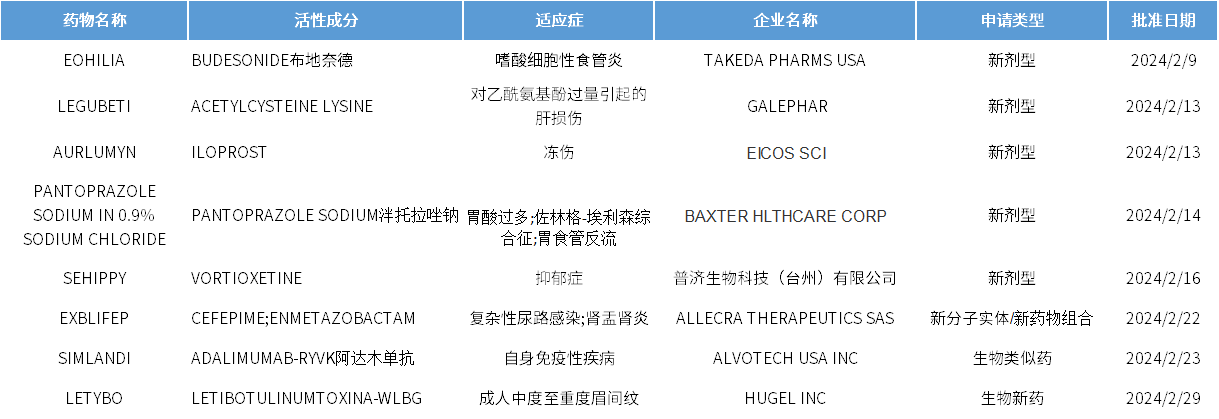
Data Source: FDA Official Website
1. EXBLIFEP
Applicant: ALLETRA
Indications: Complicated Urinary Tract Infections
On February 22, the U.S. FDA approved Allecra Therapeutics' new molecular entity drug combination Exblifep (cefepime/enmetazobactam) for the treatment of patients aged 18 years and older with complicated urinary tract infections (cUTI), including pyelonephritis.
Exblifep is a fixed-dose antibiotic combination for intravenous use, consisting of the cephalosporin antibiotic cefepime and the novel β-lactamase inhibitor enmetazobactam. This drug combination aims to combat antimicrobial resistance in Gram-negative bacteria, particularly resistance mediated by extended-spectrum β-lactamases (ESBLs). To reduce the development of resistant bacteria and maintain the effectiveness of Exblifep and other antibacterial drugs, Exblifep should be used only to treat or prevent infections that are proven or strongly suspected to be caused by susceptible bacteria.
2. LETYBO
Applicant Company: Hugel
Indications: Moderate to severe glabellar lines in adults
On February 29, the U.S. FDA approved Hugel, Inc.'s botulinum toxin product Letybo (letibotulinumtoxinA) for the treatment of moderate to severe glabellar lines in adults.
Letybo is an acetylcholine release inhibitor and neuromuscular blocker, administered via intramuscular injection, used to temporarily improve the appearance of moderate to severe glabellar lines associated with corrugator and/or procerus muscle activity in adult patients. Clinical trial results have demonstrated the efficacy and safety of Letybo in treating glabellar lines. Notably, Four Rings Pharmaceuticals is the exclusive distributor of Letybo in China, where the drug was approved for marketing in 2020. In 2022, CBC Group completed its acquisition of Hugel, and this FDA approval marks Letybo’s official entry into the U.S. market.
Eight New Drugs
NMPA Approved for Marketing
In February 2024, the National Medical Products Administration (NMPA) of China approved three domestically produced new drugs and five imported new drugs, with indications including acne, cough, multiple myeloma, and various rare diseases. For details, see Table 2.
Table 2. New Drugs Approved by NMPA in February 2024
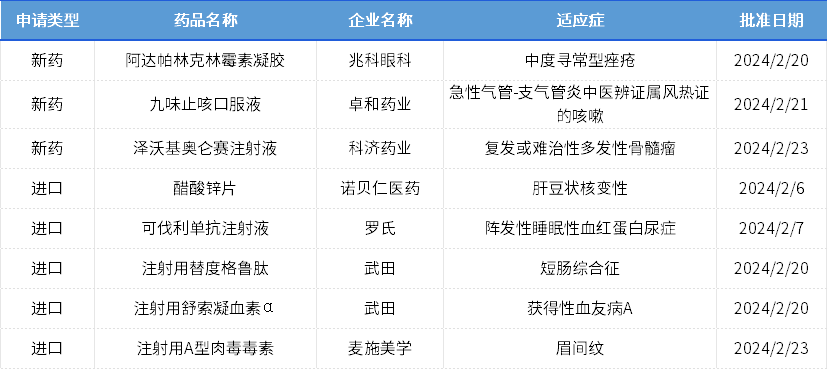
Data source: NMPA official website, PharmCube Data
1. Zevor-cel Injection
Applicant: CARsgen Therapeutics, Ltd
Indications: Multiple Myeloma
On February 23, the National Medical Products Administration approved the listing of CARsgen Therapeutics' Zevor-cel Injection (Sai Kaize) for the treatment of adult patients with relapsed or refractory multiple myeloma who have progressed after at least three prior lines of therapy (including at least one proteasome inhibitor and one immunomodulatory agent).
According to a press release from CARsgen Therapeutics, Ltd., Zevorcabtagene Autoleucel is an autologous CAR-T cell product targeting BCMA, generated through lentiviral transduction of T cells. Multiple myeloma is a refractory malignant plasma cell disease, accounting for approximately 10% of all hematologic malignancies. Under traditional treatment methods, patients with relapsed or refractory multiple myeloma have a poor prognosis and very limited treatment options. The approval of Saikaze brings new hope to patients with multiple myeloma.
In January 2023, CARsgen Therapeutics, Ltd. and Huadong Medicine reached a commercialization partnership for Theraloc in mainland China. CARsgen Therapeutics granted Huadong Medicine the exclusive commercial rights to Theraloc in mainland China.
2. Zinc Acetate Tablets
Applicant: Nobelpharma
Indications: Hepatolenticular Degeneration
On February 6, the National Medical Products Administration approved Nobelpharma's zinc acetate tablets for the treatment of Wilson's disease.
Hepatolenticular Degeneration (also known as Wilson's Disease) is a rare genetic disorder. Under normal circumstances, the liver can maintain the body's copper balance by excreting excess copper through bile. However, in patients with hepatolenticular degeneration, genetic mutations disable this biliary excretion pathway, leading to an accumulation of excessive copper in hepatocytes, eventually exceeding the body's safe storage capacity and causing cellular damage. This ultimately results in severe hepatic, neurological, and psychiatric symptoms, and can even be fatal.
Zinc Acetate Tablets, a copper absorption inhibitor, were approved for marketing in Japan in 2015 for the treatment of hypozincemia and Wilson's disease. In China, Zinc Acetate Tablets were granted priority review by the CDE in February 2023 as a "new type, formulation, or specification of pediatric medication that meets the physiological characteristics of children," intended for the treatment of hepatolenticular degeneration. This approval in China will provide a new treatment option for patients with hepatolenticular degeneration in the country.
3. Kefaliruab Injection
Applicant Company: Roche
Indications: Paroxysmal Nocturnal Hemoglobinuria
On February 7, the National Medical Products Administration approved Roche's crovalimab injection (brand name: Piasky) for marketing through the priority review and approval process. It is indicated for adult and adolescent (≥12 years old) patients with paroxysmal nocturnal hemoglobinuria who have not been treated with complement inhibitors.
Paroxysmal nocturnal hemoglobinuria is a chronic intravascular hemolysis caused by an acquired gene mutation in hematopoietic stem cells leading to a defect in blood cell membranes. It often worsens during sleep and can be accompanied by episodes of hemoglobinuria, potential bone marrow failure, and thrombosis. It has been included in the first batch of China's rare disease directory.
Covaleizumab Injection is a recombinant humanized IgG1 subtype monoclonal antibody targeting complement protein C5. It can specifically bind to complement protein C5, thereby inhibiting the cleavage of C5 into C5a and C5b, preventing the formation of the terminal complement complex C5b-9, and suppressing the immune response of the complement pathway.
According to Roche's press release, this approval of Piaoshengkai in China marks its first approval globally, offering patients a new treatment option.
4. Teduglutide for Injection
Applicant Company: Takeda
Indications: Short Bowel Syndrome
On February 20, the National Medical Products Administration approved Takeda's Teduglutide for Injection (trade name: Revestive) for the treatment of adults and pediatric patients aged 1 year and above with Short Bowel Syndrome (SBS). The product should only be used in patients who have undergone a period of intestinal adaptation and whose condition is stable while dependent on parenteral nutrition support.
Short Bowel Syndrome: A Comprehensive Overview
Teduglutide is the only globally approved glucagon-like peptide 2 (GLP-2) analog. Studies have confirmed that teduglutide can increase villus height and crypt depth, strengthen the intestinal epithelial barrier, thereby reducing local inflammation and improving intestinal permeability, and promoting intestinal adaptation.
In China, Teduglutide, leveraging the spillover effects of the CIIE (China International Import Expo), achieved the transformation from its debut at the CIIE to being used in pilot programs for patients in Boao within six months. Nine months later, it was officially approved for marketing in China, filling the gap for long-term intestinal rehabilitation treatments in the field of short bowel syndrome and providing a new therapeutic option for individuals with "short bowel."
5. Injectable Suloctidil α
Applicant: Takeda
Indications: Acquired Hemophilia A
On February 20, the National Medical Products Administration approved Takeda's Susoctocog Alfa for Injection for on-demand treatment and control of bleeding episodes in adult patients with acquired hemophilia A (AHA).
AHA refers to an acquired bleeding disorder caused by the presence of autoantibodies against coagulation factor VIII (FVIII) in circulating blood, leading to a decrease in FVIII activity. Susoctocog alfa is a recombinant porcine FVIII (rpFVIII) drug that is structurally similar and homologous in sequence to human sequence coagulation factor VIII. It is not easily inactivated by anti-human FVIII autoantibodies and can replace human FVIII to exert significant hemostatic effects, offering a promising new treatment option for patients with AHA.
86 New Drugs
Approved for Clinical Use in China
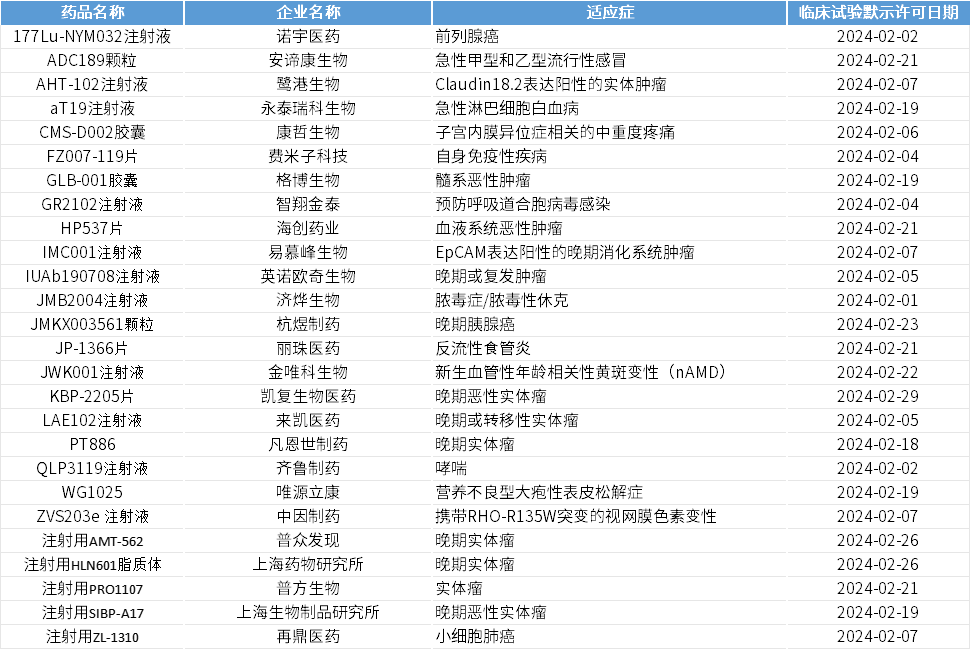
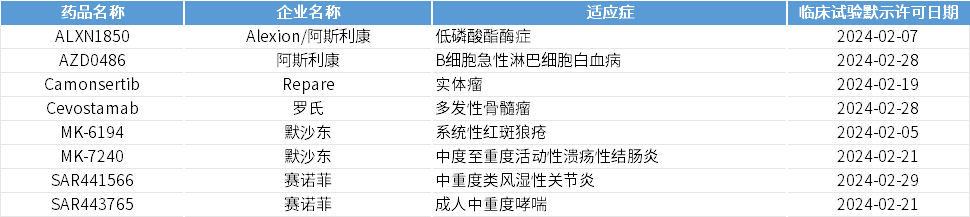
In February 2024, 86 novel Class 1 drugs received implied approval for clinical trials in China. These include various small-molecule drugs, protein degradation therapies, bispecific antibodies, antibody-drug conjugates (ADCs), cell therapies, and gene therapies. Indications cover a range of cancers, autoimmune diseases, rare diseases, RSV infections, ophthalmic diseases, gastrointestinal diseases, and more. Companies involved include domestic pharmaceutical firms such as NuYu Pharmaceutical, ZhiXiang JinTai, HaiChuang Pharmaceutical, LaiKang Pharmaceutical, FanEn Shi Pharmaceutical, Qilu Pharmaceutical, and ZaiLab, as well as multinational pharmaceutical companies like AstraZeneca, Roche, Merck, and Sanofi. Some of the new drugs receiving clinical trial approval for the first time are listed in Tables 3 and 4.
Table 3. Partial List of New Drugs Approved for Clinical Trials in China in February 2024
Data source: NMPA official website, PharmCube Data
Table 4. Imported New Drugs Approved for Clinical Trials in China in February 2024 (Partial)
Data source: NMPA official website, PharmCube Data
In March, what are the latest developments in global new drugs? Follow the Boyao WeChat Official Account for continuous updates from our editor~


Editor: Liuli
Disclaimer: This article is a reprint from PharmNet. The images and text are the property of the original author, and the purpose of the reprint is to convey more information. It does not represent the views of this platform. If there are any issues regarding the content, copyright, or other aspects, please leave a message on this platform, and we will address it promptly.