Janssen's EGFR/c-MET Bispecific Antibody Rybrevant Challenges the Therapeutic Deadlock of Third-Generation EGFR-TKI Resistance in NSCLC

Johnson & Johnson
Healthcare Product Manufacturers, Health Service Providers
Recently, Johnson & Johnson announced that the FDA has approved its EGFR/c-MET bispecific antibody Rybrevant (Amivantamab) in combination with chemotherapy (carboplatin-pemetrexed) for the first-line treatment of patients with locally advanced or metastatic non-small cell lung cancer (NSCLC) harboring epidermal growth factor receptor (EGFR) exon 20 insertion mutations. Rybrevant has also become the first targeted therapy for the first-line treatment of NSCLC patients with EGFR exon 20 insertion mutations (the third most common category of EGFR mutations).
Last year, Johnson & Johnson also submitted to the FDA Rybrevant in combination with chemotherapy for first-line treatment and for patients with EGFR-mutated NSCLC whose disease progressed during or after treatment with osimertinib. Additionally, they submitted Rybrevant in combination with their own third-generation EGFR inhibitor (EGFR-TKI) Lazertinib for first-line treatment of EGFR-mutated NSCLC patients, forming an encirclement against osimertinib.
There is no doubt that the development of EGFR-TKI has substantially moved to the next stage!
EGFR-TKI Market Is Broad and Promising
Lung cancer can be divided into small cell lung cancer (SCLC) and non-small cell lung cancer (NSCLC) based on cell morphology. NSCLC accounts for approximately 85% of cases, and its main characteristic subtypes include squamous cell carcinoma, adenocarcinoma, and large cell carcinoma. Molecular targeted therapy, known for its strong specificity and high safety, has become the preferred treatment for NSCLC.
The American Society of Clinical Oncology (ASCO) disclosed that the mutation frequency of the EGFR gene is 10%-35%, making it one of the driver genes with the highest mutation frequency in non-small cell lung cancer (NSCLC). In China, this figure is even higher, accounting for approximately 40% of NSCLC patients. According to a report by Guoxin Securities, there are about 300,000 newly diagnosed NSCLC patients with EGFR mutations in China each year. Currently, first-, second-, and third-generation EGFR-TKI drugs have been launched in China, but there remains a significant unmet clinical need. It is estimated that the total market sales of EGFR-TKIs in China will exceed 10 billion yuan.
The Third Generation of EGFR-TKIs Becomes the Mainstay in the Market
EGFR-TKI is the core treatment for EGFR-mutated NSCLC. Multiple EGFR-TKIs have become standard first-line/second-line therapies, including first-generation/second-generation EGFR-TKIs (afatinib, dacomitinib, gefitinib, erlotinib, icotinib) and third-generation EGFR-TKIs (osimertinib, almonertinib, furmonertinib, bafetinib).
Table 1 EGFR-TKI Drugs Marketed in China
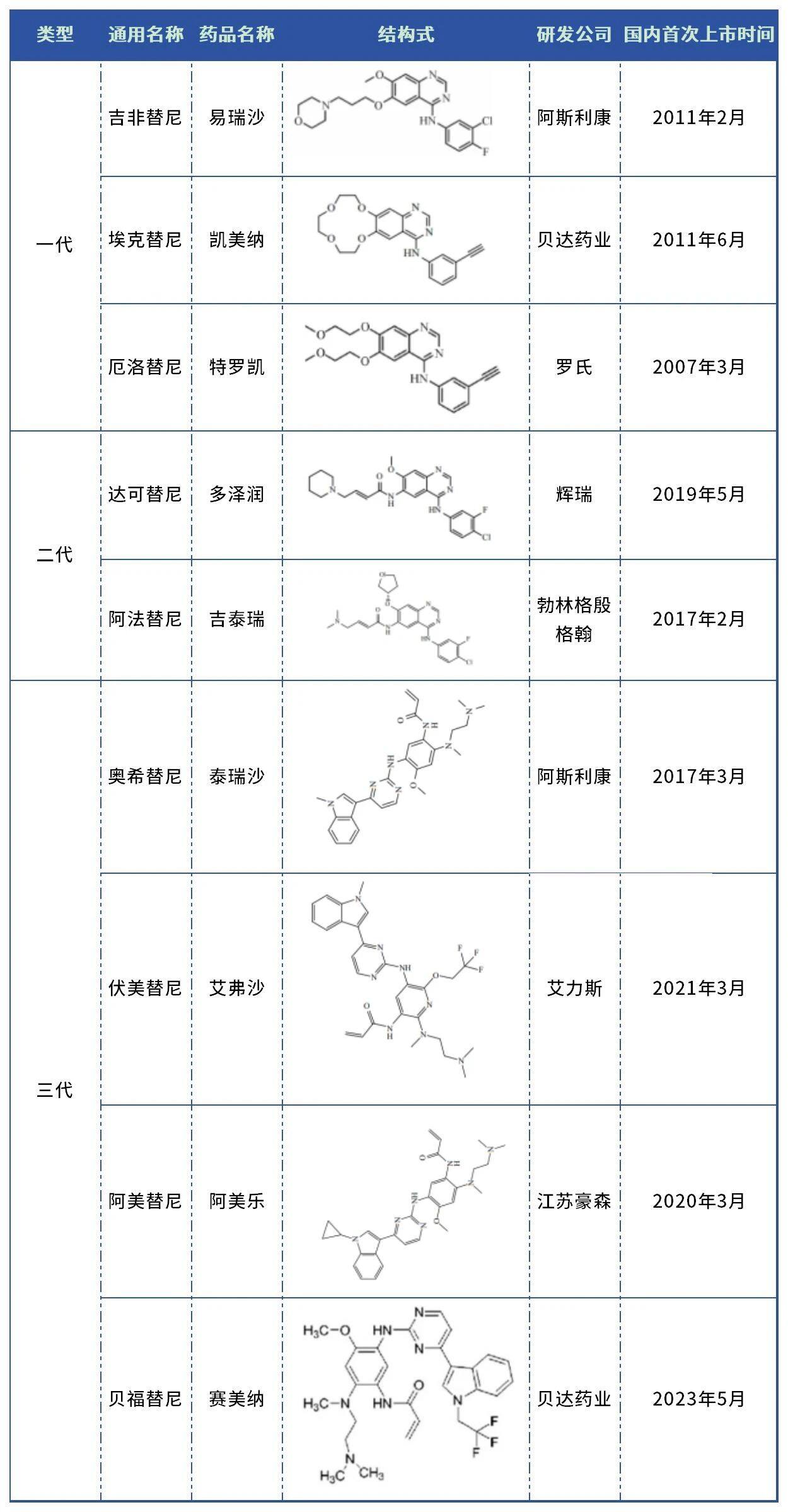
Source: PharmaGo Data
AstraZeneca's Osimertinib is undoubtedly the leader among them. According to AstraZeneca's 2023 annual report, the global sales of Osimertinib reached 5.8 billion US dollars, increasing by 7% year-on-year. In 2022, Osimertinib had the highest sales in China, reaching 4.3 billion yuan. The second was Ameitinib from Hansoh Pharma, with sales of 2.4 billion yuan in 2022. Alis' Furmonertinib ranked third with 790 million yuan. In May last year, the third domestically produced EGFR-TKI, Betta Pharma’s Befotertinib Mesylate (Camenor), was launched and included in the medical insurance in the same year it was approved. According to the annual report published by Betta Pharma, its performance in 2023 increased by 120%-154% year-on-year.
EGFR-TKI Resistance Remains an Urgent Problem to Solve
Patients generally develop resistance after receiving EGFR-TKI treatment for a period of time. Among patients who develop resistance after first-generation/second-generation EGFR-TKI treatment, 50%-60% carry the T790M mutation, which can be treated with third-generation EGFR-TKI as a second-line therapy. In the latest 2023 CSCO guidelines, Osimertinib, Aumolertinib, and Furmonertinib are also prioritized as recommendations. Compared to first-generation/second-generation EGFR-TKIs, third-generation EGFR-TKIs demonstrate advantages in PFS and OS when used as first-line treatments.
Therefore, with the availability of domestically produced EGFR-TKIs such as Aumolertinib and Furmonertinib in China, which have been included in the medical insurance, drug accessibility continues to improve. The market share of third-generation EGFR-TKIs has rapidly increased and they have now become the primary medication for patients. Patients who develop resistance to third-generation EGFR-TKIs (such as Osimertinib) lack effective treatment options, and the current standard treatment remains platinum-based doublet chemotherapy.
Drug resistance has become an urgent problem to be solved in EGFR-TKI treatment.
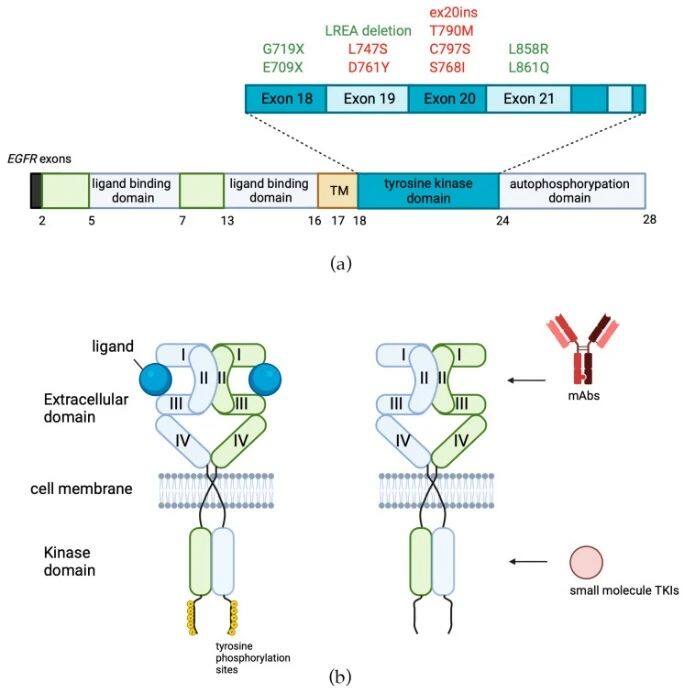
Figure 1 (a) Structure of EGFR and resistance (red) and sensitivity (green) to specific TKIs; (b) The left panel is a schematic diagram of ligand-binding dimerized EGFR. The right panel shows the inhibition of EGFR active sites by different targeted drugs (mAb: monoclonal antibody; TKIs: tyrosine kinase inhibitors).
Image source: Reference 2
EGFR is a transmembrane receptor with tyrosine kinase activity. Structurally, it consists of an extracellular domain, a hydrophobic transmembrane domain (TM domain), a juxtamembrane domain (JM domain), an intracellular protein tyrosine kinase domain that binds to ligands, and a C-terminal.
EGFR is composed of 28 exons, with exons 18 to 24 encoding the EGFR kinase domain. Mutated EGFR exhibits oncogenic activity, and mutations in the EGFR kinase domain are most commonly found in exons 18 to 21.
Exon 18 mutations account for approximately 3% to 4% of all mutation types, including point mutations such as G719X/G719A/G719S/G719C/G719D and E709X/E709A/E709G/E709K/E709V.
Exon 19 often exhibits E746-A750 deletion mutations.
Exon 20 mutation types are mainly insertion mutations, accounting for about 10% to 12% of all mutation types, with the most common ones being V769_D770insASV and D770_N771insSVD.
Exon 21 is most commonly associated with the L858R point mutation (where the leucine residue at position 858 is replaced by arginine).
Among them, the exon 19 E746-A750 deletion and exon 21 L858R mutation types are called classic sensitive mutations. Clinical studies have found that these two mutations account for about 90% of all EGFR mutation types.
The first-generation EGFR-TKI is a reversible single-target drug that specifically targets EGFR, forming a reversible bond through non-covalent interactions. It primarily binds to the ATP binding site in the tyrosine kinase domain of EGFR, affecting downstream signaling pathways. Once the drug is discontinued, ATP will rebind to this site, thereby activating downstream oncogenic signaling pathways. After approximately 10 months of taking first-generation EGFR-TKIs, drug resistance inevitably occurs. The most common mechanism of resistance is the T790M secondary mutation in exon 20, where cytosine at position 790 of exon 20 is replaced by thymidine. The T790M secondary mutation accounts for more than 60% of acquired resistance to EGFR-TKIs. The true cause of its resistance is that the mutation increases the affinity of ATP for the kinase binding site, reducing the binding efficacy of EGFR-TKIs.
The second-generation marketed EGFR-TKI is an irreversible multi-target inhibitor that can form an irreversible bond with EGFR through a covalent bond and target other ErbB family members. This irreversible binding mainly occurs via a Michael addition reaction, forming a covalent bond with the active site thiol group of the Cys residue. Compared with the first-generation reversible binding, it exhibits stronger binding ability to EGFR and can also inhibit other members of the ErbB family. Although second-generation EGFR-TKIs show significant inhibitory effects on T790M mutant EGFR, their irreversible binding can similarly inhibit wild-type EGFR. The severe side effects have also limited their clinical application. It has been reported that among NSCLC patients who develop acquired resistance after taking second-generation EGFR-TKIs, approximately half were found to have a secondary T790M mutation.
The third-generation EGFR-TKIs are also irreversible single-target inhibitors. Unlike the second generation, they possess high selectivity. The acrylamide in the EGFR-TKIs structure forms a covalent bond with the thiol group of the binding site Cys797 through Michael addition, overcoming the enhanced affinity between EGFR and ATP caused by the T790M mutation while retaining the activity of wild-type EGFR, significantly reducing toxic side effects. The side chains extending from both sides of the benzene ring of the third-generation EGFR-TKIs make their binding to proteins more stable.
As introduced above, the main resistance mechanism for first/second generation EGFR-TKIs is caused by the EGFR T790M mutation. This mutation does not prevent the drug from binding to the receptor but increases the affinity for ATP, thus leading to drug resistance.
The resistance mechanisms of third-generation EGFR-TKIs are complex. Taking osimertinib as an example, patients who develop resistance exhibit a broad range of resistance mechanisms. Resistance caused by single gene mutations or pathway activations accounts for a small proportion of the total population. Additionally, there are slight differences in the spectrum of resistance mechanisms between first-line and second-line use of osimertinib. Common resistance mechanisms include EGFR C797X mutations, MET amplification, and HER2 amplification. Notably, no clear mechanism is found in approximately 40% of resistant patients.
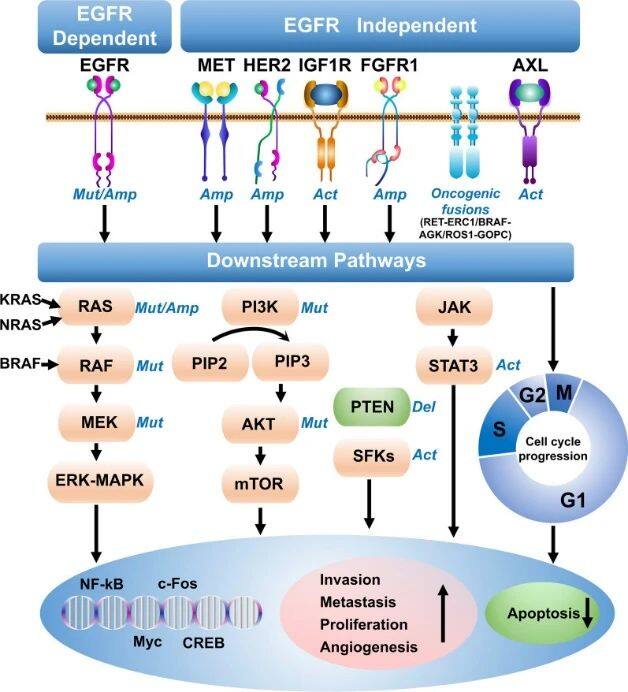
Figure 2 Mechanisms of Resistance to Third-Generation EGFR-TKIs
Image source: Reference 3
The resistance mechanisms of third-generation EGFR-TKIs can generally be divided into EGFR-dependent and non-EGFR-dependent mechanisms.
EGFR-dependent resistance mechanisms mainly include acquired EGFR mutations, the disappearance of the T790M mutation, and EGFR amplification.
Non-EGFR-dependent resistance mechanisms: including three major directions of bypass activation, downstream pathway activation, and histological transformation. Bypass activation includes MET amplification, HER2 amplification, etc.; downstream pathway activation includes RAS-MAPK pathway activation, PI3K pathway activation, cell cycle gene mutations, etc.; and histological transformation mainly refers to the transformation from small cell lung cancer to non-small cell lung cancer. Once EGFR is activated, it triggers multiple downstream signaling cascades such as the RAS-RAF-MEK-ERK pathway, PI3K/AKT signaling pathway, and JAK/STAT signal transduction pathways, thereby promoting transcriptional activation, cell proliferation, mitosis, anti-apoptosis, invasion, and metastasis.
Summary
In summary, osimertinib, as the most widely used EGFR-TKI in clinical practice, has been extensively studied for its dependency resistance mechanisms from the laboratory to the clinic. However, so far, there is no comprehensive and standardized treatment plan. We look forward to the research and development of next-generation EGFR inhibitors, immunosuppressants + chemotherapy, ADCs, and EGFR/MET bispecific antibodies (such as Johnson & Johnson's Rybrevant) with different mechanism treatment strategies. In the future, clinicians will have more solutions in their toolkit when facing NSCLC resistant to third-generation EGFR-TKIs.
References:
Advances in Epidermal Growth Factor Receptor Tyrosine Kinase Inhibitors.
Targeted Inhibitors of EGFR: Structure, Biology, Biomarkers, and Clinical Applications.
Toward the next generation EGFR inhibitors: an overview of osimertinib resistance mediated by EGFR mutations in non-small cell lung cancer.
Mechanisms of Resistance to Third-Generation EGFR-TKIs and Strategies for Combination Therapy.
Publicly available online resources such as Southwest Securities, Guoxin Securities, Beta Pharma, and Johnson & Johnson's official website.

Editor: Liuli
Disclaimer: The views expressed in this article are solely those of the author and do not represent the position of Pharma Intelligence. We welcome discussions and additional insights in the comment section; for reprints, please be sure to credit the author and source. If there are any issues related to the content, copyright, or other aspects of the article, please leave a message on this platform, and we will address it promptly.