

Pfizer Announces Positive Phase 3 Data for $43B Acquired ADC Adcetris in R/R DLBCL; Next-Gen ADC Shows DCR Up to 94.0%

Pfizer
Pharmaceutical R&D Developer

March 14, 2024
eMedClub News
Pfizer (Pfizer announcedFinishedIts antibody-drug conjugatesPositive Phase 3 Trial Data for Adcetris in Combination with Lenalidomide and Rituximab for the Treatment of Relapsed/Refractory Diffuse Large B-Cell Lymphoma (R/R DLBCL) Compared to Active Control GroupPatients receiving Adcetris combination therapy showed statistically significant and clinically meaningful improvements in overall survival (OS).。Pfizer will collaborate withFDA Discusses Related Regulatory Submissions and Announces Full Data at Upcoming Medical Conference.

ECHELON-3 is an ongoing, randomized, double-blind, multicenter Phase 3 study that enrolled 230 patients who had previously received second-line or higher therapies regardless of CD30 expression and were ineligible for stem cell transplantation or CAR-T therapy. The trial analysis showed,In addition to significant improvement in the primary endpoint OS, positive results were also observed in the key secondary endpoints PFS and ORR.The safety and tolerability of Adcetris in this trial were consistent with the results observed in R/R DLBCL patients who received Adcetris treatment in previous clinical trials.

The 6th International Summit on the Development of Novel Antibody Drugs
The Development Space for ADC Drugstarget、linker&payload
Global ADC Drug Market Investment and Cooperation Trends
Development of Antibody Drugs Targeting Claudin18.2
Construction and Application of an Innovative ADC Drug Discovery Platform
Development Strategies for Immune Cell Engager Bispecific Antibodies
Exploration of the Application of mRNA Technology in Antibody Drug Development
Clinical Challenges in Frontline Treatment Development
Clinical Pre-analysis and Quality Control Strategies for ADC Drugs
Addressing the Challenge of Light Chain Mismatch in Bispecific/Multispecific Antibodies
AI Technology Empowers Antibody Drug Discovery and Design
Advances in the Development of GPCR-Targeted Antibody Drugs

Scan the code to register,
Claim Your Free Tickets!
Hotline for cooperation:18701871600
Various rights and opportunities such as booths, speeches, and satellite meetings

Adcetris is an ADC drug, consisting of an anti-CD30 monoclonal antibody linked to the microtubule-disrupting agent MMAE via a protease-cleavable linker.According to the press release, Adcetris has been granted seven indications in the United States.Since its first approval in the United States in 2011, more than 55,000 patients have been treated in the U.S., and over 140,000 patients globally.This drug was acquired by Pfizer through its $43 billion acquisition of Seagen.
The Potential of New ADCs is Bursting Forth
eMedClub
Recently, there have been frequent transactions in the ADC track, indicating that many companies highly recognize the potential of ADC. However, the "involution" within the ADC track is also a consensus, with companies exploring the development of better candidate products to improve safety and efficacy. According to an article titled "Exploring the next generation of antibody–drug conjugatesThe article reported that there are already multiple emerging ADC models, including bispecific ADCs, conditionally activated ADCs, and dual-payload ADCs, with novel ADCs showing potential to address drug resistance and tumor heterogeneity.
Bispecific ADC
Tumor heterogeneity and drug resistance often limit the anti-tumor activity of therapies targeting a single site, leading to the development of bispecific antibodies (bispecifics) that can simultaneously bind to two different target molecules and/or cells. Bispecific ADCs, utilizing this technology as a potential approach to enhance anti-tumor efficacy, have become a hot research direction.
Bispecific ADCs can be divided into two types: those targeting different epitopes of the same antigen and those targeting different antigens.Currently, there are multiple bispecific ADC candidates, such as MEDI4276, a tetravalent HER2-targeting ADC that fuses the scFv of trastuzumab with the N-terminus of another anti-HER2 IgG1 antibody, 39S.
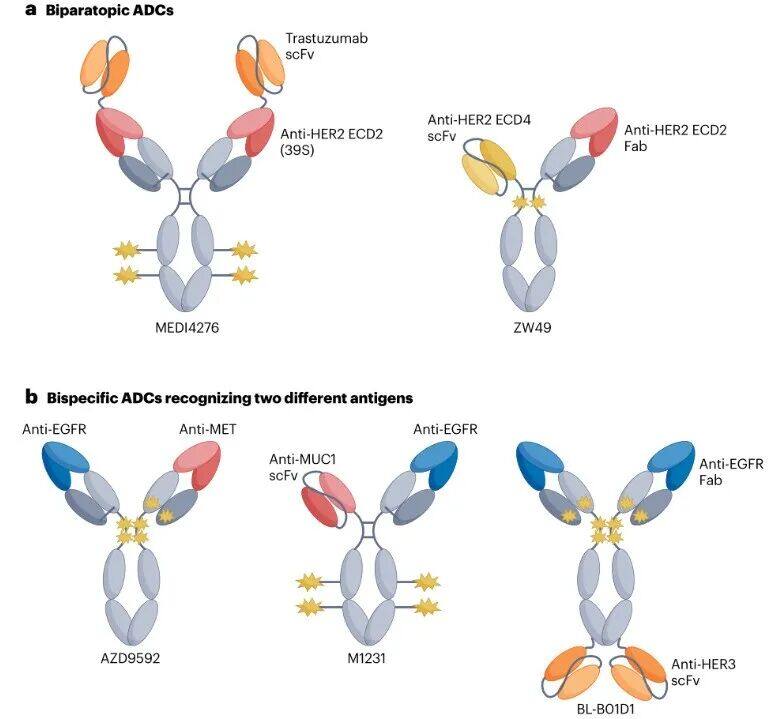
▲ Structure of each ADC (Image Source:Reference 2)
ZW49 is a bispecific ADC developed by Zymeworks, based on the parent monoclonal antibodies trastuzumab and pertuzumab, targeting the HER2 receptor. Its asymmetric structure enables bivalent HER2 binding. A disclosed dataset shows:Among 29 patients treated with ZW49, the confirmed ORR for various HER2+ advanced cancer types was 28%, with a disease control rate of 72%.。
In addition, there are ADC candidates targeting EGFR/c-Met, AZD9592, M1231 targeting MUC1/EGFR, and BL-B01D1 targeting EGFR/HER3. Reportedly, BL-B01D1 is the world's first bispecific ADC targeting EGFR and HER3 independently developed by China's Baili Pharmaceuticals. In October 2023, Baili Tianhe presented the phase 1 study results of BL-B01D1 in treating non-small cell lung cancer patients at the 2023 ESMO Congress: among 88 evaluable NSCLC patients,The median PFS for patients with EGFR mutations was 6.9 months.ORR was 63.2%, DCR was 89.5%; The median PFS for patients with wild-type EGFR was 5.2 months, with an ORR of 44.0% and a DCR of 94.0%.
Conditionally Activated ADC
Traditional ADCs target receptors expressed on both tumor cells and non-malignant tissues, leading to inevitable off-target toxicity that affects the therapeutic dose and duration. To address this issue, researchers have innovatively designed a new type of ADC featuring conditionally active antibodies – the conditionally activated ADC.
This design concept is inspired by the prodrug design of small molecules, which renders the pharmacological inactive form of the drug and then metabolizes it into its active form in circulation or certain organs, thereby enhancing in vivo stability and/or specificity. Additionally, there are ADCs with pH-responsive antigen-binding sites; the pH of the tumor microenvironment differs from that of normal tissues, and this pH difference can be utilized to activate the ADC.
Dual-Payload ADC
Solid tumors are heterogeneous with different gene expression profiles, which result in varying drug sensitivities; thus, combination therapy with multiple drugs can be employed. Based on this concept, dual-payload ADCs have the potential to act as a single agent inducing additive or synergistic effects, overcoming resistance in patients with refractory tumors while maintaining a simple dosing regimen.
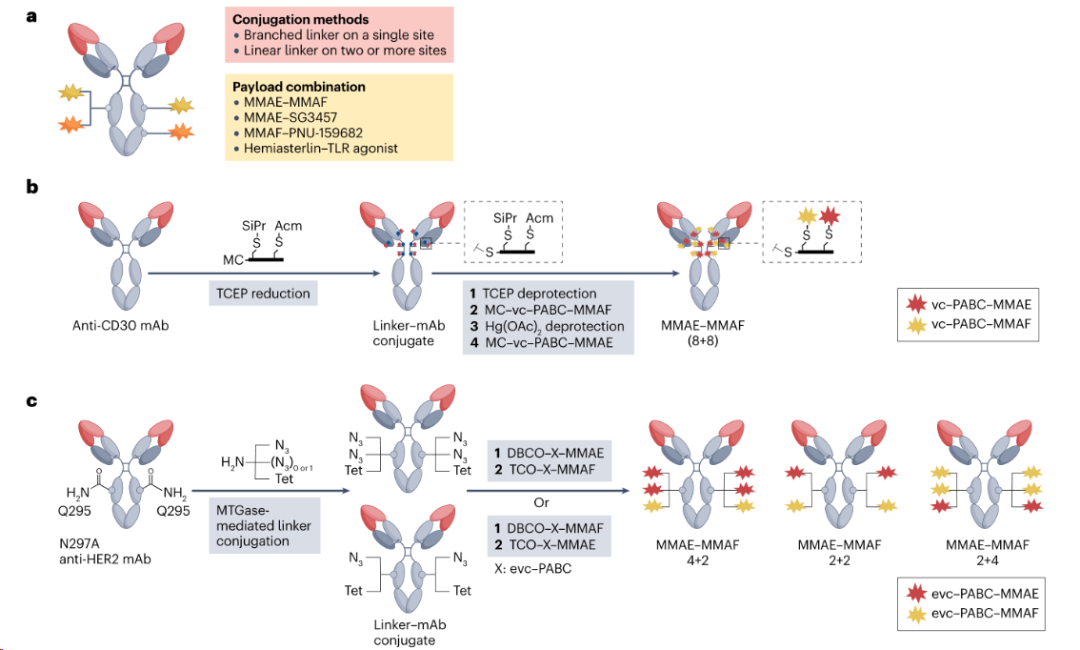
▲ Dual-payload ADC structure (Image Source:Reference 2)
Previously, a method for producing dual-payload ADCs using a branched chemical linker containing two orthogonally masked cysteine residues was reported, which enabled the uniform conjugation of MMAE and MMAF to the anti-CD30 antibody and demonstrated activity in preclinical studies.
Summary
eMedClub
ADCs themselves have a high technical threshold, and optimization is even more challenging. Therefore, the aforementioned novel ADCs are still in the preclinical or early clinical development stages. However, these explorations indicate that the future development direction of ADCs will remain highly diversified.
2.Tsuchikama K, Anami Y, Ha SYY, Yamazaki CM. Exploring the next generation of antibody-drug conjugates. Nat Rev Clin Oncol. 2024;21(3):203-223. doi:10.1038/s41571-023-00850-2


Dian Dian "Share”、“Like" and "In View", give me a little recharge~"