Bayer, Pfizer Among 36 Pharma Companies Announce Workforce Reductions

Bayer
Pharmaceutical Product R&D Developer

Pfizer
Pharmaceutical R&D Developer
1. Bayer Plans to Close Internal Consulting Department
Reduction Continues
According to reports from multiple media outlets, on March 7, a spokesperson for Bayer AG stated that the company plans to close its internal consulting department, which will result in the majority of the department's 200 employees losing their jobs.
Previously, it disclosed plans to close offices in Germany, the United States, Brazil, China, and Singapore. Bayer stated that its goal is to cut costs by 2 billion euros (2.17 billion US dollars) starting from 2026, which is approximately one-fifth of the expected operating profit for 2024.
Bayer AG's financial report for 2023 shows that the company's sales revenue was 47.637 billion euros, a year-on-year decrease of 1.2% (at constant exchange rates). Among this, the Crop Science division’s sales decreased by 3.7% to 23.27 billion euros; the Pharmaceuticals division’s sales remained flat year-on-year at 18.081 billion euros; and the Consumer Health division’s sales increased by 6.3% to reach 6.027 billion euros. Currently, Bayer has 99,723 employees, a reduction of 1,646 compared to 2022, all from marketing-related roles, with the largest decrease occurring in the Asia-Pacific region.
Bayer Group Structure
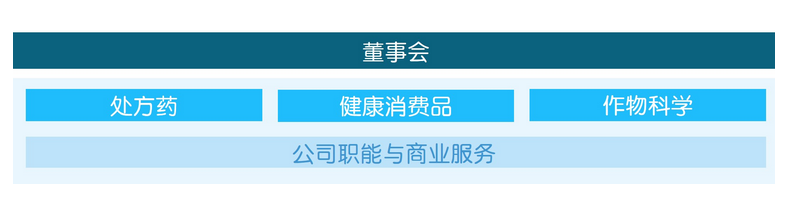
Screenshot source: Bayer China official website
Bayer's internal adjustments have been under consideration for a long time. At the beginning of this year, Bayer CEO Bill Anderson announced that a large-scale restructuring would take place in November, mainly including the elimination of several management levels and the simplification of work processes. Specific details will be announced on March 5, 2024. In addition, there is a desire to spin off the consumer health business or the agricultural division.
Earlier, after releasing its Q3 2023 financial report, Bayer indicated that it was considering spinning off and restructuring its three major business divisions—pharmaceuticals, consumer health, and crop science—and significantly reducing its workforce.
However, according to media reports at the time, the relevant industry union (IG BCE, the German Mining, Chemical and Energy Industrial Union) opposed the plan. The reasons included not only the potential unemployment of many Germans, but also concerns about Bayer becoming vulnerable after the split, possibly being acquired by other pharmaceutical companies, or even relocating its headquarters outside of Germany.
On March 5, Anderson stated regarding the potential split of Bayer, "Our answer is 'not now,' and it should not be misunderstood as 'never.'" He indicated that over the next 24 to 36 months, the focus will be on building a strong pharmaceutical pipeline, resolving litigation, reducing debt, and reforming the operational model.
Overall, Bayer's difficulties are reflected in multiple aspects, especially in its main segment, crop science. In 2016, Bayer acquired Monsanto for $66 billion; In 2018, Bayer lost the case regarding Monsanto's Roundup glyphosate causing cancer and was ordered to pay $289 million in compensation to the plaintiff, after which it has been mired in related lawsuits and claims; In June 2020, Bayer issued a statement saying it would settle approximately 125,000 related lawsuits for $10.9 billion; To this day, Bayer is still embroiled in related litigation.
2. Reasons for pharmaceutical companies reducing staff are diverse
Strategic adjustments, core pipeline clinical failures...
In the pharmaceutical field, there has been frequent news of pharmaceutical companies being acquired. Moreover, it is not uncommon for pharmaceutical companies to adjust their development by spinning off departments, closing factories, and reducing staff.
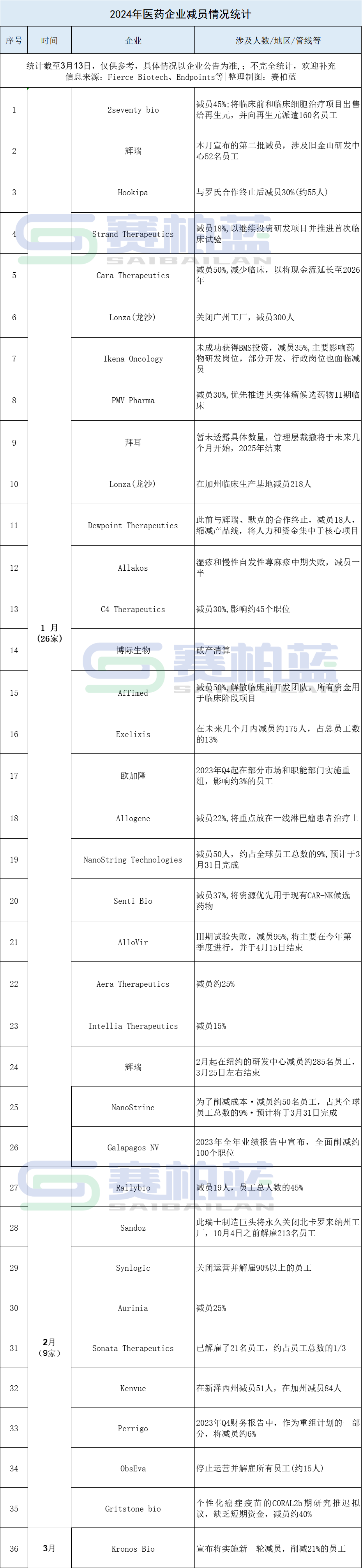
According to incomplete statistics, as of March 13, 36 companies have announced layoffs. Reasons for the layoffs include strategic adjustments, clinical failures of core pipelines, and termination of partnerships with multinational corporations (MNCs).
For example: On March 7, KronosBio, a Nasdaq-listed company, announced that it would implement a new round of layoffs, cutting 21% of its workforce. Notably, this is already its second round of layoffs in about four months, following a previous reduction of 19%. The main reason for KronosBio's decision to downsize is the lack of progress in clinical trials.
On January 29, according to the announcement by Hookipa Pharma, it received a notice from Roche deciding to terminate the joint development of the HB-700 project for treating KRAS-mutant cancers. Following this news, Hookipa decided to reduce its workforce by 30% (approximately 55 people).
"Lonza, the world's largest pharmaceutical CDMO, has announced two workforce reduction plans this year: On January 26, Lonza announced the closure of its large-molecule facility in Guangzhou and a workforce reduction of approximately 300 employees; On January 17, it announced that its clinical production base in California would reduce its workforce by 218 employees, effective February 2."
Attachment: Statistics on Workforce Reduction in Pharmaceutical Companies in 2024 (Statistics as of March 13; Incomplete Data)

Editor: Baiji
Disclaimer: This article is a reprint from Yaozhi.com. The images and text are the property of the original author, and the purpose of the reprint is to convey more information, which does not represent the views of this platform. If there are any issues regarding the content, copyright, or other aspects, please leave a message on this platform, and we will address it promptly.。