Enhertu Shows Impressive Efficacy in HER2-Low Breast Cancer but Rejected by NICE Over Cost-Effectiveness Concerns

Daiichi-Sankyo
Pharmaceutical R&D Developer

AstraZeneca
Biopharmaceutical Manufacturer

Recently, in the National Institute for Health and Care Excellence (NICE) releasedHER2-Low Breast CancerThe final draft of the guidelines rejected the recommendation to use AstraZeneca/Daiichi Sankyo's HER2-ADC drug Enhertu.
Failed to reach a consensus in price negotiations
Enhertu inIt was approved for the first time in the UK in February 2021, with a marked price of approximately £1,455 (100mg per vial) in the country. Compared to other treatment options, NICE considers it less cost-effective.Since December of last year,NHSAlsoHas always beenWith the company regarding the drugProceedPrice Negotiation,However, the two parties failed to reach a consensus.
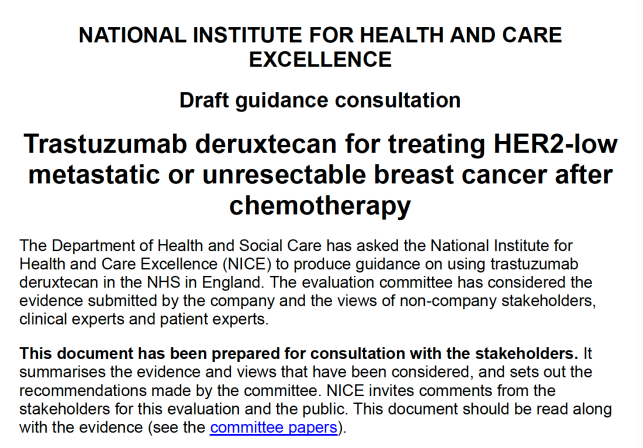
In fact, in September last year, the draft guidance consultation document issued by NICE already indicated refusal to recommend Enhertu for the treatment of inoperableFor or metastatic HER2-low breast cancer.NICE acknowledged the clinical benefits of Enhertu in this population, but its cost-effectiveness exceeds the range acceptable to the NHS.
Does Not Support the Independent Subtyping of HER2-Low
Traditionally, the diagnosis and treatment of HER2 breast cancer have been dichotomized into "either positive or negative."HER2Overexpression (IHC 3+) or amplification (ISH positive) is determined as HER2-positive breast cancer, and the absence of the above changes is HER2-negative breast cancer.The emergence of HER2-targeted drugs has significantlyImprovedHER2-Positive Breast CancerThe patient's prognosis.Such drugs have shown minimal efficacy in breast cancer patients with low HER2 expression. Therefore, in clinical guidelines, breast cancer with low HER2 expression is categorized asHER2-negative breast cancer, one typeAdopt the diagnostic and treatment standards for HER2-negative breast cancer.
However, HER2-negativeBreast CancerThe therapeutic effect of treatment regimens on this population is also less than satisfactory, and a large number of related studies have found that HER2-low breast cancer shows distinct differences in biological characteristics, response to therapeutic drugs, and prognosis compared to HER2-negative breast cancer.
In June 2022, the first Phase III clinical trial DESTINY-Breast04 for HER2-low breast cancer achieved positive results. Compared with chemotherapy, Enhertu significantly improved progression-free survival and overall survival in these patients. Enhertu was subsequently approved by the FDA, becoming the first targeted therapy for HER2-low breast cancer. This was followed by "HER2 low expression."Breast Cancer"The popularity of the concept of being classified as an independent HER2 breast cancer subtype."
However, there is still considerable controversy over whether HER2-low breast cancer should be classified as an independent subtype.
NICE Committee Considers HER2-Low as Only a Subtype of Previously HER2-Negative Breast Cancer and Recommends Treatment According to HER2-Negative Regimen.
ASCO/CAPBreast CancerHER2 Testing Guidelines
2023 Edition of ASCO/CAPHER2In the updated testing guidelines, it continues to adopt2018HER2Testing Recommendation,That is, the dichotomy of "either positive or negative,"Not recommended inHER2Introduction in the test report”HER2-Low"ThisReport Terminology.The ASCO/CAP guidelines state that the existing body of research evidence is insufficient to support modifying the HER2 classification conclusions.It is still too early to establish new HER2 breast cancer subtypes (such as HER2 low expression, HER2 ultra-low expression).
ESMO HER2-Low Breast CancerConsensus on Diagnosis and Treatment
Moreover, in the 2023 ESMO HER2-low breast cancer diagnosis and treatment consensus, although definitions for HER2-low, ultra-low, and non-expression are provided, their use in pathology reports is not recommended.
Expert consensus points out that there are no significant molecular characteristic differences between HER2-low and HER2-zero expression tumors. HER2-low expression should not be regarded as an independent molecular subtype but rather as a group of heterogeneous tumors, with their biological characteristics mainly depending on the expression level of HR (hormone receptor). Pathologists should maintain consistent nomenclature with the 2018 ASCO/CAP HER2 testing guidelines when reporting HER2 test results. In terms of prognosis, relevant studies have also not found significant survival differences between HER2-low and HER2-zero expression breast cancers.
Although there is still some controversy over whether HER2-low breast cancer should be considered an independent HER2 breast cancer subtype, the clinical benefits brought by Enhertu to this patient population have not been denied. Enhertu as a treatment for HER2-low breast cancer has been recommended by guidelines from the American Society of Clinical Oncology (ASCO), the National Comprehensive Cancer Network (NCCN), and the European Society for Medical Oncology (ESMO).




Recommended Articles of the Week
Reprint please contact BioValley and indicate the source clearly.