

Novartis Secures Approval for €2.7 Billion Acquisition of MorphoSys, Gaining Lead BET Inhibitor Pelabresib

MorphoSys
Biopharmaceutical Manufacturer

Novartis
Drug Development and Manufacturing
Germany's antitrust authority, the Federal Cartel Office, issued a statement on March 12, 2024, approving the acquisition of German biotech company MorphoSys by Swiss pharmaceutical giant Novartis.
On February 5, 2024, Novartis announced that it would acquire MorphoSys for €68 per share or a total of €2.7 billion (approximately 21.2 billion RMB) in cash. Once the transaction is completed, it will be the largest acquisition in the German biotech industry, causing quite a stir at the moment.
However, before the German antitrust authority, the Federal Cartel Office, made its decision, this transaction case caused quite a few misunderstandings in the industry: First, Novartis backed out, abandoned the acquisition, and chose to pay a small "breakup fee," because MorphoSys's drug MOR106 for treating atopic dermatitis under research did not meet the primary endpoint in clinical trials; In addition, after the acquisition news was announced, MorphoSys's stock price fell by more than 15% to 61 euros, which is only about half of the highest point in early 2020.
However, all kinds of doubts and concerns have now vanished with the statement from Germany's antitrust authority, the Federal Cartel Office. According to the statement, the acquisition is subject to customary closing conditions, including the acceptance threshold of at least 65% of the outstanding shares in the offer and regulatory approvals. The acquisition will further expand and complement Novartis' product portfolio in the priority therapeutic area of oncology and strengthen Novartis' global presence in hematology.
Pelabresib: The Novel Anti-Cancer Drug That Has Changed Hands Twice but Remains Unshaken
The focus of Novartis' acquisition this time is clearly Pelabresib — currently the fastest-progressing BET inhibitor globally.
However, Pelabresib was not originally a self-developed product by MorphoSys. Instead, it was acquired through MorphoSys’s $1.7 billion acquisition of U.S.-based Constellation Pharmaceuticals in 2021. The latter is a clinical-stage biopharmaceutical company dedicated to developing new therapies to address the significant unmet medical needs of cancer patients with abnormal gene expression or drug resistance. This acquisition means that MorphoSys will gain two innovative anti-cancer therapies currently in the mid-to-late stages of clinical development.
Constellation has a unique anti-cancer strategy, which is to change the expression level of genes by regulating the structure of cell DNA "packaging". Many companies have attempted to use this method to develop anti-cancer drugs.
One of the key investigational candidates is Pelabresib, a potential "first-in-class" targeted therapy that targets BET proteins, which are epigenetic modifier readers. At that time, it was undergoing Phase III clinical trials for myelofibrosis in myeloma cancer. Notably, Pelabresib has already demonstrated positive efficacy in Phase II clinical trials for treating myelofibrosis patients. When used in combination with the JAK inhibitor ruxolitinib in patients who had not previously received JAK inhibitor treatment, it reduced spleen volume by more than 35% in 67% of patients.
It can be said that Pelabresib is the embodiment of Constellation's unique anti-cancer strategy, which is to change the expression level of genes by regulating the structure of cell DNA "packaging."
In early March 2023, less than two years after its high-profile acquisition project, MorphoSys dropped another bombshell: halting all work and operations on preclinical research projects to optimize its cost structure. The company stated that although the data from these preclinical projects were promising, significant investment would be required to advance them into clinical stages. At the same time, the headquarters in Planegg, Germany, cut 17% of its workforce so that MorphoSys could focus its resources on its mid-to-late-stage oncology pipeline. Following the announcement, MorphoSys' stock price plummeted by more than 15%.
MorphoSys is well-known as a drug discovery partner for large pharmaceutical companies, having struck deals with manufacturers including Boehringer Ingelheim, GlaxoSmithKline, Johnson & Johnson, Novartis, Pfizer, and Roche. The company has established a research and development pipeline of over 110 projects with its global partners, approximately a quarter of which are still in clinical development, primarily targeting the fields of oncology and immuno-inflammatory diseases with significant unmet needs.
The remaining pipeline includes three projects: the marketed CD19 antibody MOR208, and two drugs still under development — Pelabresib, a BET inhibitor currently in Phase III clinical trials, and Tulmimetostat, a dual EZH1/2 protein inhibitor in Phase I/II clinical trials.
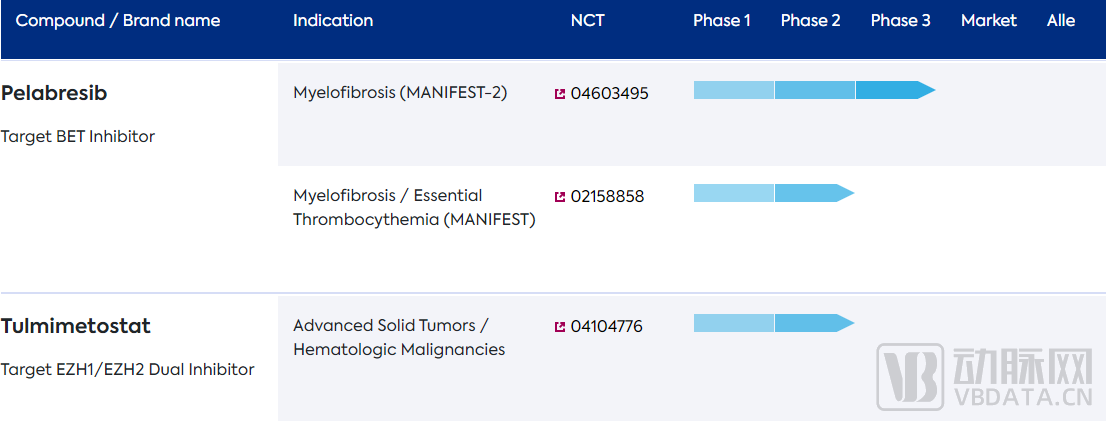
Just hours before the announcement of Novartis' acquisition, MorphoSys transferred all rights to its marketed drug, the CD19 monoclonal antibody, to Incyte. Of the remaining two pipeline projects, Novartis set its sights on Pelabresib, which has already advanced to Phase III.
Novartis Seizes the Initiative
Interestingly, Incyte, who stepped in just hours before the acquisition was announced, is also quite notable. Judging solely from MorphoSys' move to transfer the rights of the CD19 monoclonal antibody, Incyte might have been one of the companies interested in acquiring MorphoSys, but ultimately Novartis took the lead in this deal.
In the field of myelofibrosis, where Novartis and Incyte are competing, the rivalry has never stopped.
Myelofibrosis is caused by abnormal proliferation of bone marrow stem cells, with 55% of patients having the JAK2 V617F mutation. The main symptoms include anemia, shortness of breath or fatigue, increased frequency of infections, easy bleeding or bruising, extramedullary hematopoiesis, hepatomegaly or splenomegaly, and bone pain.
Hydroxyurea, oral alkylating agents, splenectomy and other treatment methods have limited efficacy and relatively high safety risks. Currently, the first-line treatment for myelofibrosis is mainly Ruxolitinib tablets (Jakavi), also known as Ruxolitinib. Ruxolitinib can significantly reduce splenomegaly and improve fibrosis-related symptoms, but it has the side effect of causing anemia, with a response rate of only 40%.
For years, Novartis' drug Ruxolitinib, approved in 2012, has been the only first-line treatment for this indication. However, about half of myelofibrosis patients who benefit from Ruxolitinib develop resistance to the drug after two to five years. Last year, Novartis achieved $1.72 billion in sales from Ruxolitinib, representing a 10% year-on-year increase.
Meanwhile, Incyte's sales revenue in the United States is expected to reach $2.6 billion.
From this perspective, it may not be difficult to understand the significance of Novartis' acquisition this time. First, MorphoSys identified the shortcomings in the treatment of myelofibrosis with Ruxolitinib tablets and placed a bet on the new drug Pelabresib, believing that it could generate more sales. For Novartis, in order to maintain its market share in the myelofibrosis market, acquiring a potential star product has become a strategic priority.
MorphoSys' CEO once mentioned that the company's top priority is to advance the MANIFEST-2 Phase III study of BET inhibitor Pelabresib in combination with Ruxolitinib for the treatment of newly diagnosed myelofibrosis patients. On November 20, 2023, MorphoSys announced that the MANIFEST-2 study had met its primary endpoint, and based on the results of this study, the company plans to submit marketing applications to the FDA and EMA in mid-2024.
The MANIFEST-2 study is a global, randomized, double-blind, active drug-controlled clinical trial that enrolled 430 adult patients with myelofibrosis who had not received prior JAK inhibitor treatment. It evaluated the efficacy and safety of Pelabresib combined with ruxolitinib or placebo combined with ruxolitinib in this patient population. The primary endpoint was the proportion of patients achieving a 35% or greater reduction in spleen volume from baseline at week 24 (SVR35).
The results showed that, compared with the ruxolitinib monotherapy group, a higher proportion of patients in the Pelabresib group achieved SVR35 (66% vs. 35%), which was statistically significant (p<0.001) and clinically meaningful.
Notably, the anemia symptoms of patients with myelofibrosis also improved. Compared to the ruxolitinib group, a higher proportion of patients in the pelabresib group achieved an increase in hemoglobin levels of at least 1.5 g/dL from baseline.
In addition, the combination of Pelabresib and Ruxolitinib demonstrated a favorable safety profile, consistent with previous studies, with no new safety signals observed. Importantly, the incidence of anemia adverse events reported in the Pelabresib group was lower compared to the Ruxolitinib group.
Ruxolitinib combined with BETi has demonstrated therapeutic potential and may hopefully become a first-line treatment for myelofibrosis in the future. The pipeline that MorphoSys once had to preserve at the expense of its preclinical team has now been incorporated into Novartis' development strategy, but whether this decision will ultimately have a positive impact remains to be validated in a few years.