

AstraZeneca to Acquire Amolyt Pharma for Up to $1.05 Billion to Strengthen Rare Disease Pipeline
Amolyt Pharma
Innovative Therapeutic Peptide Developer

AstraZeneca
Biopharmaceutical Manufacturer
On March 14, AstraZeneca announced that it had entered into a definitive agreement to acquire Amolyt Pharma (hereinafter referred to as Amolyt), an innovative peptide therapeutics developer. According to the terms of the agreement, AstraZeneca will acquire all issued shares of Amolyt on a “cash and debt free” basis for a total consideration of up to $1.05 billion (approximately 7.5 billion RMB). This includes an upfront payment of $800 million and an additional $250 million payable to shareholders upon achieving specific regulatory milestones.
In addition, the terms of the agreement state that the transaction is expected to be completed by the end of the third quarter of 2024, subject to the satisfaction of customary closing conditions set forth in the acquisition agreement (including regulatory approvals).
AstraZeneca stated that this acquisition will strengthen its Boston-based business unit, "Alexion-AstraZeneca Rare Disease Division," and enhance the existing rare disease pipeline. The latter was established based on the original rare disease giant Alexion (also translated as Alexion Pharmaceuticals), which AstraZeneca acquired for a staggering $39 billion in 2020. This deal became the largest acquisition globally that year, making headlines at the time.
The conclusion of this bold acquisition project also marks AstraZeneca's strong entry into the rare disease drug field. Rare diseases represent a high-growth, rapidly innovating therapeutic area with significant unmet medical needs, viewed by AstraZeneca as a major growth opportunity.
By contrast, Amolyt Pharma, which has just completed a $138 million Series C financing round, may not yet match the giants' prestige, but its flagship product is not to be underestimated.
Flagship product Eneboparatide, starting with the rare disease with the broadest market prospects
Currently, Amolyt is developing a treatment for hypoparathyroidism, one of the largest known patient populations among rare diseases.
Hypoparathyroidism (HP) is a rare endocrine disorder characterized by insufficient levels of parathyroid hormone (PTH), leading to decreased calcium levels and increased phosphate levels in the blood. Meanwhile, in Europe and the United States, despite being classified as a rare disease, it has an exceptionally large patient population, making it one of the most widespread rare diseases. It is estimated that there are approximately 115,000 patients in the United States and around 107,000 in Europe, with about 80% of the patients being female.
Most patients develop the disease after their parathyroid glands are injured or accidentally removed during thyroid surgery. Conventional treatments with calcium supplements and active vitamin D do not effectively address the short-term symptoms, long-term complications, or impacts on quality of life caused by hypoparathyroidism, and there is currently no alternative treatment available to restore physiological hormone levels.
Targeting this unmet market, Amolyt has launched its flagship product Eneboparatide (AZP-3601), a long-acting PTH1 receptor agonist and a parathyroid hormone (PTH) analog, which is currently in Phase III clinical development.
Eneboparatide can continuously increase serum calcium and effectively control serum calcium and clinical symptoms by binding to the R0 conformation of the PTH receptor:
1. Safely produce a sustained and stable level of calcium in the blood to effectively address symptoms while counteracting the effects of oral calcium and active vitamin D supplements;
2. Enable normal excretion of urinary calcium to prevent kidney diseases;
3. High bone turnover state improves to reach a bone balance state, while preventing the rate of bone resorption from exceeding the rate of bone formation, to help maintain the integrity of the human skeleton.
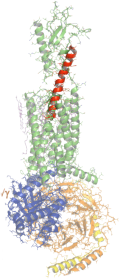
Eneboparatide (red) binds to the PTH1 receptor
In the disclosed Phase II clinical results of Eneboparatide, better outcomes have already been shown:
In animal models, Eneboparatide has demonstrated optimal pharmacological properties: long-term increase in serum calcium (sCa) and reduction in urinary calcium (uCa). In healthy subjects, a single subcutaneous injection of 40 µg and 60 µg of Eneboparatide induced a rapid increase in serum calcium levels lasting over 24 hours, with a terminal half-life of less than 1 hour and prolonged intracellular signaling.
In addition, during the 14-day treatment period, a daily dose of 20 µg of Eneboparatide administered to subjects helped achieve stable serum calcium levels. Furthermore, no increase in urinary calcium excretion was observed after 14 days of administration, and there were no changes in bone biomarkers. The long-term pharmacological effects of Eneboparatide on calcium metabolism are expected to translate into control of serum calcium levels independent of conventional therapy, reduction in urinary calcium excretion, and better symptom management for patients with hypoparathyroidism.
In addition, Eneboparatide was well-tolerated, with daily administration allowing 93% of patients to discontinue standard-of-care therapy (calcium and vitamin D supplements) while maintaining mean serum calcium within the target range. Meanwhile, even patients with reduced bone mass were able to maintain stable bone mineral density (BMD).
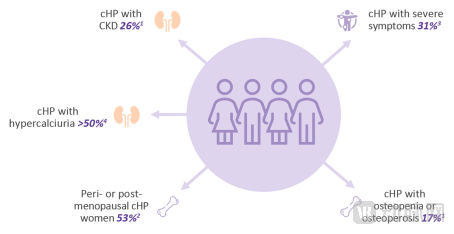
From the Amolyt official website
AZP-3813, a peptide growth hormone receptor antagonist, can be used to treat acromegaly.
According to Marc Dunoyer, CEO of Alexion, AstraZeneca's rare disease unit, patients with chronic hypoparathyroidism urgently need alternative therapies to address hormone deficiency. As the former rare disease giant, Alexion has a unique advantage in advancing the late-stage development and global commercialization of Enboparatide. This acquisition also further supports AstraZeneca’s growth in the field of rare endocrine disorders.
AstraZeneca: Expanding Rare Disease Layout
In the rare disease field, AstraZeneca mainly focuses on the development of drugs related to its subsidiary, Alexion. Alexion has maintained a leading position in the rare disease sector for over 30 years. In the first half of 2023, Alexion's rare disease business generated $3.919 billion in revenue for AstraZeneca, representing a year-on-year increase of 12%.
Thanks to Alexion's over 30 years of leadership in the rare disease field, as of the end of 2023, AstraZeneca has received approval for 7 indications across 5 innovative rare disease drugs globally, including Eculizumab, Ravulizumab, Strensiq (asfotase alfa), Kanuma (sebelipase alfa), and Koselugo. The global rare disease R&D pipeline is robust, with over 20 projects and 11 new molecular entities.
In recent years, AstraZeneca has continued to increase its investment and layout in the rare disease field. The 2023 financial report shows that AstraZeneca's global rare disease business has reached 7.764 billion US dollars, becoming the third largest business pillar.
At the same time, AstraZeneca continues to expand its rare disease business in China. On September 1, 2023, Koselugo (selumetinib sulfate capsules), the first innovative drug in the field of neurofibromatosis, was officially launched in China. This marks another significant step by AstraZeneca in strengthening its presence in the rare disease treatment sector. A year earlier, AstraZeneca showcased its first rare disease drug in the Chinese market, Sulrisib. This means that AstraZeneca now has two rare disease drugs approved in China, covering five indications.
Even so, according to the "Comprehensive Report on Rare Diseases," the global "orphan drug" (generally referring to drugs used for the prevention, treatment, and diagnosis of rare diseases) market is expected to reach $110 billion by 2025; there are more than 10,000 known rare diseases worldwide, but only 5% of them have treatment options. With a broad market outlook and such substantial unmet needs, AstraZeneca's acquisition this time can be considered as an important step in a long journey.