

From Brain-Computer Interfaces to Neuromodulation: The Entrepreneurial Journey of a Neuroscientist

NeurPlus
Precision EEG Measurement and Intelligent Wearable Medical Device Developer

From the microscopic activities of neurons to the macroscopic behaviors of cognition, brain science explores one of the most mysterious and complex fields of human study. In this process, researchers, doctors, and entrepreneurs play crucial roles. Not only are they committed to unraveling the mysteries of the brain, but they also transform scientific findings into practical applications, driving progress and development in the field of brain science.
In order to gain a deeper understanding of scientific research innovation, transformation, clinical applications, and prospects in the field of brain science, as well as entrepreneurial trends and development bottlenecks within the industry, Orange Bureau has planned the "Brain Talk Relay" series of interviews. Through conversations with researchers, doctors, and entrepreneurs, we hope to present a comprehensive and in-depth view of the world of brain science, allowing more people to understand the latest advancements and future trends in this field.
This Issue's "Brain Talk Relay"The expert is Pengfei Wei, researcher at the Shenzhen Institute of Advanced Technology, Chinese Academy of Sciences, and founder of NeurPlus. He will present“Brain Functional Connectivity Atlas ProjectAndNon-invasiveBrain-Computer InterfaceResearch Story.
As his finger pressed the switch, everyone present held their breath and stared intently, observing every move of the mouse in the cage. With the operation of the device equipped with optogenetic technology, the neural pathways of the mouse were quickly shut down. Faced with a natural predator, the mouse showed no trace of fear, calmly continuing to groom its fur.
At that moment, cheers of excitement erupted in the lab, with Wei Pengfei's voice mingling in. In 2013, Wei Pengfei, then a doctoral student, conducted pioneering research on modulating animal behavior through precise neural stimulation.At this moment, he began to realize that there is a very delicate correspondence between brain nerves and behavior, and this connection could potentially become the basis for applying brain-computer interfaces to treat brain diseases.
Two years later, the team led by Weipeng Fei and five other teams jointly completed the research, publishing it in *Nature Communications* under the title "Processing of visually-evoked innate fear by a non-canonical thalamic pathway."
This study confirms for the first time that a highly conserved subcortical neural pathway in the brain regulates primitive instinctive fear behavior in animals.Provided the most direct experimental evidence for the controversial hypothesis in the neuroscience community regarding the existence of subcortical neural pathways, drawing widespread international attention.
 Screenshot of the paper (Source: Nature Communications)
Eight years have passed, and Wei Pengfei, the main participant of the project at that time, recalled this research experience once again with VCBeat. He also shared his mental journey of transitioning from a researcher to an entrepreneur.
1. Transferred from Engineering to Biology to Study Brain-Computer Interfaces
Strictly speaking, understanding complex neural circuits and networks falls within the realm of biology, yet Wei Pengfei, who engages in this research, is without a doubt an engineering man.
Back in 2006, Pengfei Wei was admitted to the Biomedical Engineering program at Xi'an Jiaotong University for his master's studies. The field of biomedical engineering encompasses many "highly promising" areas of research. Choosing a popular specialization and then working in R&D at medical device companies after graduation has become a common career plan among many fellow students.
Wei Pengfei, however, insisted on choosing the then-unnoticed direction of brain-computer interfaces: "I once read a study where someone abroad developed an external device that could 'control' the brain's thoughts, just like in science fiction movies. I was very curious." It was this curiosity that led him down the path of brain research.And became one of the first researchers in China to study brain-computer interfaces.
In 2008, Pengfei Wei came to the Neural Engineering Research Center of Shenzhen Institutes of Advanced Technology. Under the guidance of Professor Bin He, his American mentor, he participated in the design of a brain-computer interface device. Eventually, this brain-computer interface achieved the ability to drive and control mouse cursors or virtual hands by collecting brain electrical signals during imagined movements.
In the research, Pengfei Wei found that it takes a long time for people to learn to control brain-computer interface systems through EEG. He became interested in a novel transcranial electrical stimulation neuromodulation technology that could potentially accelerate this process by activating the brain in reverse.He was the first to validate that neural modulation can effectively accelerate brain-computer interface learning — this is almost the first prototype device in China that integrates a brain-computer interface with neural modulation.
But regrettably, this breakthrough did not draw attention to brain-computer interface research and was still overlooked by mainstream research.
In the research of brain-computer interfaces, Wei Pengfei also experienced hesitation. In his view, this is a highly promising research direction, but for some reason, the public was not optimistic. As the research gradually deepened, he came to realize that at that time, the study of brain-computer interfaces only focused on algorithm-level design. We know very little about how the brain generates brain-control signals and how to effectively modulate these signals. True breakthroughs require a sufficient understanding of the brain, but there is still so much about the brain that remains unknown.
Therefore, Wei Pengfei decided to re-study the brain from a biological perspective.He started as a visiting student and later became one of Professor Wang Liping's first doctoral students during his Ph.D. due to his outstanding performance. Professor Wang Liping is one of the founding figures of optogenetics technology. Under Professor Wang’s guidance, Wei Pengfei began researching neuroscience starting with optogenetics technology, successfully making a cross-disciplinary transition from engineering to natural science.
2. Participated in the Brain Functional Connectivity Mapping Project during the Ph.D. stage
In 2012, as the importance of brain science became increasingly prominent, the Chinese Academy of Sciences (CAS) launched a strategic priority project —Brain Functional Connectivity Atlas Project(hereinafter referred to as the "Atlas Plan"), which was the predecessor of the later "China Brain Project." Pengfei Wei, then a Ph.D. student, also participated under the guidance of Professor Liping Wang.
Wang Liping's team includes professionals in various fields such as neurobiology, bioengineering, electronic information, and artificial intelligence, possessing strong engineering capabilities. Therefore, in this major project, the team is primarily responsible for the development of cutting-edge technologies.
Over a period of three years, the team developed and improved based on optogenetic technology.Multi-brain Region, High-throughput In Vivo Neuroelectrophysiology, Artificial Intelligence Neurobehavioral AnalysisAnd many other technologies. Thanks to these technologies, researchers in China have conducted numerous studies to deeply understand the operating mechanisms of brain neural circuits, achieved a series of breakthroughs, and laid an important foundation for the subsequent launch of the China Brain Project.
Wei Pengfei said: "When the brain executes specific functions, different frequency oscillation activities occur between neural networks. This is an important means of communication, also known as brain rhythms. These rhythmic activities are the main data source for brain-computer interface control signals. Optogenetics technology provides us with a brand-new tool that can precisely control these rhythmic activities, thereby accurately regulating behavior."
In the past decade, the advancement of a series of domestic and international brain science research initiatives represented by the "Brain Atlas Project," the deepened understanding of the functional aspects of brain neural circuits by researchers, and the development of a range of revolutionary neural activity recording and modulation technologies have created conditions for the renewed takeoff and rapid development of brain-computer interface technology.
Wei Pengfei explained:"Previously, the signal targets for brain-computer interfaces were identified by painstakingly searching for locations one by one. Now, with a clear map, research can precisely target specific areas, which is expected to greatly improve the accuracy and efficiency of brain-computer interfaces."
After the completion of the "Atlas Project," Wei Pengfei also successfully finished his doctoral studies. Following the establishment of the Shenzhen Institutes of Advanced Technology's Brain Cognition and Brain Disease Institute in 2015, he became one of the first researchers to join the institute. Subsequently, with his outstanding academic abilities, he quickly made research progress and was exceptionally promoted to associate researcher in 2016. In 2022, he received funding from the National Excellent Young Scientists Fund.
3. From Researcher to Entrepreneur
When talking about the "Atlas Project" again, Wei Pengfei still feels deeply moved. He told VCBeat: "That was the first time I participated in such a large-scale study." Amidst his excitement, he also profoundly realized the importance of technology in the field of brain science research and application.
After joining the Advanced Institute as a researcher, Pengfei Wei returned to the engineering field again, contemplating brain science research from the perspective of technology and application. In the time that followed,He summarized the technical experience in the "Atlas Project" to resume his research on brain-computer interfaces and successfully developed a non-invasive neural electrostimulation brain-computer interface device.
This device can identify changes in brain waves as the brain performs different tasks through flexible electrode sensors. It then delivers specific frequency current pulse stimulation via electrode combinations, combined with AI-based neural imaging positioning, allowing non-invasive delivery of stimulation signals to targeted areas of the brain. This alters brain wave activity and modulates the active state of neuronal cells.
Since his student days, Wei Pengfei has been in Shenzhen Institutes of Advanced Technology (SIAT). Influenced by the entrepreneurial and transformation atmosphere at SIAT, after successfully developing non-invasive brain-computer interface devices, his first thought was to bring them to market. In 2018, with the support of SIAT, he and his team founded a company through technical shareholding.NeurPlus(hereinafter referred to as NeurPlus), focusing on the research and development of non-invasive neuromodulation technologies and products.
 NeurPlus (Photo provided by the interviewee)
After industrial refinement, the initial non-invasive brain-computer interface developed by Weipengfei's team has evolved into the current wearable closed-loop transcranial electrical stimulation training device, which is applied in the intervention and regulation of Mild Cognitive Impairment (MCI), and is currently applying for a medical device registration certificate.
Moreover, based on this technology, the team has also upgraded and developed an individualized precision navigation non-invasive closed-loop transcranial temporal interference deep brain stimulation device, aiming to achieve non-invasive stimulation of deeper brain regions and tackle untreatable brain diseases such as Parkinson's disease and Alzheimer's disease.
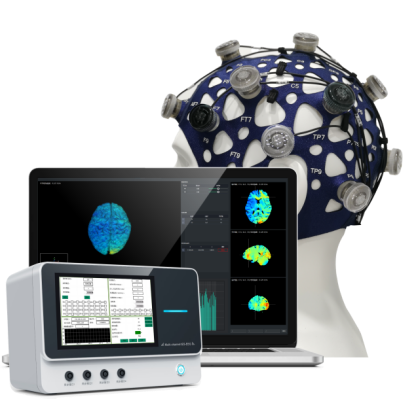
Schematic diagram of NeurPlus closed-loop transcranial temporal dry deep brain stimulation device (Photo provided by the respondent)
Recently, the Yu Pengfei team has cooperated with multiple leading medical institutions across China, aiming to provide more effective non-drug treatment options for patients with neurological and psychiatric disorders such as cognitive impairment and Alzheimer's disease, coma awakening, depression, epilepsy, and autism.
At the same time,The Yu Pengfei team pays close attention to the intersection and integration of artificial intelligence technology and brain science."Artificial intelligence technology empowering brain science and brain-computer interface research is the general trend," said Pengfei Wei. Recently, his team's research published in the top international artificial intelligence academic journal *Nature Machine Intelligence* proposed for the first time an artificial intelligence research method for cross-species analysis of abnormal social interaction behaviors in autism.Artificial intelligence technology will provide an important means for the rapid screening of abnormal targets in brain diseases, thereby forming a closed-loop model of screening-intervention.
 Screenshot of the paper (Source: Nature Machine Intelligence)
4. Researchers Should Have a Sense of Mission and Reverence
Starting a business is an ideal, as well as a test. For this reason, Pengfei Wei first crossed over from engineering to natural science, and then from a researcher to an entrepreneur. However, it has been proven that every crossover has brought him fruitful results.
When talking about the secrets of researchers starting businesses for transformation, Wei Pengfei said there are only two points:"The Sense of Mission and Reverence in Entrepreneurs Engaged in Scientific Research."These two seemingly ambiguous words are actually Wei Pengfei's personal experiences.
When Wei Pengfei first encountered the transformation, he had to deal with the impact of new commercial knowledge while continuing to advance his scientific research. Handling many transformation processes and management tasks once made him feel overwhelmed. However, he never thought of giving up. The mission of applying products to clinical use during the early days of his career has supported him and his team to this day.
The market is ruthless; belief alone does not guarantee success. Therefore, a shift in mindset is crucial. Wei Pengfei believes that as scientific researchers, the pursuit of technology should be the goal, but when it comes to commercialization, one must be down-to-earth and market-demand oriented.
Therefore, we must have a sense of reverence for the transformation work. No matter how advanced the concept or technology is, it will eventually need to withstand market tests. At the same time, young researchers do not need to blindly pursue transformation. As long as they find their own mission and goals, they can all create their own scientific research value.