The highly anticipated global top-tier AI event will kick off tonight.From March 18 to 21, NVIDIA GTC 2024, the annual GPU Technology Conference hosted by NVIDIA, will take place at the San Jose Convention Center in California, USA. Known as the "Annual AI Trendsetter," NVIDIA GTC is the company's most important event for technology announcements and exchanges each year, having been held annually since 2019.This event will feature 1045 conferences, most of which are hosted by well-known experts, entrepreneurs, and investors, covering 20 industries including aerospace, cloud services, gaming, energy, finance, healthcare, and life sciences.And as a field that Huang Renxun has repeatedly emphasized,Biology naturally occupies an important position at this conference. Statistics show that there are 90 sessions related to healthcare and life sciences, ranking first in terms of specific industry distribution.Not only that, but these 90 meetings also brought together a group of leading figures, includingCathie Wood(Cathie Wood, Founder and CEO of Ark Invest), Peter Lee (Head of Microsoft Research), Eric Topol (Executive Vice President of Scripps Research), andJohnson & Johnson, GSK, Merck, Novartis, Genentech, AstellasSenior experts from pharmaceutical giants such asRecursion、VantAI、Iambic TherapeuticsFounder of CarbonSilicon AI.Notably, two domestic Biotechs appeared at this conference:Tushen ZhiheAndCarbonSilicon AIThe former is an AI protein design company that has developed ProteinEngine, a protein design platform integrating various advanced self-developed AI models; the latter is an AI pharmaceutical company with DrugFlow, a one-stop AI-driven new drug discovery platform.Since last year, the resurgence of enthusiasm for AI + healthcare/biotech from the industry, academia, and investment sectors indicates the renewed fervor in this field. Coupled with the integration of data science, artificial intelligence, and automation, the market is betting on the next big revolution in the life sciences. The Ambition of the Leader
At 11 a.m. Pacific Time on March 19, Kimberly Powell, General Manager and Vice President of Nvidia's Healthcare and Life Sciences division, Eric Topol, Executive Vice President of the Scripps Research Institute, Cathie Wood, Chief Investment Officer of Ark Invest, and Peter Lee, head of Microsoft Research, gathered to discuss "The Role of Generative Artificial Intelligence in Modern Medicine."A little attention will reveal that each of the above individuals is a heavyweight.Scripps Research Institute is the largest non-profit biomedical research institution in the United States., with a history of over a century, its research strength consistently ranks among the top 10 in the United States. Nature Index once named it as the "world's most influential research institution" in first place.AndEric TopolHe is the founder of the institute's translational department and an academician of the National Academy of Medicine, with over 1,300 peer-reviewed articles published and more than 340,000 citations.One of the top 10 most cited researchers in the medical field.Regarding the previous event where AI independently discovered Norn cells in the kidneys, Eric Topol commented, "This is a major discovery in biology that biologists would not have made otherwise.". Last September, Eric Topol published a commentary titled "Artificial Intelligence Goes Multimodal, Medical Applications Multiply" in Science, demonstrating his enthusiasm for AI + healthcare."Another big shot,Peter Lee, former professor and chair of the Department of Computer Science at Carnegie Mellon University, currently leads Microsoft Research. He is one of the pioneers in Microsoft's exploration of artificial intelligence applications in the healthcare field, one of the earliest members within Microsoft to evaluate and experiment with GPT-4, and a co-author of the book *The Medical Artificial Intelligence Revolution: GPT-4 and Beyond*.Peter Lee has emphasized more than once the profound impact of large models on healthcare, stating that generative AI technology will become the most revolutionary tool in the fields of healthcare and medicine.Unlike the two top experts in academia above, Cathie Wood comes from the investment circle. Nevertheless, with Ark Invest's management scale exceeding tens of billions of dollars and an investment style favoring disruptive innovation technology companies, she is also a highly influential figure in the technology field.Cathie Wood, known as the "Queen of Bull Market," recently statedArtificial intelligence will continue to take off and catalyze other technologies – including robotics, energy storage, blockchain, and multi-omics sequencing – potentially creating structural macroeconomic shifts with more impact than the first and second industrial revolutions.Ark Invest's "Big Ideas 2024" points out three major trends in the biotech field:The throughput and depth of proteomics are increasing exponentially.:Over the past decade, advances in mass spectrometry and bioinformatics have significantly improved proteomics analysis, enhancing resolution, accuracy, and the ability to analyze multiple samples simultaneously. These developments have not only enabled detailed exploration of the proteome in health and disease but also accelerated the discovery of cancer biomarkers and the development of targeted therapies.Artificial Intelligence and Automation Are Driving Drug Discovery: High-throughput automated workflows, such as drug biosynthesis and in vitro/in vivo analyses, are essential for leveraging AI-driven drug discovery.In the next decade, companies implementing AI/ML drug discovery methods and automated workflows may double the probability of clinical success from Phase I to approval.In the early stages of this process, eliminating compounds and increasing productivity should halve the cost of single-drug approval.The Cost of Drug Development May Drop Significantly: Advances in basic biology, artificial intelligence, automation, and experimental design are expected to significantly reduce the cost of preclinical drug development. In the next decade,Companies that make full use of these technologies can reduce the cost of each approval by nearly 50%, partly because the success rate of candidate drugs entering clinical trials has more than doubled. Strongly Promote Own Platform
In the healthcare field of this GTC,AI-driven drug discovery takes center stage, with 27 sessions dedicated to the topic. Among these, BioNeMo stands out as the key focus, with over 10 sessions related to it.BioNeMo is a set of pre-trained biomolecular AI models developed by NVIDIA, which can be used for protein structure prediction, protein sequence generation, molecular optimization, generative chemistry, docking prediction, etc. It also provides models to a wide range of users through an easily accessible application programming interface (API) for inference and customized model development.Including small-molecule AI pharmaceutical company Terray Therapeutics, biotechnology software company OneAngstrom, protein engineering and molecular design company Innophore, AI-designed protein drug discovery company Evozyne, and AI pharmaceutical companies in China.Insilico MedicineAre all clients of BioNeMo and have produced numerous outcomes.For example, last year, researchers at Evozyne used the BioNeMo platform,Developed the protein generation model ProT-VAE and created two proteins with significant potential in healthcare and clean energy, reducing the entire process cycle from months or years to just weeks.
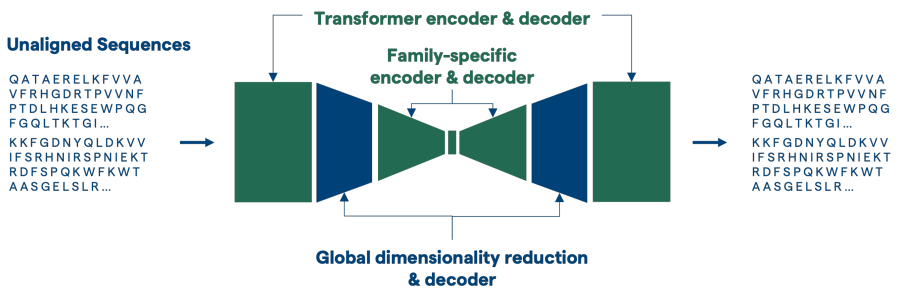
Figure:Architecture of ProT-VAE
Obviously, NVIDIA won't miss the opportunity of this global event to promote its own products.At GTC 2024, professionals including the Director of NVIDIA's Healthcare AI Products, the Founder and CEO of Receptor AI, a Senior Leader at Amazon Web Services, the Chief Engineer of Astellas, a Senior Data Scientist at Evozyne, the Founder and CEO of Innophore, and the CTO of Iambic Therapeutics will share their experiences and insights on using BioNeMo.The information shows that BioNeMo packages the following models: protein structure prediction (AlphaFold2, ESMFold, and OpenFold), protein generation (ProtGPT2), protein embedding generation (ESM-1nv, ESM-2), molecular generation (MegaMolBART, MoFlow), and molecular docking (DiffDock), and can be deployed in NVIDIA DGX Cloud services.Currently, Astellas has gained early access to the integration of NVIDIA BioNeMo and DGX Cloud services, driving advancements including the development of internal antibody-specific language models, accelerating de novo enzyme design, and mastering state-of-the-art generative AI solutions for early drug discovery.AnHorn Medicines (AnHorn Biomedical) stated that it has accelerated the generation of Protac drugs using BioNeMo.。In addition, other AI medical solutions developed by NVIDIA also appeared at the conference, includingHoloscan for medical devices, Parabricks for genomics, and MONAI for medical imaging。It is undeniable that NVIDIA has become one of the most successful SaaS providers in the biopharmaceutical field in a short period of time. NVIDIA's "Circle of Friends"
At this conference, besides the presence of multinational pharmaceutical companies, the emergence of a group of AI biotech companies also drew significant attention.Founded in 2015InnoplexusHeadquartered in India, the company uses artificial intelligence to explore new therapies from global data composed of life sciences, human data, and real-world data. Its specialized capabilities in life science language processing and computer vision can handle multimodal data, discover potential connections, and accelerate drug development.Currently, the company has participated in the development of 30 pipelines from companies such as Verik Bio, Cureteq, Inflection Biosciences, and Chain Pharmaceuticals, covering multiple fields including oncology, immune diseases, neurology, and metabolism.At this conference, the company proposed a deep learning solution capable of generating molecules from scratch. These molecules can also be prioritized based on their binding potential with targets, drug-likeness, and ADMET (Absorption, Distribution, Metabolism, Excretion, Toxicity). In addition, the company also showcasedMethods for Generating Molecules Using Large Language Models, Particularly Combining GPT with Reinforcement Learning, using self-organizing maps as a reward function to evaluate the synthesizability and bioactivity of the generated molecular structures.AI Protein Design Company from ChinaTushen Zhihe, founded in 2023, has recently completed its seed and angel financing rounds consecutively,The protein design platform ProteinEngine developed by the company utilizes a large amount of structural biology data and bioinformatics data, mining potential patterns and rules through graph neural networks, enabling itCapable of rapidly generating protein structures and sequences with desired functions.
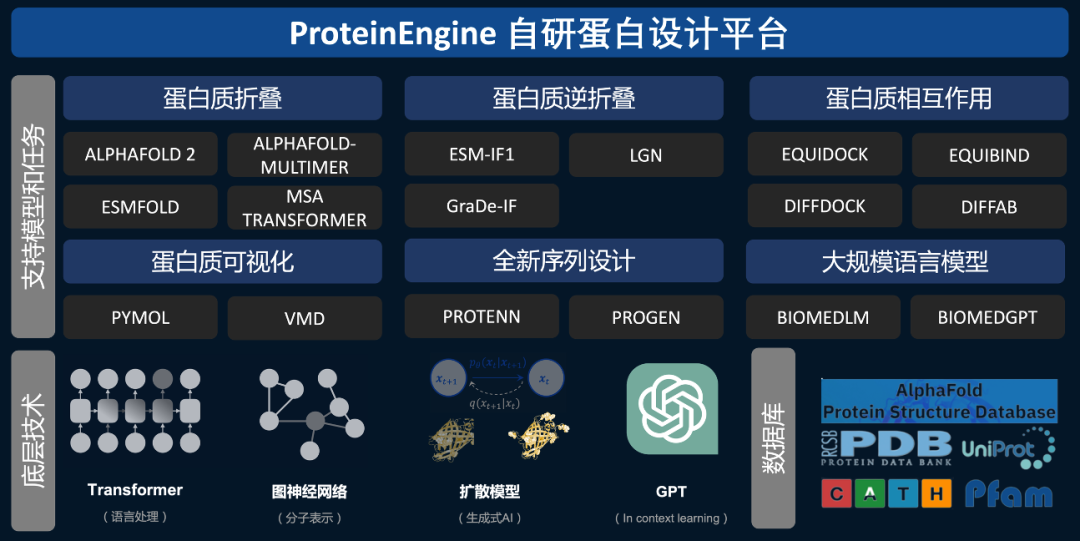
The founder once stated that the company is committed to applying artificial intelligence technology in the field of synthetic biology, assisting biologists in conducting protein modification and design more efficiently.
This time, the company showcased IMS2Trans at NVIDIA GTC 2024, a new type of lightweight and scalable Swin Transformer network it has developed. It uses a single encoder to extract latent feature maps from all available modalities, enabling effective information sharing and fusion between modalities, thereby improving efficiency.Another AI Protein CompanyEvozyneWhich brings its development of a sequence-based latent diffusion modelDiffuTase,Improving protein design through multimodal input (including text, structure, etc.), empowering protein engineering similar to ChatGPT.Just last September, Evozyne completed an $81 million Series B financing round, with investors including Fidelity Investments, OrbiMed, and NVIDIA.In fact, many Biotechs attending the conference, including Recursion, Iambic Therapeutics, Terray Therapeutics, and Charm Therapeutics, have been invested in by NVIDIA.These companies, having secured funding, promptly turn around to procure hardware and software from NVIDIA, further integrating into the industry ecosystem that NVIDIA has built, fostering synergistic development.It is not uncommon for large technology companies to deeply invest in the healthcare sector. Previously, Google and Microsoft did the same, but the end results were less than satisfactory.But obviously, NVIDIA's focus is more concentrated, and the companies it invests in are all centered around artificial intelligence and data.As the head of Nvidia's healthcare and life sciences division puts it, "Healthcare adopting generative AI is set to become one of the largest technology industries.", the technology-driven transformation of the medical industry by AI marks a watershed moment in the development of this ancient field. Many terms previously only applied to the growth of tech companies, such as 'network effects,' may soon be used to describe a pharmaceutical company."It took Pfizer over 170 years to grow from zero to nearly 160 billion US dollars in market value, while Google, with a market value ten times that of Pfizer, is less than 26 years old.Perhaps the initial intention of NVIDIA's entry into this field is to seek the Google or Meta of the biotech industry, or maybe NVIDIA itself wants to become such a company. Written at Last
As the new top player in global assets, every move by NVIDIA is under the market's spotlight.This giant, which holds the bull by the horns in global AI, wherever it sets its sights next is where opportunities abound.And biomedicine is undoubtedly Nvidia's most beloved niche field recently, no exception.From Huang Renxun's frequent mention of biology to Nvidia's continuous investment in multiple AI + biotech companies, whether in words or actions, this two-trillion-dollar giant is showing strong optimism about the biotech field.Among the recently leaked favorable documents, artificial intelligence + healthcare and artificial intelligence + drug development are also key areas mentioned.Sogou's Wang Xiaochuan recently stated: "GPT can build larger world models in the future, including life models," which is "no less significant than language models."All the information is showing that AI + biomedicine is a风口 that cannot be missed.
—The End—
Recommended Reading