

GSK's Jemperli-Based Combination Therapy Meets OS Primary Endpoint in Phase 3 Trial for Advanced or Recurrent Endometrial Cancer

GSK
Pharmaceutical R&D Manufacturer
▎WuXiEdited by Kant Content Team
Recently, GSK announced that the combination therapy of its PD-1 inhibitor Jemperli (dostarlimab) for the treatment of patients with primary advanced or recurrent endometrial cancer met the primary endpoint in a Phase 3 clinical trial.The overall survival (OS) of the total patient population achieved a statistically significant and clinically meaningful improvement.These patients also include those with mismatch repair proficient (MMRp) and microsatellite stable (MSS) tumors, for whom there are currently no approved immunotherapy-based treatment options.GSK to Submit Regulatory Application to U.S. FDA in the First Half of 2024 to ExpandJemperli'sIndications for the overall population of patients with primary advanced or recurrent endometrial cancer.

The results showed that the safety and tolerability profiles of Jemperli in combination with standard chemotherapy, as well as Jemperli in combination with standard chemotherapy followed by Jemperli in combination with Zejula, were generally consistent with the known safety profiles of the individual drugs.
In Part 1 of the RUBY study,Compared with chemotherapy alone, the risk of death in the patient subgroup treated with Jemperli combined with standard chemotherapy was reduced by 31% (HR: 0.69; 95% CI: 0.539-0.890), with a median OS improvement of 16.4 months (44.6 months vs. 28.2 months), which is clinically significant.Exploratory analysis results for the MMRp/MSS population showed a 21% reduction in the risk of death (HR: 0.79; 95% CI: 0.602-1.044) and a 7-month improvement in median OS (34.0 months vs. 27.0 months), which is clinically significant. Detailed data are shown in the table below.
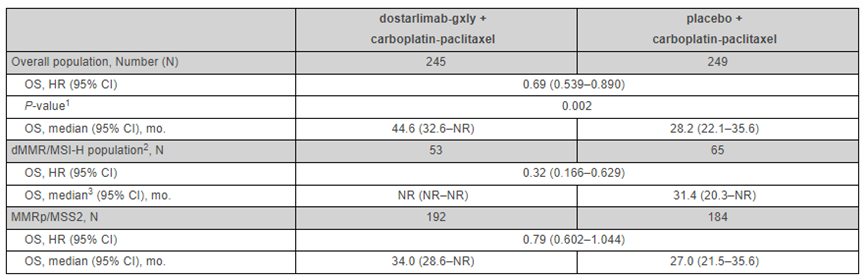
▲Overall survival data from Part 1 of the RUBY study (Image source: Reference [1])
In terms of safety, the incidence of severe adverse events (AE) of grade 3 or higher was approximately 12% higher in the Jemperli plus standard chemotherapy group (treatment group) compared to the chemotherapy-alone group (control group). Immune-related AEs associated with Jemperli or placebo were observed in 40.7% of subjects in the treatment group and 16.3% of subjects in the control group. Additionally, 19.1% of patients in the treatment group and 8.1% of patients in the control group discontinued Jemperli or placebo due to treatment-emergent AEs.
In Part 2 of the RUBY study,Jemperli Combined with Standard Chemotherapy Followed by Jemperli and Zejula as Maintenance Therapy Reduced the Risk of Disease Progression or Death by 40% (HR: 0.60; 95% CI: 0.43–0.82) Compared to Chemotherapy Alone, with Statistical Significance; Median Progression-Free Survival (PFS) Improved by 6.2 Months (14.5 Months vs. 8.3 Months), Demonstrating Clinical Significance.Exploratory analysis results for the MMRp/MSS population showed that the risk of disease progression or death in the overall patient population was reduced by 37% (HR: 0.63; 95% CI: 0.44–0.91), which was statistically significant; the median PFS improved by 6.0 months (14.3 months vs. 8.3 months), which was clinically meaningful.
In terms of safety, the incidence of severe adverse events (AEs) of grade 3 or higher was approximately 36% and 24% higher in the Jemperli plus standard chemotherapy followed by Jemperli plus Zejula group (treatment group) compared to the chemotherapy-alone group (control group). Immune-related AEs associated with Jemperli or placebo were observed in 36.6% of the treatment group participants and 6.3% of the control group participants. No cases of myelodysplastic syndrome/acute myeloid leukemia were reported by the investigators. One patient in each group developed other secondary primary malignancies. Additionally, 24.1% of the patients in the treatment group and 5.2% in the control group discontinued Jemperli or placebo due to treatment-emergent AEs, while 15.7% of the patients in the treatment group and 4.2% in the control group discontinued Zejula or placebo for the same reason.

Jemperli is an antibody that binds to the PD-1 receptor and blocks its interaction with the ligands PD-L1 and PD-L2.In the treatment of endometrial cancer, Jemperli has been approved by the U.S. FDA for use after prior platinum-containing therapy.Mismatch Repair Deficiency (dMMR)Monotherapy for advanced or recurrent endometrial cancer.July 2023, U.S. FDAApprovalFor Jemperli in combination with carboplatin and paclitaxel, followed by Jemperli monotherapy, for the treatment of adult patients with primary advanced or recurrent endometrial cancer determined to be dMMR or microsatellite instability-high (MSI-H) by an FDA-approved test.
Zejula is an oral, once-daily PARP inhibitor that GSK acquired through the purchase of TESARO.PARP inhibitors are a targeted therapy that kills cancer cells by inhibiting PARP-mediated DNA damage repair (DDR). Based on the principle of "synthetic lethality," they can kill cancer cells without affecting healthy cells.

Everyone is watching






▲If you have any business needs, please long press to scan the QR code above.Or click "Read more" at the end of the article.You can access the business对接platform and fill in the business requirements information.

▲To learn more about the application of cutting-edge technologies in the biopharmaceutical industry, please long-press and scan the QR code above to access "WuXi AppTec Live Studio" and watch live discussions and exciting replays on related topics.
References:
[1] Positive RUBY phase III data show potential for Jemperli (dostarlimab-gxly) combinations in more patients with primary advanced or recurrent endometrial cancer. Retrieved March 18, 2024, from https://www.businesswire.com/news/home/20240315640367/en
Disclaimer: The content team of WuXi AppTec focuses on introducing the research progress in global biopharmaceuticals and health. This article is for information exchange purposes only, and the views expressed in the article do not represent the position of WuXi AppTec, nor does it mean that WuXi AppTec supports or opposes the views in the article. This article is not a recommendation for treatment plans. If you need guidance on treatment options, please visit a正规 hospital.
Copyright Statement: This article is from the content team of WuXi AppTec. Individuals are welcome to share it on their social media circles, but unauthorized reproduction by media or institutions in any form to other platforms is prohibited. For authorization to reproduce, please reply with "reprint" on the WeChat Official Account of "WuXi AppTec" to obtain reprint guidelines.


Share,PointLike,In View, Focus on Global Biomedical Health Innovation