Source: Siyu MedTech; Editor: Li Yuanming
Reprint Requirements: Please indicate the source of the article at the beginning of the text, and it can be reprinted directly.

# IT Empowers Healthcare!
The other day,ChipCompanyNVIDIA announced cooperation withCooperation with multiple medical device companies, includingIncluding Johnson & Johnson, GE Healthcare, etc.Si Yu first explained the uncommon name in the medical industry.NVIDIA is a chip company founded by CEO Jensen Huang, who is of Chinese descent.In the fiscal year 2024, NVIDIA's annual revenue reached $60.9 billion, making it the first chip company in the world to surpass a market value of $2 trillion., and it is a fabless pure-play chip design company.Jensen Huang, a man with a master's degree who was elected as an academician of the National Academy of Engineering of the United States and loves to wear black leather jackets – holds 3.6% of NVIDIA shares, and his net worth has soared to $69.2 billion.Such a generous sponsor, at the annual meeting heldMore than 90 medical and life sciences events, which is the highest in all fields.
# Partnering with GE Healthcare to Bring AI into Ultrasound
March 19, 2024GE HealthcareAnnounced the development of an AI-driven research model using NVIDIA technologySonoSAMTrack。
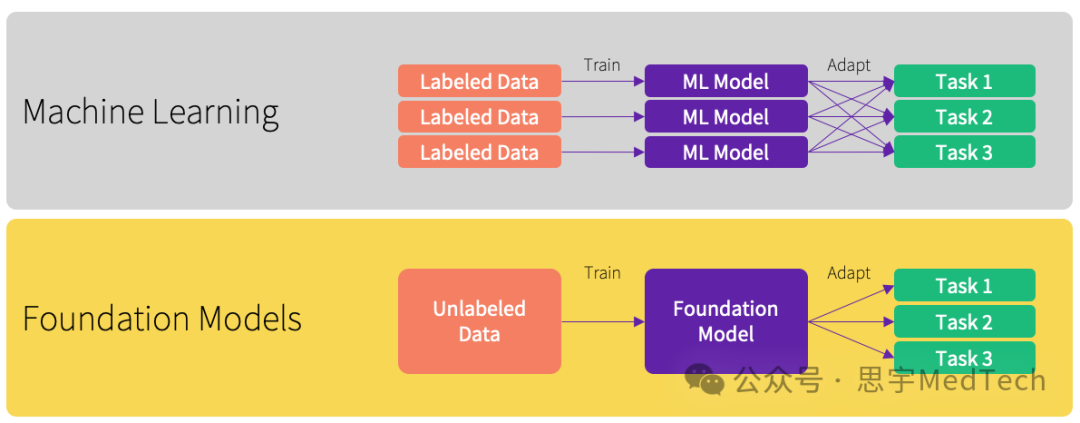 ▲Basic Model (Source: GE Healthcare Official Website)
SonoSAMTrack combines a scalable base model forSegmenting Objects in Ultrasound Images, referred to asSonoSAMIt can segment anatomical structures, lesions, and other critical regions in ultrasound images. GE Healthcare also offers a simplified version called SonoSAMLite.A recent study shows that SonoSAMTrack demonstrates high performance across seven ultrasound datasets. These include a wide range of anatomical (adult heart and fetal head) and pathological (breast lesions and musculoskeletal pathologies) contexts. They also encompass diverse scanning equipment. ▲ Display Area of Example Ultrasound Images
GE Healthcare's Chief Artificial Intelligence Officer Parminder Bhatia discussed: "The company focuses on investing in innovative technologies. It hopes to promote the development of medical imaging by introducing fundamental AI technologies, assist data scientists in accelerating AI application research and development, and ultimately help clinicians improve patient care.David Niewolny, Director of Business Development for Healthcare at NVIDIA, stated: "Combining NVIDIA's accelerated computing and AI technology with GE Healthcare's medical imaging expertise enables faster and more accurate ultrasound diagnostics, helping to enhance patient care."
# In collaboration with Johnson & Johnson Medical Technologies,Develop AI Surgical System
March 18, 2024Johnson & Johnson MedTechAnnounced plans to collaborate with NVIDIA to accelerate and expandAI Applications in Surgical Procedures。

According to the terms of the agreement,Johnson & Johnson will gain access to NVIDIA's IGX edge computing platform and Holoscan edge AI platform. The core purpose of this collaboration is,By leveraging NVIDIA's advanced computing platform and artificial intelligence technology, real-time analysis of surgical software and equipment data can be performed in the operating room, thereby promoting the improvement of surgical techniques.。Not only that, but the two parties also plan toIntroduction of AI Technology into Medical Imaging Analysis and Disease Diagnosisand other aspects, which will provide doctors with richer and more accurate medical information during the diagnosis process, thereby accelerating the diagnostic speed and improving treatment accuracy.In addition, this collaboration will also extend to the field of medical education and training. By utilizing NVIDIA's cutting-edge virtual reality and augmented reality technologies, a more realistic and efficient training environment will be created for medical students and doctors, effectively enhancing their skills and professional capabilities.# Partnering with Novo Nordisk to Build a Supercomputer
March 18,Novo Nordisk FoundationAnnounced an agreement with NVIDIA to build aSupercomputer, leading Denmark into the AI field.The Novo Nordisk Foundation has become the wealthiest investment institution in the world due to Novo Nordisk's substantial revenue in recent years, holding 85% of the company's shares.The foundation will invest approximately $88 million to build a device namedGEFIONSupercomputer. AndHealthcare will be the focus of the GEFION supercomputer, but this supercomputer will also attempt to achieve other goals, such as training a large language model in Danish.
GEFION is expected to start operation in the fourth quarter of 2024, with several pilot projects testing the system at that time. If these projects are successful, the supercomputer will be fully launched in early 2025 and will collaborate with a range of partners in Denmark, from academic researchers to corporate giants like Novo Nordisk.
# LeadAnnual AI Trendsetter!NVIDIA GTC Event
On the afternoon of March 18, local time in the United States, NVIDIA 2024 GTC(GPU Technology Conference)The conference opened in San Jose.
The conference is known as "Annual AI Trendsetter" is an annual global technology event since 2019, aiming to showcase and discuss innovations and developments in the fields of GPU technology, AI, deep learning, data science, autonomous driving, etc.
This year, technology enthusiasts, industry leaders, and innovators from around the world will attend the conference to explore more than 900 sessions and nearly 300 booths, delving into the future of technologies such as AI and computing.HealthcareAndRawLife ScienceOccupied an important position at this conference. This meeting gathered numerous heavyweights, including investment guru Cathie Wood (known as the female Warren Buffett), senior experts from pharmaceutical giants such as Johnson & Johnson, GSK, Merck, Novartis, Novo Nordisk, Genentech, Astellas, as well as founders of various AI pharmaceutical companies.One of the most anticipated events is "AI Transformation Seminar", multiple architects who attended the conference are pioneers originally responsible for fundamentally changing the concept of today's AI applications, including Ashish Vaswani, Noam Shazeer, Niki Parmar, Jakob Uszkoreit, Llion Jones, Aidan N. Gomez, Lukasz Kaiser, and Illia Polosukhin.In addition,Leading Enterprise in the Healthcare Industryare also vying to establish several new collaborations with NVIDIA, including those mentioned above.Novo NordiskGermany, Johnson & Johnson Medical Technologies, and GE Healthcareetc.At this year's GTC conference, NVIDIA unveiled a series of significant products:
- The Strongest Chip in History Unveiled
NVIDIA Released What It Called"The Strongest Chip in History"GB200(Planned for launch this year) and the new generation of chip architectureBlackwell。
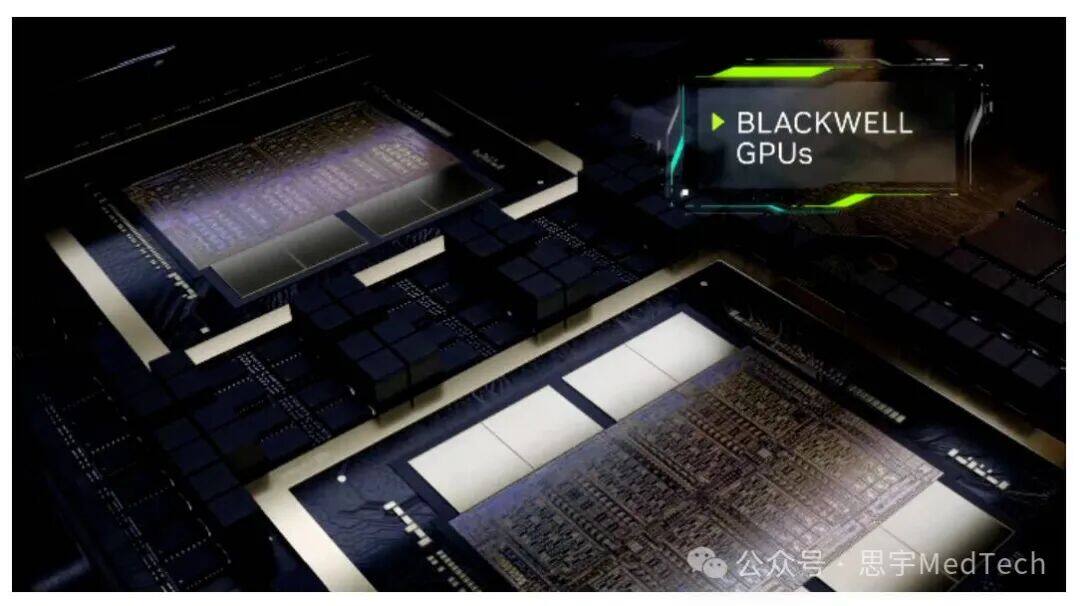 ▲Blackwell Diagram
BlackwellUsing NVIDIA's previously launched Hopper architecture, it contains 208 billion transistors and can support AI models with up to 10 trillion parameters.NVIDIA also released a superchip composed of one Grace CPU and two sets of Blackwell GPUs.GB200, with computing power six times that of the previous generation product H100, and the corresponding processing power for multi-modal specific domains can increase up to 30 times.Almost all leading companies in the AI fieldIncluding OpenAI, Amazon, Google, Microsoft, and Oracle, all are already part of GB200.First Batch of Users。As the leader in global AI hardware, NVIDIA's latest chip GB200 offers higher performance and lower energy consumption. Especially with the onset of the "arms race" for large models, the demand for computing power has surged. Only chips with stronger computing capabilities and lower energy consumption can remain more competitive.
Notably, at this conference, Nvidia also separately announced 25 initiatives based on medical scenarios.Microservice (NIM), helping global healthcare companies improve efficiency based on generative AI.
NVIDIA NIM is a set of optimizedCloud-Native Microservices, aiming to shorten the time to market and simplify the deployment of generative AI models on the cloud, in data centers, and on GPU-accelerated workstations. By using industry-standard APIs, the complexity of AI model development and packaging is abstracted, thereby expanding the scope for AI model developers.
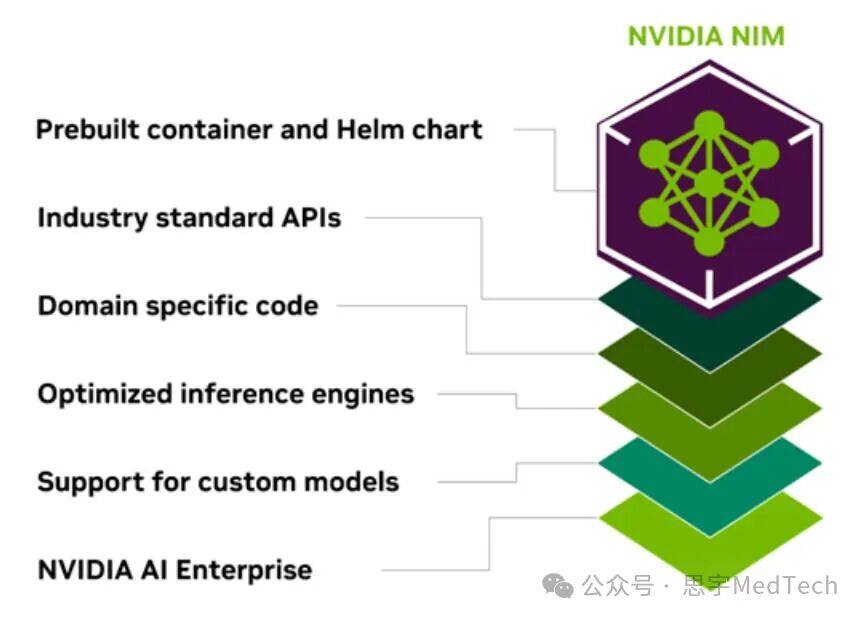
These microservices include a series of drug discovery models, including "MolMIM" for generative chemistry, "ESMFold" for protein structure prediction, and "DiffDock" to help researchers understand how drug molecules interact with targets.Medical enterprises can leverage these microservices to screen trillions of drug compounds, collect more patient data to aid in early disease detection, or implement smarter digital assistants, among other things.For example, compared to running on a CPU, NVIDIA’s microservices can increase the speed of variant calling in genomic analysis workflows by more than 50 times. In terms of implementation, NVIDIA introduced that a startup company has built an AI-driven medical clinical dialogue platform, which will talk to patients over the phone to arrange appointments, preoperative visits, post-discharge follow-ups, etc., greatly alleviating the shortage of personnel, improving patient treatment outcomes, and saving time for clinicians.Currently, nearly 50 application providers worldwide are using NVIDIA's healthcare microservices.
Global MedTech TOP100: 2023 Global MedTech TOP100
2023 Global MedTech Industry Contribution Award
2023 Global Medical Technology Innovation Award
2023 Global MedTech Rising Star Award
2023 Global Innovative Medical Device Award
Global Leading Medical Device Companies | Dynamic CollectionChina Medical Device Listed Companies | Dynamic CollectionEditor-in-Chief | Zhao Qing Reviewed by | Yi He