Pfizer's CD3/BCMA Bispecific Antibody Elranatamab Granted Priority Review in China for Relapsed/Refractory Multiple Myeloma
Pfizer
Pharmaceutical R&D Developer

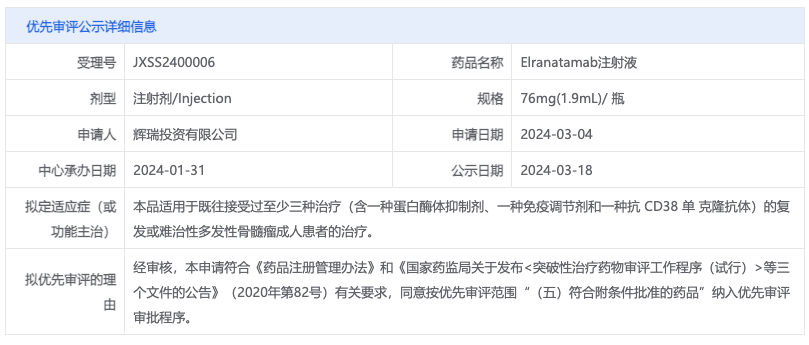
Source: CDE Official Website
Elranatamab (ELREXFIO) is the second BCMA/CD3 bispecific antibody to be approved for marketing globally. It received accelerated approval from the U.S. FDA on August 14 last year for the treatment of adult patients with relapsed or refractory multiple myeloma (R/R MM) who have previously received at least four types of therapy, including a proteasome inhibitor, an immunomodulatory agent, and an anti-CD38 monoclonal antibody.
Approval in the United StatesBased on Single-Arm Phase II MagnetisMM-3 The positive results of the study (Registration No.: NCT04649359) showed that in patients (n=97) who had received four or more prior lines of therapy before Elranatamab treatment, the ORR was 58%, with an estimated 82% of patients maintaining remission for at least 9 months. The median time to first response was 1.2 months.
MagnetisMM-3 Cohort B (n=64) study data showed that among the 63 patients included in this cohort who had received at least four prior lines of therapy, including BCMA-targeted treatments (CAR-T or antibody-drug conjugates), after a median follow-up of 10.2 months, the ORR was 33%, with an estimated 84% of patients maintaining response for at least 9 months.
Long-term efficacy data for Cohort A (n=123) presented at the 2023 EHA meeting showed that, with a median follow-up of 14.7 months, the ORR was 61%, and the median DOR, OS, and PFS were not yet reached. For patients who achieved a response, the probability of maintaining the response at 15 months was 72%.
According to the Insight database, there are currently 26 CD3/BCMA bispecific antibodies under research and development globally. In addition to the marketed Teclistamab (Johnson & Johnson/Genmab) and Elranatamab (Pfizer), Linvoseltamab (Regeneron/Sanofi) has also been submitted for marketing approval, and another two are in Phase III clinical trials. Chinese companies are involved in 16 projects, although these are still in the early stages of development.