

Tubulis Files for IPO Following $1B+ BMS Deal and Backing from WuXi AppTec Ecosystem

Bristol-Myers Squibb
Biopharmaceutical and Nutritional Product R&D and Sales

Tubulis
Developer of Drug Conjugates
On April 20, 2023, the multinational pharmaceutical giant Bristol-Myers Squibb made a significant investment to introduce a new R&D platform in the antibody-drug conjugate (ADC) field. According to the terms, Bristol-Myers Squibb paid $22.75 million as an upfront payment, over $1 billion in milestone payments, and a certain percentage of sales royalties, with a total amount exceeding $1.02 billion (nearly 2 billion RMB).
In fact, this is not the first time that Bristol-Myers Squibb has made a move or invested heavily in the antibody-drug conjugate (ADC) field. In June 2021, Bristol-Myers Squibb entered into a global collaboration agreement with Eisai to jointly develop and commercialize the investigational ADC MORAb-202, which targets folate receptor alpha (FRα). Under the agreement, Eisai will receive an upfront payment of $650 million and potential milestone payments of up to $2.45 billion, for a total of $3.1 billion.
The Rise of Antibody-Drug Conjugates: Echoing the Glory of PD-1. The current popularity of antibody-drug conjugates is largely due to their remarkable clinical efficacy, especially in the field of oncology. Compared with traditional chemotherapy, antibody-drug conjugates offer advantages such as more controllable toxicity and a broader range of applications.
Meanwhile, as a multinational pharmaceutical company with a global perspective, Bristol-Myers Squibb was also facing the dilemma of the patent cliff at the beginning of 2023. This is precisely why, at the JPM conference in the same year, the company conveyed the development theme of striving for growth amidst the backdrop of the patent cliff and announced that it would invest approximately $50 billion in cash flow to bolster internal and external innovation pipelines between 2022 and 2024.
Meanwhile, Bristol-Myers Squibb stated that diversification is the key to its next phase of growth, and the company is also launching a younger and more diversified portfolio.
This may explain the birth of this commercial cooperation project with a total amount exceeding 1.02 billion US dollars in April 2023.
The other party in the cooperation agreement is Tubulis, a protein-drug conjugate developer based in Munich, Germany, which develops novel antibody-drug conjugates with superior performance by customizing the combination of targeting molecules and payloads for specific targets.
Entrepreneurship funded by Munich University, involving freelance programmers and orthodox academics
The career paths of Tubulis' two founders are quite different. This divergence is largely due to the somewhat unconventional career of Dr. Dominik Schumacher, the founder and CEO, while Dr. Jonas Helma-Smets, the other founder and Chief Strategy Officer, leans more towards a traditional academic background.
When Helma-Smets was still a postdoctoral researcher in the laboratory at Munich University, she could never have imagined that in the future, not only would she change careers and found a company, but also sign a cooperation agreement with pharmaceutical giant Bristol-Myers Squibb, and that her workplace would be just 250 meters away in a straight line from the Munich University lab.
However, Helma-Smets has made significant professional progress. At that time, the molecular biologist was researching site-specific protein functionalization and single-domain antibodies as novel research reagents for cell biology applications, and had an entrepreneurial experience: ChromoTek, a company dedicated to developing highly specific antibodies for protein purification and super-resolution microscopy, was acquired by the benchmark antibody company Proteintech in 2020.
Thereafter, perhaps seeing that the commercial application of his scientific research results was gradually getting on track, or perhaps unwilling to stop the pace of exploration, Helma-Smets returned to academic life and continued his career in scientific research. He did not expect that the moment to embark on a second entrepreneurial journey would come a few years later.
Going back to 2010, the year that marked the dawn of the mobile internet era, another key figure, Schumacher, ended his five-year and ten-month career as a freelance programmer to focus on studying chemistry at the University of Düsseldorf. In hindsight, this seemed like a foreshadowing, as he later entered Heinrich Heine University to study economics, apparently laying a solid foundation for his future entrepreneurial endeavors.
Schumacher continued his studies and earned his doctorate at Humboldt University. He then co-founded the Leibniz Research Institute for Molecular Pharmacology (FMP) with colleagues, while also serving as the head of a research group at Ludwig Maximilian University of Munich (LMU).
Helma-Smets did not go into detail about how the two met, but within the same academic circle, the chances of them knowing each other were still many. After Schumacher and Helma-Smets discussed the latter’s new technology for protein functionalization, they waited together for the critical experimental results of this technology targeting a specific enzyme.
Not long after, they realized: this technology is very effective.
When they were thinking about the current discoveries' application scenarios and whether to proceed with commercial implementation, Schumacher's business education and Helma-Smets' entrepreneurial experience came in handy; also providing a boost was the entrepreneurial-friendly environment and incubation services at the University of Munich.
It is worth mentioning the startup incubation environment at the University of Munich. The entrepreneurial experiences of Schumacher and Helma-Smets are not isolated cases but are among the entrepreneurial projects spun off by the University of Munich each year, with an increasing trend in recent years. For instance, the latest spin-off projects from the University of Munich include innovative immunotherapy from the Munich Gene Center, a marina booking platform from the Business School, and an ultra-sensitive microscope from the Physics Department.
Against this backdrop, Schumacher gained the support of his professor, Heinrich Leonhardt, and, together with Helma-Smets, set an entrepreneurial goal: to develop a new type of antibody-drug conjugate. Thus, after securing the first round of startup funding and handling various administrative procedures, Tubulis was officially born in 2019.
Tubulis Technology Platform
Schumacher and Helma-Smets' motivation for seeking antibody-drug conjugates is to open up new avenues for treating solid tumors, in order to bring safe and effective treatments to cancer patients. The two believe that although innovation in the field of antibody-drug conjugates has made progress, it still faces bottlenecks related to toxicity, efficacy, and indications, and these unmet needs have led to Tubulis' series of antibody-drug conjugate technology platforms.
According to the introduction on Tubulis' official website, the company's current series of technical platforms are expected to overcome the limitations of antibody conjugation technology:

Drug toxicity independent of target antigens, such as premature payload loss and non-specific cellular uptake
The design space of ADC is limited by matching the target biology through the adoption of appropriate payload categories and the correct drug-to-antibody ratio (DAR).
Tubulis' P5 conjugation technology platform enables the rapid generation of antibody-drug conjugates with unprecedented stability and chemically flexible linkers, offering the opportunity to develop truly differentiated antibody conjugates.
Its unique advantages include:
Homogeneous DAR8 conjugation ratio
Chemical Flexibility and Broad Possibilities in Antibody-Drug Conjugate Design
Unique Stability and Selectivity
Novel Cysteine-Selective Chemistry
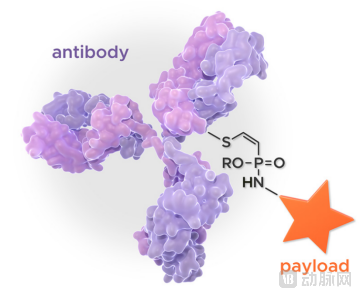
Image source: Tubulis official website
Tubulis' proprietary linker-payload platform enables the targeted delivery of optimized potent topoisomerase I inhibitors while reducing undesired off-target toxicity. Stable and high DAR value (DAR8) payload attachment is achieved without compromising the biophysical properties of the entire antibody-drug conjugate molecule.
Currently approved maleimide-based Topo-I antibody-drug conjugates lose over 60% of their payload over time, resulting in an average drug-to-antibody ratio (DAR) of only 3 after three days. Topo-I antibody-drug conjugates based on Tubulis' proprietary P5 conjugation technology can maintain a stable DAR in serum for more than 7 days.
The unique characteristics of Tubutecan-based ADCs will translate into sustained in vivo potency, with a single dose of 1mg/kg providing significant benefits and complete remission in all animals within 90 days.
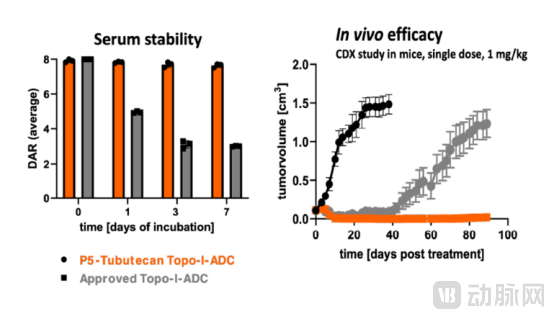
Image source: Tubulis official website
Inspired by microtubule biology, this technology platform creates a beneficial microenvironment for payload delivery through antibody modulation and enhances the stability of antibody-drug conjugate candidates. The conjugation process utilizes Tubulin Tyrosine Ligase (TTL)-based site-specific conjugation, producing uniform and stable antibody-drug conjugates.
In addition, since the antibody-drug conjugates based on the Tub-tag® technology platform are mainly customized for different individuals, they are expected to reduce the risk of adverse immune reactions after medication.
Its unique advantages include:
Homogeneous DAR2 or DAR4 conjugation
Determination Method for Drug Loading with High DAR Flexibility
Tub-tag® provides a beneficial microenvironment for effective payload conjugation at specific sites.
BD+ Capital: Breaking Through Supply Chain and Indication Barriers
In addition to深耕in technological innovation, the Tubulis team is also highly meticulous about the clinical efficacy and implementation of their products. Just one year after the company's establishment, on December 2, 2020, Tubulis formed strategic partnerships with HuaQuan Pharmaceuticals, a subsidiary of WuXi AppTec, and WuXi Biologics to jointly accelerate the development of Tubulis' next-generation antibody-drug conjugates (ADCs) up to the Investigational New Drug (IND) application stage.
Under the cooperation agreement, WuXi Biologics and HuaQuan Pharmaceuticals will become CDMO partners of Tubulis, providing scale-up, process development, and GMP production services for intermediates of antibody-drug conjugates (ADCs). HuaQuan Pharmaceuticals will focus on linkers and payloads, while WuXi Biologics will concentrate on monoclonal antibodies and enzymes used in Tubulis’ proprietary Tub-tag® platform.
With the support of collaboration, Tubulis successfully debuted at the 13th World ADC San Diego 2022 (2022 World Antibody-Drug Conjugate Conference, abbreviated as World ADC Conference) two years later and delivered a speech on payload-related topics.
Not only that, but two years later, on March 14, 2024, Tubulis announced the successful completion of a $138.8 million Series B financing round to further support its solid tumor antibody-drug conjugate pipeline. The funds will be used to help obtain clinical proof-of-concept for the two leading candidate drugs, TUB-040 and TUB-030.
Among them, TUB-040 targets the tumor antigen Napi2b, a well-characterized target in ovarian and lung cancers; TUB-030 targets 5T4, an antigen frequently overexpressed in solid tumors. Preclinical proof-of-concept data for these two candidates will be presented at the American Association for Cancer Research (AACR) Annual Meeting in April. Additionally, Tubulis stated that the first Phase 1/2a clinical trial, including dose escalation and dose optimization cohorts, is expected to commence in 2024.
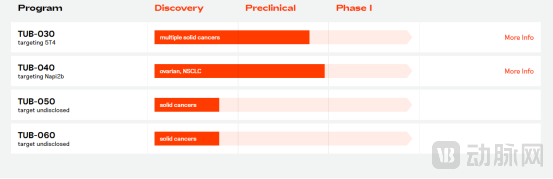
Image source: Tubulis official website
In addition, the funds obtained from this financing will also support Tubulis to expand its full range of technical platforms, providing new payloads for the development of multifunctional and customizable antibody-drug conjugates.
It is worth noting that the tremendous progress achieved in the antibody-drug conjugate field in recent years has been primarily driven by tailored designs for specific targets. This success can be attributed to the exploration and validation of an increasing number of targets, screening antibodies specifically for antibody-drug conjugates (with a focus on cross-reactivity, leveraging pH changes to facilitate preferential binding to tumors, promoting endocytosis and FcRn recycling), improvements in conjugation technologies, and the diversification of payloads. The flexibility of Tubulis' existing technology platform heralds the possibility of "customized" design and development for antibody-drug conjugates.