

GSK, Merck, BMS, and AstraZeneca Report Key Phase III Clinical Data; FDA Approves Three New Drugs – Weekly Pipeline Review (March 18–22)

GSK
Pharmaceutical R&D Manufacturer

MediLink
Antibody-Drug Conjugates Developer
Welcome to follow Asymchem Pharma News
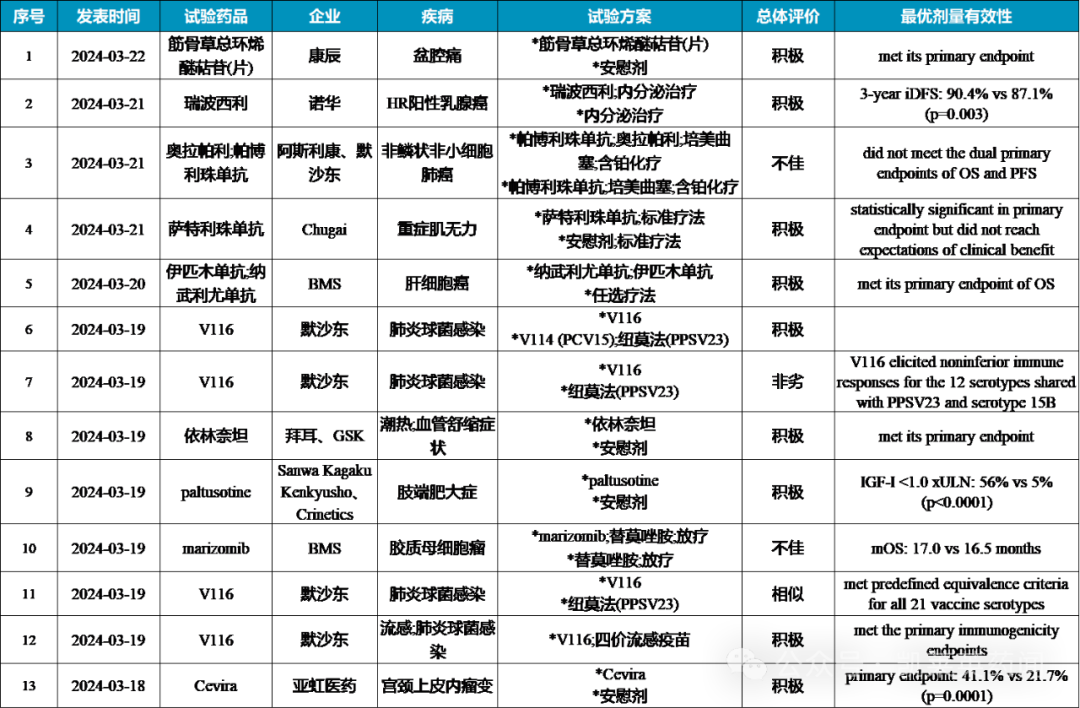
(Collection period: 3.18-3.22, the part in China includesFirst application for listing,First Application for Clinical TrialsInnovative drugs; Global section includes newly approved drugs by FDA for the first time, latest progress in Phase III clinical trials)
Summary of IND for Innovative Drugs in China

1. MediLink: Injectable YL211
Mechanism of Action: Targeted c-MET ADC
Indications: Solid Tumors
On March 19, the clinical application of MediLink's injectable YL211 was accepted by the CDE. YL211 utilizes MediLink's next-generation ADC platform technology and is combined with a highly specific c-MET antibody. It is currently in the clinical application stage. The c-Met signaling pathway exhibits abnormal regulation in various types of solid tumors and plays a crucial role in the formation, growth, and metastasis of colorectal cancer liver metastases and oral squamous cell carcinoma, as well as in the invasion and metastasis of breast cancer, ovarian cancer, and gastric cancer, and in the development and progression of liver cancer, lung cancer, and pancreatic cancer.
In January 2024, MediLink announced a global collaboration and licensing agreement with Roche; Roche will obtain exclusive rights globally for the development, manufacturing, and commercialization of MediLink’s YL211 project. MediLink will collaborate with Roche China Innovation Center (CICoR) to advance the YL211 project into Phase I clinical trials, after which Roche will take over further global development and commercialization. Under the terms of the agreement, Roche will pay MediLink an upfront payment and near-term milestone payments totaling $50 million, with additional potential development, regulatory, and commercial milestone payments of up to nearly $1 billion, as well as tiered royalties based on future global annual net sales.
Summary of NDA for Innovative Drugs in China

1. Syneos;/Ipsen: Odevixibat Capsules (Pellets)
Mechanism of Action: IBAT Inhibitor
Indications: Intrahepatic Cholestasis
On March 22, the Center for Drug Evaluation (CDE) accepted the New Drug Application (NDA) for Ipsen's Odevixibat capsules (pellets). Odevixibat is a first-in-class, potent, selective, non-systemic ileal bile acid transporter (IBAT) inhibitor. It is the first drug approved by the U.S. FDA and the EU EMA for the treatment of Progressive Familial Intrahepatic Cholestasis (PFIC), with minimal systemic exposure and localized action in the intestine. The drug is taken once daily in capsule form and can block the reabsorption of bile acids through the enterohepatic circulation, thereby reducing bile acid concentrations within the liver and systemic circulation. Additionally, the product acts locally in the small intestine, minimizing systemic drug exposure. PFIC is a group of autosomal recessive genetic disorders; mutations in specific genes lead to impaired bile secretion, causing intrahepatic cholestasis, which can eventually progress to liver failure.
The results of the global Phase 3 clinical study of the drug showed that: compared with placebo, odevixibat significantly reduced bile acids (SBA, p=0.003), significantly improved pruritus (p=0.004), and the rate of diarrhea was only in the single digits. In addition, long-term data from PEDFIC-2 (an open-label Phase 3 extension study) showed that in patients treated for up to 48 weeks, serum bile acids (sBA) were continuously and persistently reduced, pruritus assessments improved, liver and growth function indicators were encouraging, and odevixibat was well tolerated.
FDA New Drug Approval
1、Orchard :atidarsagene autotemcel
Mechanism of Action: Gene Therapy
Indications: Metachromatic Leukodystrophy
On March 18, the FDA approved Lenmeldy (atidarsagene autotemcel), a gene therapy developed by Orchard, for the treatment of children with metachromatic leukodystrophy (MLD) who meet specific criteria. This drug is the first gene therapy approved by the FDA to treat this rare genetic disorder and can preserve patients' motor function and cognitive development through a one-time treatment.
Atidarsagene autotemcel (arsa-cel) uses a lentiviral vector to introduce the ARSA transgene, encoding arylsulfatase-A, into autologous CD34-positive hematopoietic stem and progenitor cells of patients with MLD, to restore arylsulfatase-A expression, thereby preserving motor function and cognitive development in patients through a one-time treatment.
The aforementioned approval is based on data from 37 pediatric MLD patients treated with Lenmeldy. The study results showed that, compared to untreated children in the natural history of the disease, Lenmeldy significantly extended the survival rate without severe motor impairment in pre-symptomatic late-infantile (PSLI) MLD children. Additionally, Lenmeldy significantly prolonged overall survival compared to the untreated natural history. Furthermore, Lenmeldy was associated with the maintenance of motor function and cognitive skills in PSEJ and ESEJ MLD children. In terms of safety, the most common adverse reactions were febrile neutropenia, stomatitis, elevated D-dimer, respiratory tract infections, rash, device-related infections, other viral infections, neutropenia, elevated liver enzymes, fever, gastroenteritis, and hepatomegaly.
2、Idorsia:Aprocitentan
Mechanism of Action: Dual Endothelin A/B Receptor Antagonist
Indications: Refractory Hypertension
On March 19, aprocitentan developed by Idorsia was approved by the FDA for marketing to treat patients with resistant hypertension. Aprocitentan is a novel oral dual endothelin A/B receptor (ETA/ETB) antagonist that effectively inhibits the binding of ET-1 to ETA and ETB. It has a half-life of up to 44 hours and can be administered once daily.
The FDA's approval this time is mainly based on the positive results of the Phase III PRECISION study. This study is a multicenter, blinded, randomized Phase III clinical trial, divided into three phases: the first phase is a 4-week double-blind period, in which 730 patients were randomly assigned to receive 12.5mg (n=243), 25mg (n=243) aprocitentan, or placebo (n=244); the second phase is a 32-week (weeks 4-36) single-blind period where patients received 25mg of aprocitentan (n=704); the third phase is a 12-week (weeks 36-48) double-blind withdrawal period, during which patients were re-randomized 1:1 to either the 25mg aprocitentan group (n=307) or the placebo group (n=307).
The primary and key secondary endpoints of the study were the changes in systolic blood pressure from baseline to week 4 and week 40, respectively. At baseline, 63% of patients had received at least four antihypertensive medications. The results showed that the study met its primary endpoint, with a significantly greater reduction in seated systolic blood pressure (SiSBP) in the aprocitentan group compared to the placebo group. Specifically, SiSBP was significantly reduced in patients treated with aprocitentan after 4 weeks, with differences of -3.8 mmHg (p=0.0042) and -3.7 mmHg (p=0.0046) in the 12.5 mg and 25 mg groups, respectively, compared to placebo. In addition, the study also achieved the key secondary endpoint, with SiSBP remaining significantly lower in the aprocitentan group compared to placebo during weeks 36-40, with a difference of -5.8 mmHg (p<0.0001), sustained for up to 48 weeks.
3、Italfarmaco:Givinostat
Mechanism of Action: HDAC Inhibitor
Indications: Duchenne Muscular Dystrophy
On March 21, the FDA approved the oral drug Duvyzat (givinostat) for the treatment of Duchenne muscular dystrophy (DMD) in patients aged six years and older. Givinostat is a histone deacetylase (HDAC) inhibitor that reduces inflammation and muscle loss by targeting the disease-causing process; the drug is designed to alleviate damage to muscle tissue and protect the function of muscle ultrafine fibers by inhibiting abnormally elevated HDAC activity in DMD patients; unlike other approved or developmental DMD treatments, which include steroids and therapies aimed at restoring dystrophin expression.
It is the first non-steroidal drug approved for the treatment of patients with all DMD gene mutations, and its efficacy was evaluated in a randomized, double-blind, placebo-controlled, 18-month Phase 3 study. The results showed: (1) Compared with placebo, the decline in the time required for patients treated with Duvyzat to climb four stairs was statistically significant. The average time change for patients treated with Duvyzat to climb four stairs from baseline to 18 months was 1.25 seconds, compared to 3.03 seconds for those receiving placebo. (2) Compared with placebo, patients treated with Duvyzat experienced less deterioration in NSAA scores after 18 months. (3) Compared with placebo, patients treated with Duvyzat experienced less deterioration in NSAA scores after 18 months.
Global Phase III Clinical Update Summary




"Views"Click once