BMS's Dual Immunotherapy Nivolumab Plus Ipilimumab Granted Priority Review in China for First-Line Treatment of MSI-H/dMMR Metastatic Colorectal Cancer

Bristol-Myers Squibb
Biopharmaceutical and Nutritional Product R&D and Sales
▎WuXi AppTec Content Team Report
On March 27, the official website of the Center for Drug Evaluation (CDE) of the China National Medical Products Administration (NMPA) announced that Bristol-Myers Squibb had submitted an application.Nivolumab Combined with IpilimumabProposed for inclusion in the priority review, targeting the indication ofFirst-line treatment for unresectable or metastatic microsatellite instability-high (MSI-H) or mismatch repair-deficient (dMMR) colorectal cancerPatient.
Ipilimumab is a CTLA-4 antibody, and nivolumab is a PD-1 inhibitor. According to the clinical study published by Bristol-Myers Squibb in January this year (CheckMate-8HW)Data show that, compared with chemotherapy, the combination of two drugs as first-line treatment for MSI-H/dMMR phenotype mCRC patients...Reduced the risk of disease progression or death by 79%. This dual immunotherapy combination was included in the breakthrough treatment category by the CDE in March this year.
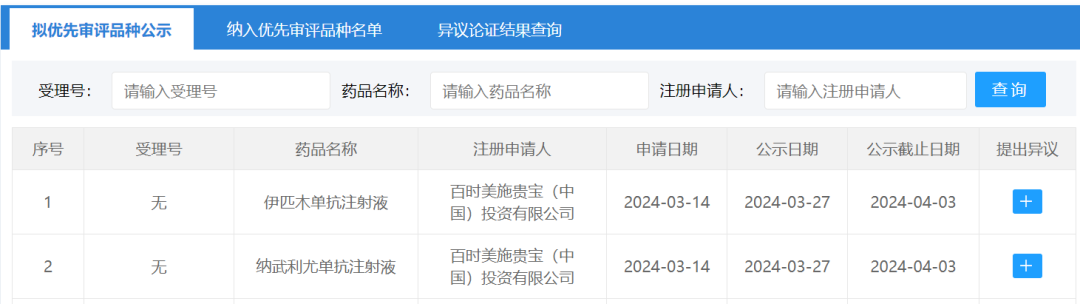
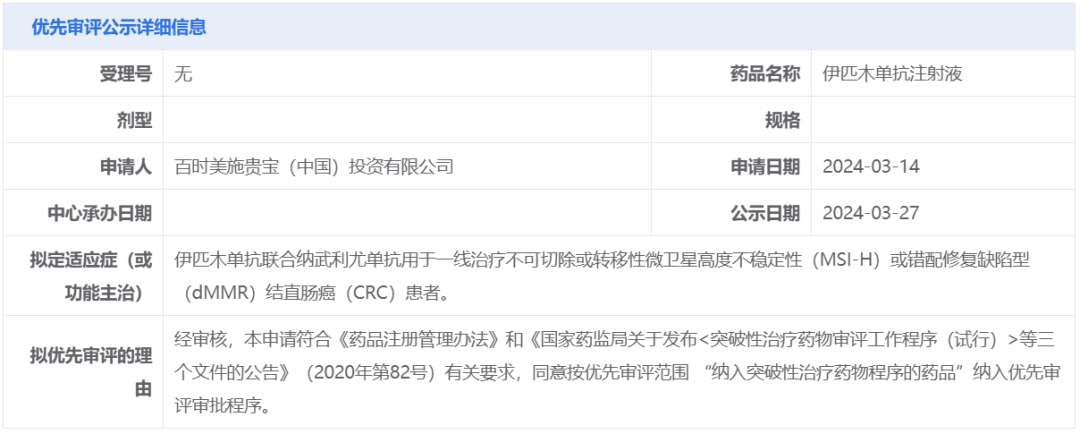 Screenshot source:CDE Official Website
Colorectal cancer (CRC) is a malignant tumor that occurs in the colon or rectum, both of which are parts of the human digestive system.The dMMR phenotype occurs when proteins responsible for repairing mismatch errors during DNA replication are missing or lose function, leading to MSI-H tumors.Public data shows that approximately 5% to 7% of patients with metastatic colorectal cancer have dMMR or MSI-H tumors. They are less likely to benefit from traditional chemotherapy and usually have a poor prognosis.
In January this year, Bristol-Myers Squibb at the ASCO Gastrointestinal Cancers Symposium held by the American Society of Clinical Oncology (ASCO)Oral ReportCompletedCheckMate-8HWThe latest data of the study. ThisA Phase 3 randomized, open-label study evaluating nivolumab in combination with ipilimumab (dual immunotherapy group) compared to nivolumab monotherapy or investigator’s choice of chemotherapy regimen (mFOLFOX-6 or FOLFIRI, with or without bevacizumab or cetuximab) for treatment.Patients with MSI-H or dMMR phenotype metastatic colorectal cancerThe efficacy.Approximately 830 patients were randomly assigned to the nivolumab monotherapy group, the nivolumab plus ipilimumab combination therapy group, or the investigator's choice of chemotherapy regimen.

According toBlinded Independent Central Review (BICR)Evaluation,Dual Immunotherapy CombinationShowed a statistically significant and clinically meaningful improvement in the primary endpoint PFS: compared with chemotherapy, in the first-line treatment,For mCRC patients with MSI-H/dMMR phenotype confirmed by central laboratory testing, the risk of disease progression or death was reduced by 79%.。
In addition,Dual Immunotherapy CombinationLawThe PFS improvement in the group began to appear at about three months and continued throughout.。The median PFS in the combination therapy group has not yet been reached, while it was 5.9 months in the chemotherapy group.A consistent PFS benefit was observed across all pre-specified subgroups, including those withKRASOrNRASPatients with mutations, as well as those with liver, lung, or peritoneal metastases at baseline.The safety profile of the combination therapy was consistent with previously reported data, remained manageable under the established study protocol, and no new safety signals were identified.
This article is from the content team of WuXi AppTec. Individuals are welcome to share it on their social media, but unauthorized reproduction by media or organizations in any form to other platforms is strictly prohibited.For authorization, please leave a message on the "MedObserver" WeChat Official Account to contact us. For other cooperation needs, please contact wuxi_media@wuxiapptec.com.
Disclaimer: The content team of WuXi AppTec focuses on introducing the research progress in global biopharmaceuticals and health. This article is for information exchange only, and the views expressed in the article do not represent the position of WuXi AppTec, nor does it mean that WuXi AppTec supports or opposes the views in the article. This article is not a recommendation for treatment plans. If you need guidance on treatment options, please visit a regular hospital.