

Q1 2024 CGT Sector Sees 28 Strategic Collaborations, Led by Novartis-Voyager’s $1.3B Gene Therapy Deal

GSK
Pharmaceutical R&D Manufacturer

Kelonia Therapeutics
Gene Drug Developer
Disclaimer: Due to limited proficiency, errors are inevitable, and some information may not be the latest. Please feel free to point out in the comments. This article is only an introduction to medical and health-related drugs, not a recommendation of treatment plans (if involved); this article does not constitute any investment advice.
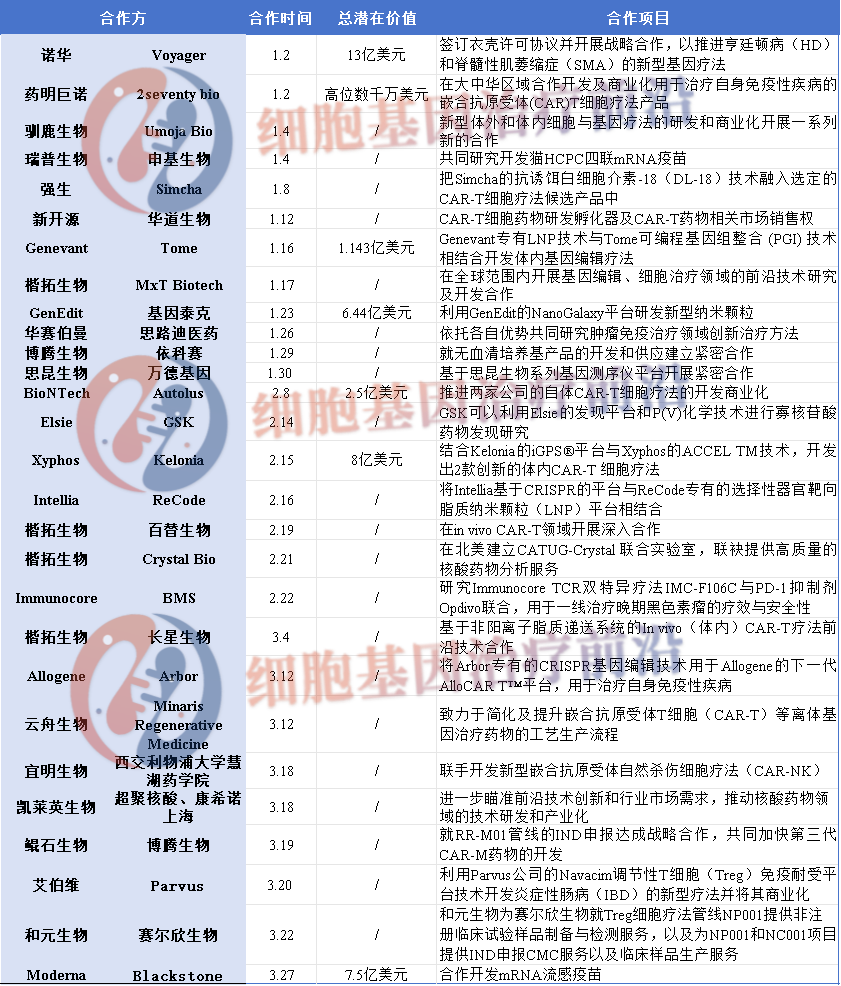
In recent years, the development of cell and gene therapy (CGT) has provided revolutionary treatment methods for people to overcome cancer, rare diseases, autoimmune diseases, etc., but this is stillAn arduous battle requiring multi-party collaboration and united efforts.According to incomplete statistics, 2024Q1 saw 28 collaborations in the CGT field., with the highest total potential valueThe $1.3 billion deal between Novartis and Voyager is based on a new typeCollaboration in gene therapy.
1、AllogeneWith Arbor
On March 12, Allogene Therapeutics and Arbor Biotechnologies jointly announced a non-exclusive global gene editing licensing agreement to apply Arbor's proprietary CRISPR gene editing technology to Allogene's next-generation AlloCAR T™ platform for the treatment of autoimmune diseases.
Allogene designs the next generation of allogeneic CAR-T research products based on its deep understanding of CAR-T research and development. Allogene's first AlloCAR T product for autoimmune diseases is expected to enter Phase I clinical trials in early 2025.Arbor discovers and develops next-generation gene medicines based on its machine learning/artificial intelligence-driven discovery platform for genomic editors.As Arbor continues to advance clinically, with an initial focus on liver and central nervous system diseases, the company is also collaborating with Vertex Pharmaceuticals on several gene-editing and ex vivo cell therapy projects to expand the reach of its novel nuclease technology.
2. Xyphos Biosciences and Kelonia Therapeutics

3. Kelonia Therapeutics and Biotron Biotech
On February 19, Kelonia Therapeutics (Suzhou) Co., Ltd. ("Kelonia Therapeutics") and Beijing Better Biotechnology Co., Ltd. ("Better Biotechnology") announced the official signing of a strategic cooperation agreement. In the new year, the two parties will engage in in-depth cooperation in the in vivo CAR-T field, jointly promoting technological innovation and development with an enterprising spirit of exploration, contributing to advancements in the healthcare sector.
On February 22, Immunocore announced a clinical trial collaboration and supply agreement with Bristol Myers Squibb. The two parties will jointly study the efficacy and safety of Immunocore's off-the-shelf T cell receptor (TCR) bispecific therapy IMC-F106C in combination with the PD-1 inhibitor Opdivo (nivolumab) for the first-line treatment of advanced melanoma.

The PRISM-MEL-301 trial will randomly assign HLA-A*02:01-positive advanced melanoma patients to receive IMC-F106C + Opdivo, Opdivo monotherapy, or Opdivo + relatlimab (LAG-3 Targeting Monoclonal Antibody) combination therapy, depending on the country and region where the patient is enrolled. Immunocore plans to administer the first patient dose in the first quarter of 2024.

On February 8, BioNTech and Autolus Therapeutics announced a strategic collaboration aimed at advancing the development and commercialization of their autologous CAR-T cell therapies. Under the agreement, Autolus will receive a $50 million upfront payment, and BioNTech will make a $200 million equity investment in Autolus.

8. Novartis and Voyager
On January 2, Voyager Therapeutics announced that it had signed a capsid licensing agreement with Novartis subsidiary Novartis Pharmaceuticals and established a strategic partnership to advance novel gene therapies for Huntington's disease (HD) and spinal muscular atrophy (SMA).

According to the agreement, Novartis will pay Voyager $100 million, including $20 million for the purchase of newly issued shares of Voyager. Voyager is eligible to receive up to $1.2 billion in preclinical, development, regulatory, and sales milestones, as well as tiered royalties on global net sales of products containing Voyager's TRACER capsid, totaling $1.3 billion.
Novartis will obtain the exclusive rights to the TRACER capsid target related to SMA from Voyager and will be responsible for all development and commercialization. Novartis will also acquire global rights to Voyager's AAV gene therapy for HD, utilizing Voyager’s TRACER capsid and proprietary payload. Voyager will be responsible for preclinical progress, while Novartis will handle all clinical development and commercialization for the HD program.
9. JW Therapeutics and 2seventy bio
January 2, WuXiJunoAnnounced an exclusive collaboration agreement with 2seventy bio to co-develop and commercialize treatments for autoimmune diseases in Greater China.SexChimeric Antigen Receptor (CAR) T-cell therapy products for the treatment of diseases. The strategic alliance is an expansion of the partnership established in 2022 for the MAGE-A4 project, building on the company’s capabilities in cell therapy development, with the initial aim of accelerating progress in Greater China.Development and validation of T-cell-based immunotherapy products. In addition, the contracting parties plan to add other candidate products in the future.

10. Reindeer Bio and Umoja Biopharma
January 4, 2024, Icarus Bio and UmOja Biopharma jointly announced a series of new collaborations on the research, development, and commercialization of novel in vitro and in vivo cell and gene therapies. Previously, in November 2022, Ixotech Biology and Umoja reached an agreement to combine Ixotech Biology’s chimeric antigen receptors (CARs) with Umoja’s iCIL platform to co-develop next-generation off-the-shelf cell therapies. The signing of this new agreement deepens the strategic cooperation between the two parties and further advances innovative off-the-shelf cell and gene therapy solutions.

In the current pharmaceutical environment, actively seeking partners is a common topic for biotech companies, achieving a 1+1>2 outcome through win-win cooperation. As the number of collaboration deals increases, "return" cases are also common, such as this year.In February, BeiGene announced the termination with Shoreline Biosciences.The latter has developed allogeneic NK cell therapies targeting 4 different sites.CombineWork;Everest Medicines Announces Termination of mRNA Therapy Collaboration and License Agreement with Providence Therapeutics, "Return" Mostly Due to Strategic Decisions. This Also Shows That Only by Assessing the Situation,Only by doing the right thing with the right partner at the right time can we achieve a win-win situation.
Reference: Official websites of various companies