

NVIDIA officially enters biomanufacturing, partnering with over 200 companies
NVIDIA
Artificial Intelligence Computing Service Provider
Chip giant NVIDIA is seeking to provide services for companies in the biomanufacturing sector through its AI platform, primarily in drug discovery, but also in areas such as protein structure prediction and laboratory process optimization.
Recently, according to synbiobeta, Dr. Anthony Costa, NVIDIA’s Director of Digital Biology, stated that NVIDIA’s role lies not only in drug discovery itself, but also in building “infrastructure around world-class algorithms.”
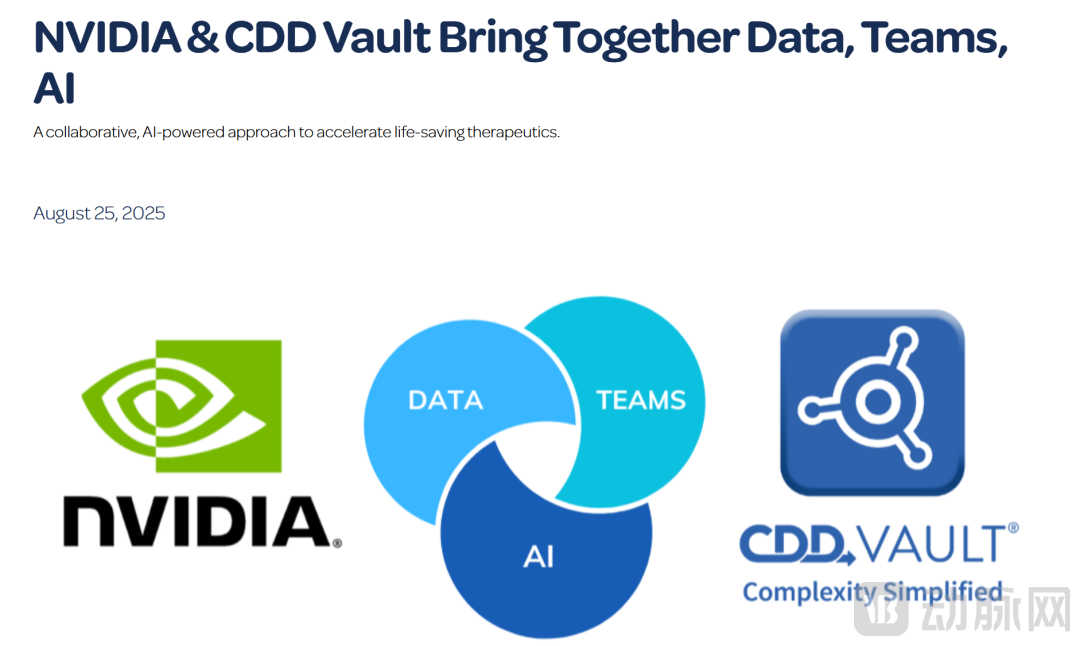
Costa mentioned that NVIDIA's goal is to "accelerate scientific progress and make high-speed operations more accessible", which includes providing powerful AI tools to startups, CROs, and pharmaceutical companies through platforms such as CDD Vault.
As early as November 2024, NVIDIA had already announced the adoption of the open-source BioNeMo platform to advance drug discovery and accelerate molecular design.
In June 2025, NVIDIA partnered with Collaborative Drug Discovery (CDD). With the integration of CDD’s platform and the BioNeMo platform, scientists can automatically generate protein structures and explore novel molecules within a code-free browser environment, enabling an efficient “daytime experimentation, nighttime modeling” cycle.
NVIDIA stated that more than 200 biotechnology firms, major pharmaceutical companies, and startups have already integrated BioNeMo into their computer-aided drug discovery platforms and workflows.
Global system integrators, software providers, and cloud service providers such as Accenture, AWS, and Deloitte are bringing NVIDIA’s BioNeMo platform to enterprises worldwide.
According to NVIDIA’s official information, BioNeMo is a generative AI platform for chemistry and biology, enabling researchers and developers in drug discovery to more quickly and easily design and integrate state-of-the-art generative AI applications across the drug development process—from target identification to lead compound optimization.
The BioNeMo platform is designed to accelerate the creation, customization, and deployment of AI models for drug discovery and molecular design. Seamlessly integrated with accelerated computing infrastructure, it helps reduce costs, scale operations, and speed up drug discovery workflows, delivering rapid and reliable insights from biomolecular data.
Additionally, the platform supports workflows such as 3D protein structure prediction, de novo design, virtual screening, docking, and property prediction. It also supports NVIDIA NIM™ and BioNeMo Blueprints, which are optimized reference designs for wet-lab and computational workflows.
NVIDIA has also introduced a suite of optimized, user-friendly NIM microservices for BioNeMo. These microservices can be deployed quickly and easily on-premises or in any data center or cloud environment, giving developers flexibility to run applications across diverse environments while shortening the time from inference to insight in biopharmaceutical research.
Kimberly Powell, NVIDIA’s Vice President of Healthcare, stated: “The convergence of AI, accelerated computing, and expanded datasets presents unprecedented opportunities for the pharmaceutical industry—a fact underscored by the recent Nobel Prize in Chemistry. To help unravel the complexity of biological systems, we introduced the open-source BioNeMo platform, enabling researchers worldwide to accelerate the development of life-saving therapies.”
Regarding AI applications in biomedicine, according to information from Headline Insights, traditional drug discovery processes—such as target identification, compound screening, and molecular synthesis—are time-consuming and costly, making AI the most widely adopted technology in drug R&D.
AI can perform deep learning on vast amounts of existing drug data to analyze chemical properties and biological activity, design new drugs more rapidly, and predict complex processes such as absorption, metabolism, and toxicity, thereby shortening drug development timelines.
Compared to traditional drug R&D, AI can reduce drug discovery and preclinical research time by nearly 40%, and increase the success rate of clinical drug development from 12% to approximately 14%.
From 2019 to 2023, the market size of China’s AI-driven drug discovery and development sector grew from ¥70 million to ¥410 million, a compound annual growth rate (CAGR) of 57.4%. It is projected that from 2024 to 2028, the market will expand from ¥730 million to ¥5.86 billion, representing a CAGR of 68.5%.
Beyond biomedicine, NVIDIA has been making major moves in AI. In June 2025, NVIDIA founder and CEO Jensen Huang announced plans to build over 20 AI “super factories” in Europe, aiming to increase the continent’s AI computing power tenfold within two years. This ambitious plan spans multiple countries, including France, the UK, Germany, and Italy.
NVIDIA is regarded as one of the world’s most important stocks. After reaching a market capitalization of $4 trillion, NVIDIA reported its fiscal Q2 2026 results on August 27. Revenue for the quarter reached $46.743 billion, up 56% year-over-year, with net profit of $26.422 billion, up 59%, and a gross margin of 72.7%.
The company’s data center segment has been its strongest growth engine in recent years, generating $41.1 billion in revenue this quarter, up 56% year-over-year and accounting for 88% of total revenue.