

Contineum Therapeutics Files for IPO Backed by Johnson & Johnson and BeiGene's Second-Largest Shareholder

Johnson & Johnson
Medical Device R&D and Manufacturer
On April 1, with the updated disclosure of Contineum Therapeutics' FORM S-1 filing, specific details of this Biotech IPO process have come to light.
This IPO is expected to issue 8.8 million shares at $16-$18 per share, and the final scale of the offering could exceed the previously estimated $150 million.

On the shareholder side, JJDC, a Johnson & Johnson affiliated fund that was previously an investor in Contineum Therapeutics, Sectoral Asset Management, a well-known capital firm, and Baker Brothers, former major shareholders of Seagen and current second largest shareholder of BeiGene, have also been attracted.
Contineum Therapeutics will be the eighth biotech company to file for an IPO this year. However, it differs significantly from previous IPOs such as Alto Neuroscience, ArriVent Biopharma, CG Oncology, Kyverna Therapeutics, and Metagenomi, as this small-molecule drug company is seeking a relatively higher amount in its IPO. Its main focus is on developing treatments for the highly competitive multiple sclerosis (MS) market, and its pipeline is still in the early stages of clinical trials.
In theory, the multiple sclerosis market is a fiercely competitive red ocean among rare disease fields. From a market perspective, the former dominant player Biogen has seen a significant decline in sales in recent years due to the entry of generic drugs and deep competition from Roche, illustrating the intense level of competition.
And in this case, the fact that this company has been valued by Johnson & Johnson definitely indicates its unique qualities.
Pipeline Overview
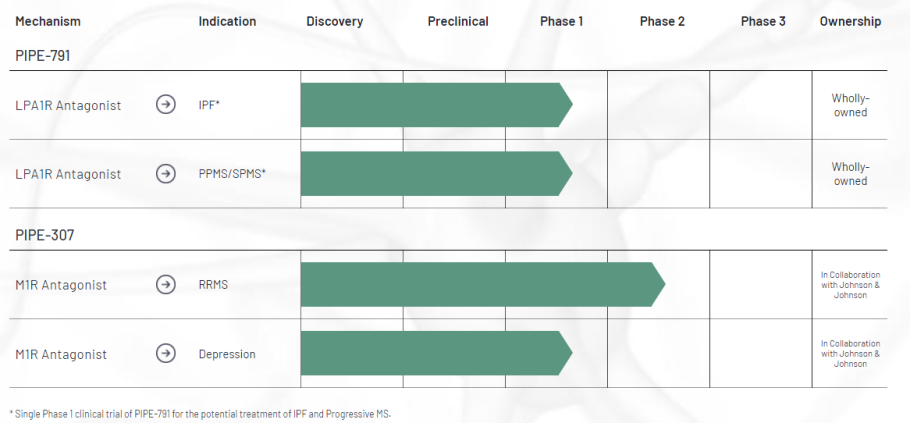
Although both are MS, the pipeline mechanism of Contineum is quite different from many other companies. Existing MS treatments, such as Dimethyl Fumarate and Ocrelizumab, work by suppressing inflammation.
Contineum Therapeutics’ pipeline, with clear indications, adopts two routes that are completely different from the mechanisms of existing therapeutic drugs:
One is the lysophosphatidic acid 1 receptor (LPA1R) inhibitor PIPE-791, and the other is toxicMushroomAlkaline Type 1 M1 receptor (M1R) inhibitor PIPE-307. In addition, the company has another pipeline with an unknown indication: LPA1R inhibitor CTX-343.
Although both of these drugs have two different细分的 MS indications, the company hasn't solely focused on MS. PIPE-791 can also be used to develop idiopathic pulmonary fibrosis (IPF), while PIPE-307 is additionally being developed for depression.
Johnson & Johnson seems to value PIPE-307 highly. In the licensing deal with Johnson & Johnson in April last year, Contineum Therapeutics (then still named Pipeline Therapeutics) not only received a $50 million upfront payment, with the potential for $1 billion in milestone payments, but also secured $25 million in equity investment and $25 million from existing investors.
Development of LPA1R Inhibitors
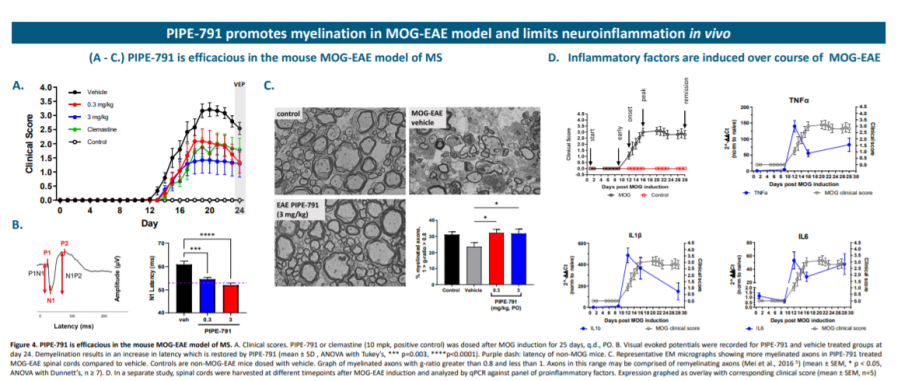
Lysophosphatidic acid (LPA) is a bioactive mediator that acts through specific G protein-coupled receptors (LPAR), and its role in the etiology of fibrosis is currently understood. In many organs, fibrosis is associated with increased production of LPA and increased expression of certain LPAR subtypes, mainly LPA1R.
Therefore, it is not difficult to understand that the indication for PIPE-791 is IPF, while its application in MS mainly began in recent years with the development by Contineum Therapeutics.
MS is an inflammatory demyelinating disease that causes interruption of neuronal transmission, eventually leading to neurodegeneration.
The current treatment focus is on suppressing the immune system to limit further inflammation and myelin loss.
Previous studies have found that in MS, levels of the inflammatory lipid lysophosphatidic acid (LPA) are elevated, and this increase in inflammatory lipids is detrimental to the progression of MS.
In addition to neuroinflammation, LPA also inhibits the differentiation of oligodendrocyte precursor cells (OPCs). OPCs are the cells that produce myelinating cells, and MS is often associated with chronic demyelination. Inhibiting LPA may help regenerate myelinating cells in MS.
And PIPE-791 is the product of this achievement transformation.
PIPE-791 is the first orally bioavailable, brain-penetrant LPA1 antagonist.
Muscarinic M1 Receptor Inhibitor
Most of the development of muscarinic M1 receptor inhibitors has focused on Alzheimer's disease and psychiatric disorders such as schizophrenia, but Contineum Therapeutics has surprisingly applied it to MS.
The mechanism is similar to the aforementioned LPA used for MS.
Previously, MS treatment drugs mainly reduced progression by inhibiting inflammatory pathways, while Contineum focuses on modulating molecules involved in myelin regeneration.
The MI muscarinic acetylcholine receptor (MIR) has been shown to be a key regulator in the maturation of oligodendrocyte precursor cells (OPCs) into oligodendrocytes (OLs), the cells responsible for producing myelin.
This finding is based on non-selective antimuscarinic compounds such as Clemastine and Benzetropine, and was subsequently validated through cell type-specific MIR knockout studies.
Based on this preliminary finding, Contineum initiated a medicinal chemistry study to discover a novel MIR-selective antagonist.
The initial antagonist produced was PIPE-359, and subsequent iterations led to the development of PIPE-307.
Preclinical studies show that PIPE307 can induce functional myelin regeneration.
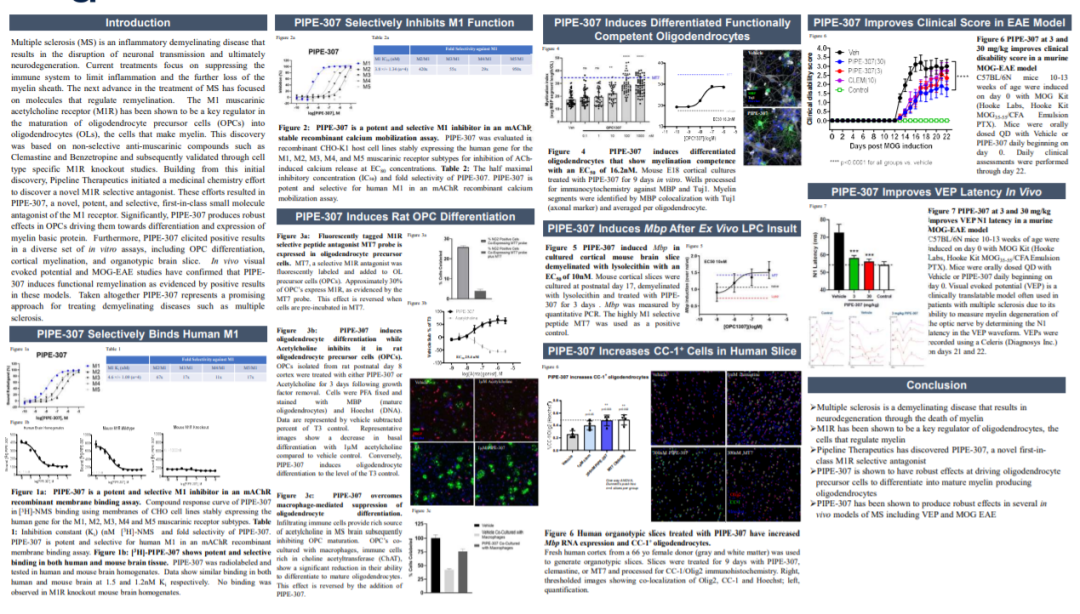
Overall, PIPE307 and PIPE-791 are actually not in conflict with existing MS treatments in terms of mechanism; they may even be complementary. Most current treatments focus on suppressing inflammatory pathways, which can only serve to delay progression. The combined use of these two drugs could potentially change the landscape of existing MS treatments. This might be the reason why Johnson & Johnson has taken a special interest in this company.
However, it is also worth noting that while delivering a good PPT presentation is one thing, the actual effectiveness of patient regeneration is another. Whether PIPE307 and PIPE-791 can demonstrate statistically significant clinical improvement in efficacy may be the key.
Reference Source:
Rancoule C, Pradère JP, Gonzalez J, Klein J, Valet P, Bascands JL, Schanstra JP, Saulnier-Blache JS. Lysophosphatidic acid-1-receptor targeting agents for fibrosis. Expert Opin Investig Drugs. 2011 May;20(5):657-67. doi: 10.1517/13543784.2011.566864. Epub 2011 Mar 24.
This article is reprinted from the BioPharma Editor.
Disclaimer
This article is a reprint and is only intended for sharing purposes, and does not represent the platform's views. The copyrights of images, articles, fonts, etc., belong to the original authors. If there is any infringement, please inform us, and we will handle it promptly.
------------------------------ 「Long press」Add Xiao Da via QR code「Join the group」
Explore Cutting-Edge Market Insights with More Industry Partners

Amida Medical Consulting IMEDA (Beijing) Pharmaceutical Information Consulting Co., Ltd., established in April 2014, is a professional pharmaceutical industry consulting service provider. The company is committed to deeply integrating industrial policy research with real-world data mining, gaining insights into the impact of industry policies on the market, and providing forward-looking market analysis through specialized research. It offers comprehensive solutions for market access after the launch of corporate products.
Disclaimer
This article is a reprint and is only intended for sharing purposes, and does not represent the platform's views. The copyrights of images, articles, fonts, etc., belong to the original authors. If there is any infringement, please inform us, and we will handle it promptly.
IMEDA (Beijing) Pharmaceutical Information Consulting Co., Ltd., established in April 2014, is a professional pharmaceutical industry consulting service provider. The company is committed to deeply integrating industrial policy research with real-world data mining, gaining insights into the impact of industry policies on the market, and providing forward-looking market analysis through specialized research. It offers comprehensive solutions for market access after the launch of corporate products.