

SparingVision Files IPO Prospectus: Advancing Mutation-Independent Gene Therapies for Inherited Retinal Diseases Affecting Over 2 Million Patients

SparingVision
Gene Therapy Developer
According to data from the World Health Organization's "World Report on Vision," in 2020, over 4 billion patients worldwide were affected by eye diseases. Due to various factors, the number of patients with eye diseases is increasing year by year.
Although the patient market is large, due to the complex structure of the eye, many structural changes are often irreversible. While drug treatments may alleviate some symptoms, they cannot alter the pathological structure. The emergence of new treatment methods has brought hope to patients with eye diseases.Take most hereditary ophthalmic diseases as an example. These diseases are mostly related to gene mutations, and gene therapy is currently recognized as an effective means of treating genetic diseases such as gene mutations.
In 2017 and 2018, the FDA and EMA successively approved the first ophthalmic gene therapy drug, voretigene neparvovec (Luxturna, Spark Therapeutics), for the treatment of inherited retinal diseases caused by mutations in both copies of the RPE65 gene, allowing patients with this condition to truly regain their sight. This undoubtedly ignited enthusiasm in the ophthalmic gene therapy field.
Seeing this blue ocean, major companies such as Novartis, Roche, Sanofi, Regeneron, and AbbVie have long been positioned in the ophthalmic gene therapy field. An increasing number of emerging companies are also joining this track, with the French ophthalmic gene therapy company SparingVision being today's main character.
Holding over 900 million yuan in funds,
Backed by SparingVision
SparingVision, founded in 2016 and headquartered in Paris, France, is a company focused on developing genomic medicines for blinding inherited retinal diseases.
SparingVision, spun off from the Paris Vision Institute, has completed three rounds of financing since its establishment, with a total financing amount of 119.5 million euros (approximately 931.2 million yuan)., including 4BIO Capital, UPMC Enterprises, Bpifrance, Ysios Capital, Jeito Capital and other international excellent investment institutions.
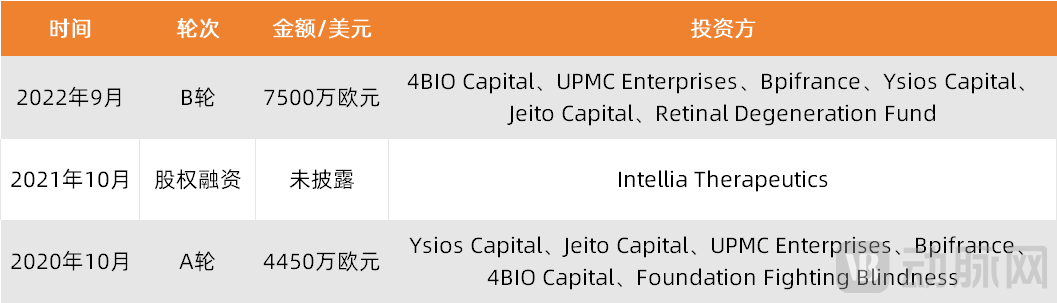
SparingVision Financing History, Compiled from Public Information
Not only is the investment team strong, but SparingVision's scientific founding team also has significant credentials. Its scientific founders are Dr. José Alain Sahel and Dr. Thierry Léveillard, both of whom are "veteran pioneers" of the Paris Vision Institute.
Dr. Sahelis the Chair and Distinguished Professor of the Department of Ophthalmology at the University of Pittsburgh School of Medicine, Director of the University of Pittsburgh Medical Center Eye Center, and holds the Endowed Chair of the Eye and Ear Foundation.Founded the Paris Vision Institute from 2008 to 2020.And guided the relevant work., he also established the French National Reference Center for Retinal Dystrophy between 2006 and 2019.And guided the relevant work.。
Based on decades of scientific research and industrialization experience, Dr. Sahel has developed various therapies for ophthalmic diseases, including stem cell implants, gene therapy, innovative pharmacological approaches, and retinal prostheses. These therapies are used to treat retinitis pigmentosa, other retinal dystrophies, age-related macular degeneration, and other currently incurable visual impairments, such as Leber's hereditary optic neuropathy.
Over the past decade, Dr. Sahel has also led pioneering work in "optogenetic therapy," a novel gene technology. Unlike traditional gene therapy, optogenetic therapy involves inserting DNA into neurons, using light-sensitive channelrhodopsin (ChR) to make neurons responsive to light, thereby helping all patients with damaged photoreceptors restore vision.Dr. Sahel's team helped a retinitis pigmentosa patient who had been blind for 40 years regain partial vision through this therapy, and the related research was published in the prestigious journal *Nature Medicine*.
In addition, Dr. Sahel has co-authored more than 700 articles and is a co-inventor of over 40 patents. Based on these achievements, he co-founded Fovea Pharmaceuticals (later acquired by Sanofi) and served as the scientific co-founder of several companies including GenSight Biologics Inc., Pixium Vision Inc., Tinak Healthcare, Chronolife, Prophesee, SharpEye, Vegavet, Avista, and Tenpoint, aside from SparingVision.
Another Scientific Co-Founder of SparingVisionDr. Léveillard also co-founded the Vision Institute at the French National Institute of Health and Medical Research (INSERM),He is also the director and researcher of the institute. In recent years, Dr. Léveillard's main research directions have been signaling and treatment of hereditary retinal degeneration as well as the treatment of neurodegenerative diseases.
Based on years of research accumulation, Dr. Léveillard founded Fovea-Pharmaceuticals in 2005 to utilize high-content screening technology for identifying new molecules to treat retinal diseases. In addition, Dr. Léveillard is also the primary inventor of Rod-derived Cone Viability Factor (RdCVF)-related technology.
Rod-derived cone viability factor can bind with transmembrane peptides on human cone photoreceptor cells. This binding can bring more glucose to neighboring photoreceptor cells, providing more nutrients to the photoreceptor cells and slowing down or even halting the rate of photoreceptor apoptosis, thereby reducing vision loss. Previously, SparingVision invested 15.5 million euros (approximately 120 million RMB) to complete this research.
Focus on 2 million patients,
Collaborates with Gene Editing Leader
Driven by both the team and funding, SparingVision is developing ophthalmic gene therapies for inherited retinal diseases (IRD) based on an AAV vector delivery system and gene editing technology.
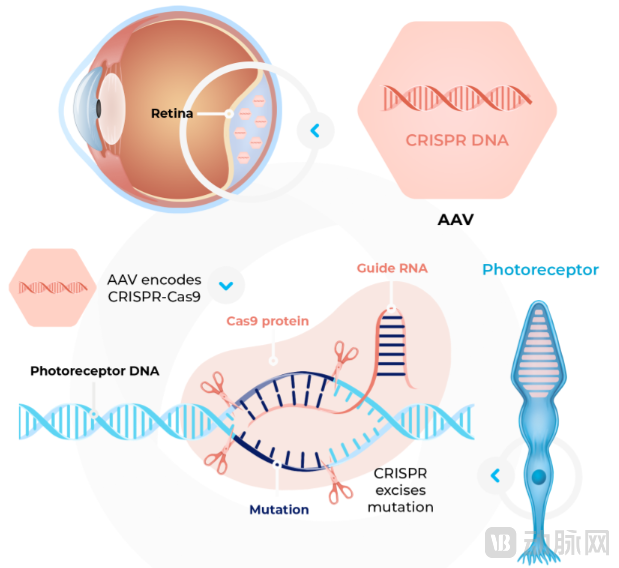
In-body Gene Therapy Strategy for Ophthalmic Diseases, Image Source: SparingVision Official Website
It is worth mentioning that, in breaking through the industry pain points in the field of gene therapy, SparingVision chose to "stand on the shoulders of giants" —By collaborating with Intellia, a pioneer in gene editing, to research and develop novel self-inactivating AAV vectors and LNP-based delivery technologies, addressing the challenges of CRISPR/Cas9 gene editing in retinal delivery.
Intellia is a company that everyone is presumably familiar with, co-founded by Nobel laureate Doudna. The company is committed to rapidly translating CRISPR/Cas9-based therapeutic developments into clinical applications, pioneering novel engineered cell therapies for various cancers and autoimmune diseases.
Currently, SparingVision has established six R&D pipelines, three of which are self-developed, and the other three are collaborative pipelines. The indications for its self-developed pipelines are all retinitis pigmentosa (RP, rod cell dystrophy).RP is the most common form of IRD, with other forms including cone/rod dystrophy (CD/CRD), Leber congenital amaurosis (LCA), macular dystrophy (MD), achromatopsia (rod monochromacy), and more.
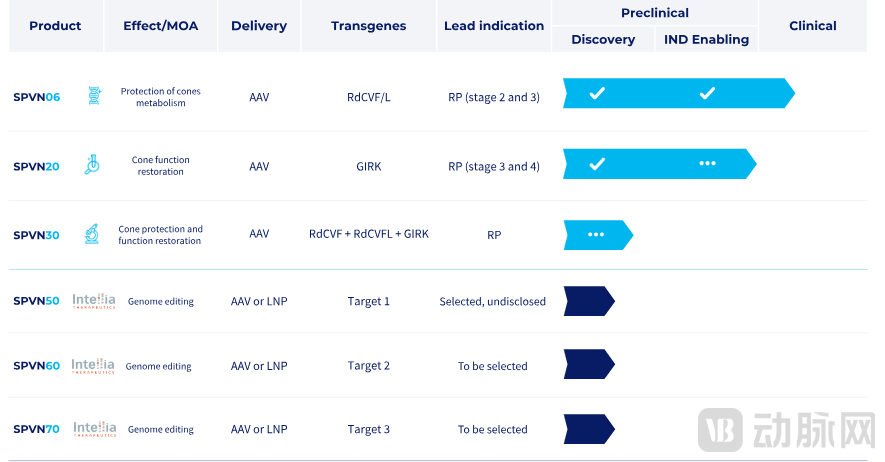
R&D pipeline, image source: SparingVision official website
RP is a rare genetic disorder caused by mutations in more than 80 genes (identified to date) that affect the retina. These genes carry instructions for making proteins necessary for the normal function of cells within the retina, known as photoreceptors. When these genes undergo harmful mutations, the ability to produce the required proteins is impaired, thus limiting the cells' functionality. Individuals with RP experience vision loss as the retinal photoreceptor cells gradually die.
It is estimated that this disease affects nearly 2 million people worldwide, with approximately 1 patient in every 3,500 individuals. However, there is currently no treatment available in the industry for this rare retinal disease.Therefore, once SparingVision's three self-developed pipelines are approved for marketing, 2 million RP patients will welcome a new gene-independent treatment method, indicating a huge clinical market potential.
Core Pipeline Achieves Significant Clinical Progress,
Global pharmaceutical companies synchronize their efforts
In January this year, SparingVision announced its core pipeline SPVN06.Ⅰ/ⅡPhase Clinical Trial (PRODYGY, NCT05748873) Achieves Significant Progress.The trial has now entered the final dose cohort of the dose-escalation phase (Part 1), with Part 2 expected to commence in the second quarter of 2024, and the primary endpoint anticipated to be reached in the second half of 2025.
SPVN06 Aims to Halt or Slow the Progression of Inherited Retinal Diseases (IRD) and Dry Age-Related Macular Degeneration (AMD). It Can Deliver RdCVF and RdCVFL Neurotrophic Factors to the Retinal Pigment Epithelium Layer via a Single Subretinal Injection, Expected to Provide Long-Lasting Neuroprotection to Prevent Disease Progression in Patients with Moderate to Severe Retinitis Pigmentosa. Previously, SPVN06 Was Granted Orphan Drug Designation in Europe.
In February, SparingVision announced the preliminary safety data from the Phase I/II PRODYGY clinical trial of SPVN06.Research data show that preliminary six-month data from three patients who received low-dose SPVN06 treatment indicated no serious adverse events, significant inflammation, discontinuation, or dose-limiting toxicity. Additionally, data from three patients who received the medium dose within one month further confirmed these findings.
In addition, SparingVision presented positive data on another core pipeline, SPVN20, at the ASGCT 2023 conference. This pipeline originated from SparingVision's acquisition of biotechnology company GAMUT Therapeutics in April 2021 and is mainly used to restore vision and color perception in patients with advanced retinitis pigmentosa who have dormant cone cells. SPVN20's mode of action involves reactivating the function of dormant cone cells by introducing G protein-coupled inwardly rectifying potassium (GIRK) channels.
At the ASGCT 2023 conference, SparingVision shared the proof-of-concept data for SPVN20 for the first time. Florence Lorget, Chief Development Science Officer of SparingVision, stated, "These data are crucial for our progress toward the IND of SPVN20."
In addition to SparingVision's continuous stream of good news, overseas companies such as ProQR Therapeutics, REGENEXBIO, MeiraGTx, Allergan, GenSight Biologics, and Spark Therapeutics have also been frequently reporting successes in the field of ophthalmic gene therapy in recent years.
In China, dozens of companies, including Neuforce Bio, Raygene Biotech, Zhongyin Technology, Lonsen Bio, Dingxin Bio, Huada Gene, Jinweike, Anlong Bio, Leadgen Pharma, InnoVector, Lingyi Bio, Mirror Bio, StarEye Bio, and Jiutian Bio, are also actively entering the ophthalmic gene therapy field.
Currently, a variety of pathogenic genes have been identified in eye diseases, with nearly 580 defined hereditary ophthalmic diseases and about 400 pathogenic genes associated with eye conditions. In China alone, there are approximately 450,000 new blind individuals and 1.35 million people with low vision each year. In the future, with the continuous increase in patient populations and the expansion of indications, it is believed that the global ophthalmic gene therapy industry chain will accelerate breakthroughs in addressing the pain points of the gene therapy sector, bringing safer and more effective treatments to tens of thousands of patients with ophthalmic diseases.