In recent years, Claudin 18.2 has become a popular target in the industry. Targeted therapy drugs and immunotherapy methods for gastric cancer developed with Claudin 18.2 as the target have achieved promising results.
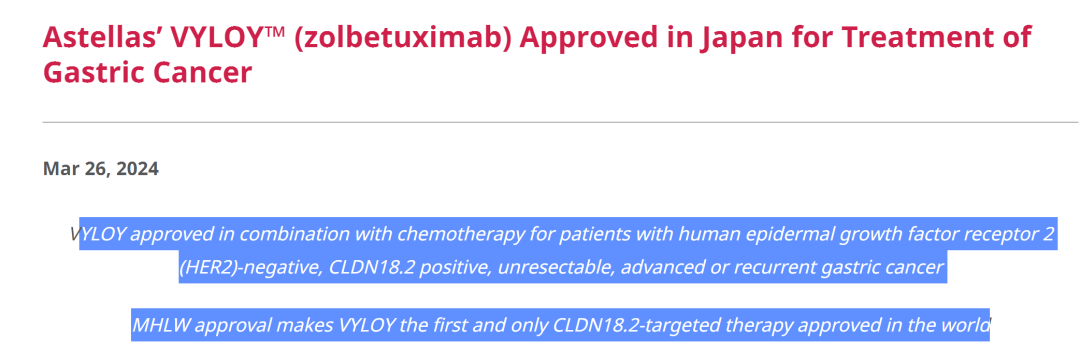
On March 26, Astellas Pharma announced that its targeted Claudin18.2 (CLDN18.2) antibody Vyloy (zolbetuximab) was approved by Japan's Ministry of Health, Labour and Welfare (MHLW) for the treatment of CLDN18.2-positive, unresectable, advanced or recurrent gastric cancer patients.
On Par with HER2, What Exactly is CLDN18.2?
Claudin proteins are a class of four-transmembrane proteins present on cells and are an important component of tight junctions. To date, 27 members of the Claudin protein family have been discovered, which can be abnormally expressed in various cancerous tissues. For instance, Claudin1 is often highly expressed in colon cancer tissues, Claudin10 is frequently highly expressed in liver cancer tissues, and Claudin18 is commonly highly expressed in gastric cancer tissues. Claudin18 is currently the most extensively studied member of the Claudin protein family and includes two subtypes: Claudin18.1 and Claudin18.2.
Data analysis revealed that, under pathological conditions, CLDN18.2 can be expressed in gastric cancer (70%), pancreatic tumors (50%), esophageal cancer (30%), breast cancer, colon cancer, liver cancer, ovarian cancer, and lung adenocarcinoma. Therefore, as a pan-cancer target, CLDN18.2 is highly anticipated to become the second significant target in the gastric cancer field after HER2.
World's First! The First CLDN18.2 Monoclonal Antibody for First-Line Treatment of Gastric Cancer!
For patients with advanced or recurrent gastric cancer who have failed standard treatment, immunohistochemical testing for the CLDN18.2 drug target has been recommended by CSCO/ASCO. Currently, the main CLDN18.2-targeted drugs under investigation include monoclonal antibodies, antibody-drug conjugates (ADCs), bispecific antibodies, and chimeric antigen receptor T cells (CAR-T).
Among them, the CLDN18.2-targeted drug Zolbetuximab was temporarily rejected by the FDA for market approval in February this year. However, this was not due to issues with Zolbetuximab's clinical data (including efficacy or safety). In fact, in first-line treatment, the 2023 CSCO guidelines have specifically added the results of the Phase III SPOTLIGHT clinical study on the CLDN18.2 monoclonal antibody Zolbetuximab combined with chemotherapy for first-line treatment of CLDN18.2-positive and HER2-negative advanced gastric cancer patients.
Now, the approval of zolbetuximab has fulfilled expectations, becoming the new standard for first-line treatment in CLDN18.2-positive advanced gastric cancer patients.
The approval of zolbetuximab is mainly based on the positive results of the SPOTLIGHT and GLOW Phase 3 clinical trials.
At the 2023 ASCO GI Conference, the CLDN18.2 monoclonal antibody Zolbetuximab reported detailed data from the Phase III SPOTLIGHT study. The published results indicate that compared to the placebo group (placebo + mFOLFOX6), Zolbetuximab + mFOLFOX6 reduced the risk of disease progression or death by 24.9% (HR=0.751; P=0.0066); the median progression-free survival for patients receiving the Zolbetuximab combination therapy was 10.61 months (vs 8.67 months), and overall survival was also extended, with a median overall survival of 18.23 months (vs 15.54 months). In terms of safety, the incidence of severe treatment-related adverse events was similar between the two groups, at 44.8% vs 43.5%, respectively.
In the GLOW clinical study, compared with the placebo plus CAPOX group, the zolbetuximab plus CAPOX group reduced the risk of disease progression or death by 31.3% (HR=0.687; P=0.0007). The median progression-free survival in the treatment and placebo groups was 8.21 months and 6.80 months, respectively. Regarding severe adverse events (TEAE), the incidence rates in the two groups were similar, at 47.2% vs 49.8%, respectively.
CLDN18.2, a promising future!
Currently, research targeting CLDN18.2 worldwide is advancing simultaneously in areas such as monoclonal antibodies, bispecific antibodies, ADCs, and CAR-T. Drugs targeting this site have now been approved for marketing. It is believed that with the disclosure of more Phase III clinical data, CLDN18.2 will fill the clinical gap in targeted therapies for gastric cancer. It is expected that in the near future, more patients with advanced gastrointestinal tumors will benefit as a result.
References
1.https://www.astellas.com/en/news/29026
2. Guan Wenlong, Wang Fenghua. Interpretation of the 2023 CSCO Gastric Cancer Diagnosis and Treatment Guidelines Update: Targeted Therapy for Metastatic Gastric Cancer[J]. Journal of Practical Oncology, 2023, 38(4): 301-304. DOI: 10.13267/j.cnki.syzlzz.2023.048.
3.Kohei Shitara, et al. Zolbetuximab + mFOLFOX6 as 1L treatment for patientswith CLDN18.2+/ HER2-locally advanced(LA)unresectable or metastatic gastric or gastroesophageajunction(mG/GEJ)adenocarcinoma: Primary phase 3results from SPOTLIGHT. 2022 ASCO GI. Abs LBA292.
4. Zolbetuximab + CAPOX in 1L claudin-18.2+ (CLDN18.2+)/HER2− locally advanced (LA) or metastatic gastric or gastroesophageal junction (mG/GEJ) adenocarcinoma: Primary phase 3 results from GLOW. J Clin Oncol 41, 2023 (suppl 36; abstr 405736)