Four CGT Therapies Approved in Q1 2024, Led by $4.25M Lenmeldy; Eight More Expected to Launch This Year

Iovance Biotherapeutics
Developer of Novel Cancer Immunotherapies

CARsgen Therapeutics
Developer of CAR-T Cell Immunotherapy Drugs
Bristol-Myers Squibb
Biopharmaceutical and Nutritional Product R&D and Sales
Orchard Therapeutics
Gene Therapy Developer
Rocket Pharmaceuticals
Gene Therapy Developer
Pfizer
Pharmaceutical R&D Developer

Hrain Biotechnology
Developer of Tumor Immunotherapy Technology R&D
2023 was a remarkable year for cell and gene therapies (CGT), with the U.S. FDA approving a total of seven therapies.
In the first quarter of 2024, the approval pace of global CGT therapies continued. According to the statistics from PharmaNews, a total of 4 CGT therapies were approved for marketing worldwide in Q1 2024, including 3 cell therapies and 1 gene therapy.
Table 1: CGT Therapies Approved for Marketing in Q1 2024
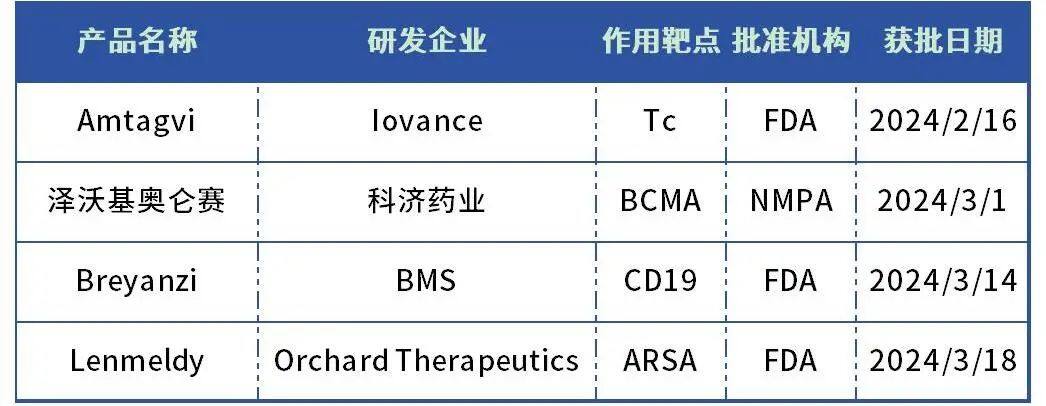
Data Source: Collated from Pharmcube data and public information
Cell Therapy: 3 Products
The Fifth CAR-T Therapy Approved in China
1.Amtagvi
R&D Company: Iovance Biotherapeutics, Inc.
Approval Date: February 16, 2024
Approval Authority: FDA
Approved Indication: Melanoma
Amtagvi, a one-time cell therapy developed by Iovance Biotherapeutics, was approved by the FDA through an accelerated pathway on February 16, 2024, for the treatment of unresectable or metastatic melanoma, becoming the world's first tumor-infiltrating lymphocyte (TIL) therapy.
Some experts believe that Amtagvi has more advantages than CAR-T therapy. Sammy Farah, CEO of Turnstone Biologics, stated in an interview with BioSpace that CAR-T can only recognize a small number of proteins on the surface of tumor cells, while TILs can recognize tumor targets derived from intracellular or extracellular tumor proteins.
According to Iovance's press release, the current price of Amtagvi is $515,000.
2. Zevorcleucel
R&D Company: CARsgen Therapeutics, Ltd
Approval Date: March 1, 2024
Approval Authority: NMPA
Approved Indication: Relapsed or Refractory Multiple Myeloma
On March 1, 2024, CARsgen Therapeutics announced that its self-developed new drug, a BCMA-targeted CAR-T cell therapy called Zevor-cel (zevor-cel injection), has been approved for marketing in China. It is indicated for the treatment of adult patients with relapsed or refractory multiple myeloma who have progressed after at least three prior lines of therapy (including at least one proteasome inhibitor and one immunomodulatory agent).
Zevorcel Oleclst is the fifth CAR-T therapy approved in China, once again proving that China's cell therapy has entered a period of rapid development.
But the commercialization of CAR-T cell therapy has always been considered an industry challenge. Zevorcel's price is 1.15 million yuan per injection, slightly lower than that of Icelis. Among the five CAR-T cell therapies currently on the market in China, only one does not break the million-yuan threshold, but it still costs 999,000 yuan per dose, exceeding the payment ability of most patients.
Table 2: CAR-T Cell Therapies Already on the Market in China
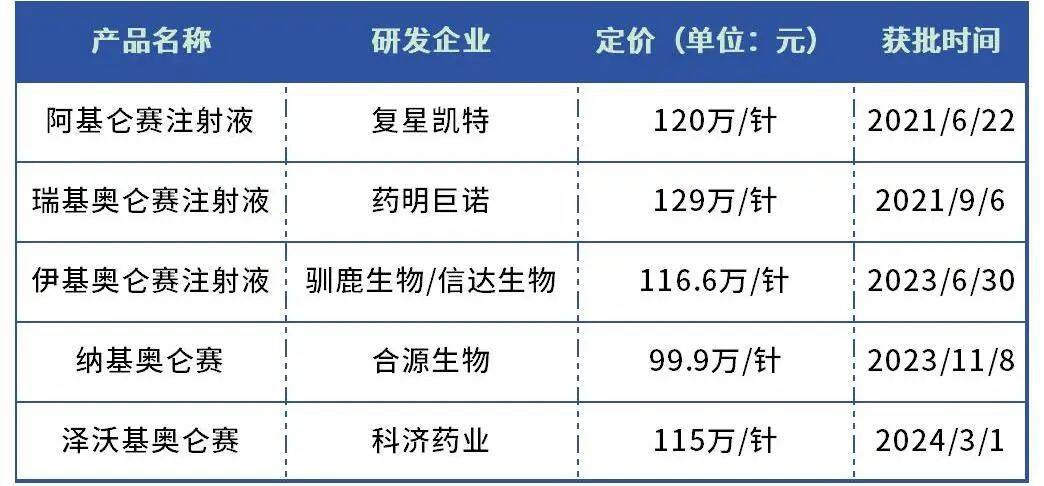
Data Source: PharmCube Data
However, CARsgen Therapeutics mentioned in media interviews that it is also making efforts in innovating payment models for CAR-T therapy, actively helping patients gain support from惠民保 (public welfare insurance) and commercial insurance.
3.Breyanzi
R&D Company: BMS
Approval Date: March 14, 2024
Approval Authority: FDA
Approved Indications: Chronic Lymphocytic Leukemia and Small Lymphocytic Leukemia
Breyanzi, developed by Juno Therapeutics, a subsidiary of Bristol-Myers Squibb, is a CAR-T cell therapy targeting the CD19 antigen with a defined composition and 4-1BB co-stimulatory domain. On March 14, it received FDA approval, becoming the world’s first CAR-T cell therapy for the treatment of relapsed or refractory chronic lymphocytic leukemia (CLL) and small lymphocytic lymphoma, as well as the fourth CAR-T therapy to be approved globally.
What sets Breyanzi apart is the controlled ratio of CD8-positive and CD4-positive T cells in CAR-T therapy, which allows for better management of the toxic side effects of cellular therapy. The 4-1BB signaling domain enhances the expansion and persistence of CAR-T cells.
The approval was based on the TRANSCEND CLL 004 trial, an open-label, single-arm, multicenter Phase 1/2 clinical trial. Data analysis showed that the trial met its primary endpoint, with 20% of patients with relapsed or refractory CLL or SLL who were treated with Breyanzi achieving complete response (CR). The duration of response exceeded 35 months, and the safety profile was confirmed.
Previously, Breyanzi has been approved for the treatment of diffuse large B-cell lymphoma (DLBCL) in the United States, the European Union, and Japan, with a market price of $410,300. According to the 2023 financial report disclosed by Bristol-Myers Squibb (BMS), Breyanzi achieved sales revenue of $364 million, doubling year-over-year.
Now, Breyanzi has secured a new indication for CLL/SLL and has become the only currently approved CAR-T cell therapy for this indication. With further differentiated expansion, its competitiveness is expected to be enhanced once again, and Breyanzi’s commercial performance in 2024 is anticipated to reach new heights.
Gene Therapy: 1
Priced at $4.25 million
Lenmeldy
R&D Company: Orchard Therapeutics
Approval Date: March 18, 2024
Approved Institution: FDA
Approved Indication: Metachromatic Leukodystrophy
On March 18, 2024, the FDA announced the approval of the gene therapy Lenmeldy (atidarsagene autotemcel, arsa-cel), developed by Orchard Therapeutics, for the treatment of pediatric patients with metachromatic leukodystrophy (MLD) who meet specific criteria. This approval marks Lenmeldy as the first gene therapy for MLD to be approved by the FDA.
MLD is a rare and fatal hereditary disease caused by mutations in the ARSA gene (22q13.33), leading to a deficiency of arylsulfatase A, which prevents the normal metabolism of sulfatides, thereby causing damage to the central and peripheral nervous systems. Affected children will eventually deteriorate into a vegetative state, potentially requiring 24-hour intensive care. Most patients pass away within five years of symptom onset, imposing a significant financial burden on families.
Lenmeldy aims to correct the underlying genetic cause of MLD by inserting one or more copies of a functional human ARSA gene into the genome of a patient’s own hematopoietic stem cells (HSCs) in vitro using a lentiviral vector. The genetically repaired cells are infused back into the patient, and once engrafted, they differentiate into various cell types, some of which cross the blood-brain barrier into the central nervous system and express the functional enzyme. This approach holds promise to restore enzyme function through a single treatment to halt or slow disease progression.
On March 20, 2024, Orchard Therapeutics announced on its official website the commercial launch details of Lenmeldy in the United States, setting the price of the drug at $4.25 million. Although Orchard believes that the $4.25 million price is reasonable, it sets a new record for the most expensive drug. Prior to this, the world's most expensive drug was Hemgenix, developed by CSL Behring and uniQure, priced at $3.5 million.
More CGT Therapies on the Way
CGT Therapy is Gradually Becoming the Golden Track in the Biopharmaceutical Field, with More Potential Waiting to Be Uncovered. In addition to the four drugs approved in the first quarter of 2024, according to incomplete statistics, eight CGT therapies are expected to successfully pass the FDA in 2024. Among them, Kresladi from Rocket Pharmaceuticals and Beqvez from Pfizer are taking the lead, with approvals anticipated in the first half of the year.
Table 3: CGT Therapies Expected to Be Approved in 2024
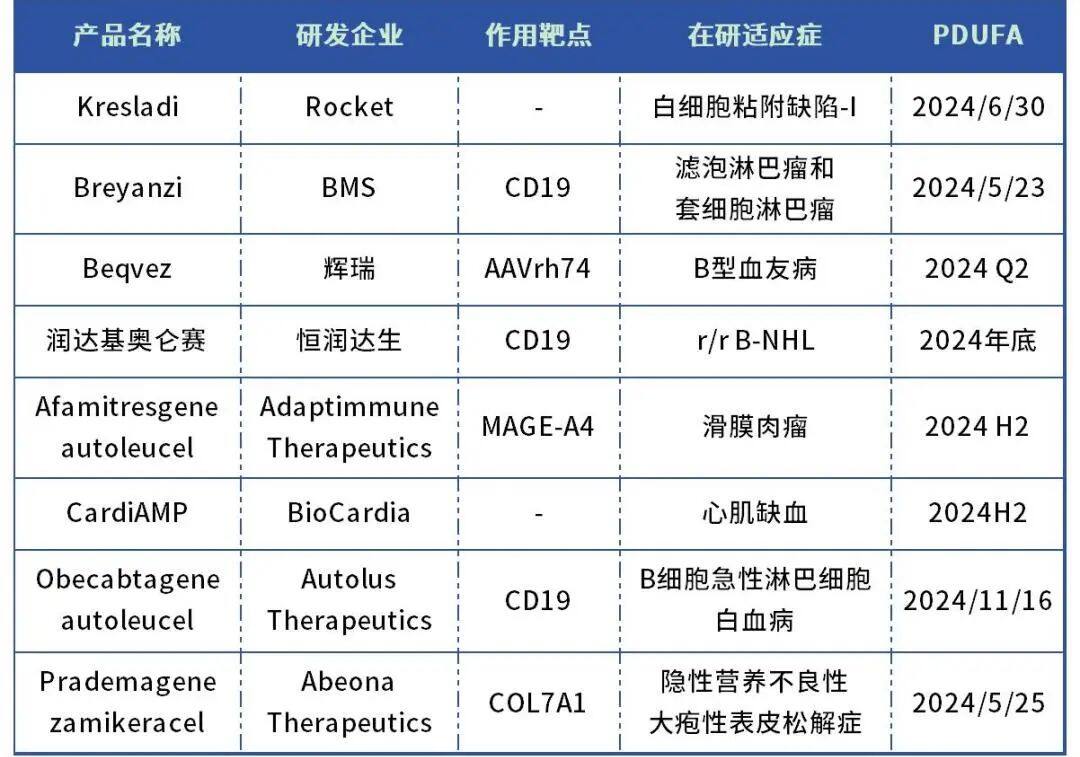
Data Source: Collated from Pharma Data and public information
1.Kresladi
R&D Company: Rocket
Indication under research: Leukocyte Adhesion Deficiency-I
PDUFA Date: June 30, 2024
FDA Extends Priority Review Period for Rocket Pharmaceuticals' Gene Therapy Kresladi™ (RP-L201, marnetegragene autotemcel) for the Treatment of Severe Leukocyte Adhesion Deficiency-I (LAD-I), with PDUFA Date Moved from March 31 to June 30 This Year. No Advisory Committee Meeting is Currently Planned by FDA, and the Extension May Be Related to FDA's Staffing Issues.
2.Breyanzi
R&D Company: BMS
Indications under research: Follicular Lymphoma and Mantle Cell Lymphoma
PDUFA Date: May 23, 2024
2024 is a fruitful year for Breyanzi. Bristol-Myers Squibb expects the FDA to make a decision on May 23 regarding Breyanzi for the treatment of patients with relapsed or refractory follicular lymphoma, and on May 31 for Breyanzi in the treatment of patients with relapsed or refractory mantle cell lymphoma who have received Bruton's tyrosine kinase inhibitor therapy.
3.Beqvez
R&D Company: Pfizer
Indication under research: Hemophilia B
PDUFA Date: Q2 2024
Beqvez (generic name: fidanacogene elaparvovec) is an AAVrh74-based adeno-associated virus (AAV) gene therapy drug.
On January 3, 2024, Pfizer announced that Health Canada had approved Beqvez for marketing. It is used to treat adult patients aged 18 years or older with moderate to severe or severe hemophilia B, provided that these patients are confirmed not to have neutralizing antibodies against the AAV serotype Rh74 subtype.
Currently, Beqvez gene therapy has not yet been approved for marketing in the United States. In June 2023, the FDA accepted Pfizer's Biologics License Application, with an expected regulatory decision to be made in the second quarter of 2024.
4. Runda Kiolron Injection
R&D Company: Shanghai Hengrun Dasheng Biotechnology Co., Ltd
Indication under research: Relapsed/Refractory B-cell Non-Hodgkin Lymphoma
Expected Approval Time: End of 2024
On December 14, 2023, the CDE official website announced that the marketing application for Runta Car-t Injection (tentative) from Shanghai Hengrun Dasheng Biotechnology Co., Ltd. has been accepted. According to the company’s earlier prospectus, the drug targets CD19 and its clinical trial application is for relapsed/refractory B-cell non-Hodgkin lymphoma (r/rB-NHL). Notably, this drug has already been granted priority review and is expected to be approved by the end of 2024 or in 2025.
Summary
CGT Therapy: A Rapidly Emerging New Treatment Approach with the Potential for "One-Time Treatment, Permanent Cure"CGT therapy is a rapidly emerging new treatment approach that holds the potential for "one-time treatment, permanent cure." However, its high cost has also drawn significant criticism from the market. With the deepening research in treatment technologies by pharmaceutical companies worldwide, it is believed that CGT therapy will overcome more bottlenecks in the future through collective efforts, reduce costs, and truly benefit more cancer patients.
References:
1.https://www.biospace.com/article/6-recently-approved-cell-and-gene-therapies-and-why-they-matter-/
2.Official Websites of Various Companies

Editor: Pea Shooter
Disclaimer: The views expressed in this article represent the author's personal opinions and do not reflect the position of Pharma Intelligence Network. We welcome discussions and additional input in the comment section; for reprints, please be sure to credit the author and source. If the content, copyright, or other issues are involved, please leave a message on this platform, and we will address it promptly.