

Wuhan's Health Industry Soars with Continuous IPO Momentum

Neurophth
Ophthalmic Gene Drug Developer
Yesterday, the World Health Industry Expo opened in Wuhan. According to information released by the organizing committee, more than a thousand well-known enterprises and organizations participated, with 56 overseas buyers coming for trade negotiations.
Since 2024, Wuhan has been highly active in investment and trade within the large health industry, with the annual World Health Industry Expo being just one of many initiatives.
On March 7, the Optics Valley Life Sciences and Health Industry Investment and Financing Conference was held. At the conference, the Optics Valley Life Sciences and Health Industry Fund was inaugurated. This fund will be led by state-owned capital, focus on niche sectors within the broader health industry, attract private capital participation, and aim to establish an Optics Valley Life Sciences and Health Industry Fund cluster with a total scale of 10 billion yuan within three years.
On March 12, at the Q1 Dual Recruitment and Investment Conference and Bio-Industry Supply Chain Matchmaking Conference held in Optics Valley Biolake, a number of key enterprises signed agreements with the Wuhan National Biological Industry Base Construction Service Center, with a total contract value reaching 16.652 billion yuan. Projects focus on cutting-edge fields such as artificial organs, innovative stem cell drugs, organ-on-a-chip, functional proteins, and semiconductor laser treatments.
On March 20, Guanggu South Big Health Industrial Park signed 15 projects with a total amount of 10.1 billion yuan.
……
Even with a biopharmaceutical industrial cluster worth tens of billions like Guanggu Bio-city, Wuhan is still accelerating its pace in the field of large-scale health industry.
One obvious manifestation is that Wuhan has become a popular destination for venture capital investment in the large health industry, especially prominent in central China.
According to statistics from the VCBeat database, Wuhan had 27 disclosed financing events in 2023, showing the highest level of activity among cities in central China.
In August 2023, Neurophth, an innovative gene therapy company for ophthalmic diseases, completed a nearly 700 million yuan C+ round of financing. The funds will be used to continuously advance the clinical trials of its core products, enhance R&D capabilities, and expand the product pipeline. This contribution marks the highest single financing amount in Wuhan's large health industry within a year.
In the same year, Neurophth's core product NR082 (rAAV2-ND4) became the first gene therapy drug in China to complete patient enrollment for a Phase III clinical trial and completed the enrollment of the first patient in the U.S. Phase I/II clinical trial. The company’s second new drug, NFS-02, currently the world's only gene therapy under research targeting ND1-LHON, has received implied consent for clinical trials from China's National Medical Products Administration and the U.S. Food and Drug Administration (FDA), and is currently conducting global multicenter clinical trials.
Previously, Neurophth had already received investments from several well-known institutions such as Sequoia Capital China and Northern Light Venture Capital.
In 2023, Wuhan Langlai Science and Technology Co., Ltd. secured 500 million yuan in Series A funding, primarily allocated for new product development, acceleration of clinical research, and the construction of key technology platforms. The company has initiated multiple drug development projects in areas such as cardiovascular, respiratory, autoimmune, pain management, and renal diseases. Currently, it has over 20 ongoing projects, eight of which have entered clinical stages, while four are in the preclinical drug feasibility development phase, all demonstrating high differentiation and leadership.
This round of financing was jointly led by Lilly Asia Ventures and Vivo Capital. According to media reports, this is also the first time that Lilly Asia Ventures has invested in a pharmaceutical company in Hubei.
Active investment and financing, and the favor of well-known investment institutions, have made Wuhan a hot spot for venture capital in the large health industry. From the perspective of the investment environment, there are mainly two reasons.
First, Wuhan has superior policies for innovation and investment in the health industry.
During the 2023 World Health Industry Expo, Wuhan announced the establishment of a 30 billion yuan Big Health and Biotechnology Industry Investment Fund. Leveraging municipal and district fiscal funds as leverage, it aims to mobilize various social capitals to form a fund cluster with a scale of hundreds of billions.
In the same year, the Hubei Provincial Government issued the "Action Plan for Accelerating the Construction of 'World Optics Valley'," with healthcare being one of the key industry sectors. The plan also emphasized guiding social capital and government funds to jointly support major cutting-edge scientific research projects, while encouraging private equity funds, not initiated by government guidance funds, to invest in Optics Valley's technological innovation projects.
In 2024, Wuhan East Lake High-tech Development Zone released the "Policy Measures to Accelerate the Construction of World Optics Valley," supporting the development of venture capital, encouraging venture capital institutions to invest early, invest small, and invest in the future. A reward of up to 10% of the actual investment amount by the venture capital institution will be given, with a maximum annual reward of 10 million yuan per institution.
Favorable policies have attracted the attention of numerous investment institutions. The 2024 Optics Valley Life and Health Industry Investment and Financing Matchmaking Conference mentioned at the beginning of this article has drawn interest from institutions such as CICC Qiyuan, Hony Capital, Mountain Blue Capital, and Ji Feng Capital. Additionally, 10 investment institutions signed equity investment agreements with five projects, with a total signing amount of approximately 300 million yuan.
Second, the Optics Valley group, Changtou group, and other state-owned enterprises are making efforts, linking up for innovative investments.
Wuhan's state-owned assets at all levels have played an important role in the investment of the large health industry. For example, Donghu Investment under Donghu High-tech Group focuses on two major fields: intelligent manufacturing and life health. The company independently manages and participates in the management of four funds and has invested in nearly 30 enterprises. According to the VCBeat database, Hubei High-Tech Investment has made 23 investments in the medical and health field, making it one of the institutions with more investments.
Among numerous state-owned capital platforms, entities like Optics Valley and Changtou frequently appear in the venture capital circle.
"The Optics Valley System" mainly refers to institutions named after Optics Valley, not all of which belong to the same large state-owned capital platform. According to incomplete statistics from the VCBeat database, among Wuhan's investment institutions, Optics Valley Talent, under the Optics Valley Financial Holdings, has directly invested in the Greater Health industry the most times, with a total of 29 investments. As a comprehensive investment institution, Optics Valley Talent is also involved in other key industries developed in Wuhan.
In the specialized investment in healthcare, the "Optics Valley System" also has subdivisions. Taking Optics Valley Health Investment (Wuhan Optics Valley Health Industry Investment Co., Ltd.) as an example, according to data from Qichacha, this institution has directly or indirectly invested in more than 30 companies, including the ophthalmic star company Neurophth and YZY Biopharma, which went public in 2023.
According to Qichacha, Optics Valley Venture Capital, which focuses on the biomedicine field, has indirectly invested in 278 companies. Among the invested enterprises of Optics Valley Venture Capital, there are also Wuhan star projects such as Epizyme, Hoyo Biotech, and BinHui Biotech.
"The Changtou System" (mainly referring to the institutions under the Yangtze River Industrial Investment Group in this article) also plays an active role in Wuhan's large health industry.
In March 2023, Hubei Province established the Chutian Fengming Science and Innovation Angel Fund, jointly funded by the provincial guidance fund, the Yangtze River Industry Group, and the Donghu High-tech Zone Management Committee. The total scale of the fund is 10 billion yuan, with the first phase amounting to 3 billion yuan, managed by Changjiang Venture Capital (Changjiang Venture Capital Fund Management Co., Ltd.).
In October, the Chutian Fengming Fund formed an angel sub-fund matrix, including six sub-funds, and established partnerships with well-known institutions such as Legend Capital and EF Capital.
Among the six sub-funds, Wuhan Mingjun Hezong Venture Capital Investment Fund Partnership (Limited Partnership), managed by Mingxi Capital, primarily invests in areas related to biopharmaceuticals. Its partners include Wuhan-listed company and leading enterprise Mingde Biotechnology, as well as Legend Capital. Mingxi Capital itself is also a professional medical investment institution jointly established by Legend Capital and Mingde Biotechnology, focusing on early-stage investments in the healthcare industry.
Public data shows that, as of now, this sub-fund has already invested in the "Smart Reproduction" enterprise Mutual Creation United in Wuhan.
In addition, Wuhan Yifeng Zhuohua Venture Capital Partnership (Limited Partnership), managed by Yifeng Capital, mainly invests in the biomedical-related fields. Its partners include innovative R&D institutions such as Wuhan Innovation Institute (WRI) and local state-owned enterprises like Anhui Railway Fund. Since its establishment, the fund has invested in two companies in Wuhan: Tianqin Bio and Huiguan Bio.
In the field of the large health industry, Changjiang Industrial Investment Group is accelerating the expansion from the "one-way street" of biopharmaceuticals to the "multi-lane" of life health. It is gradually diversifying its relatively single raw material pharmaceutical production into multiple businesses such as biopharmaceuticals, traditional Chinese medicine, and high-end medical equipment. In November 2023, Hubei Changjiang Medical Industry Investment Co., Ltd. was established through integration to carry out more specialized investments.
State-owned capital platforms not only provide direct financial support to innovative enterprises but also attract leading institutions and invigorate the venture capital market by leveraging social investment, further diversifying the funding sources needed by innovative enterprises.
In fact, Wuhan has been developing the large health industry for a long time and has already produced a group of leading enterprises.
From the perspective of listed companies, Wuhan currently has 15 IPOs. Among them,Companies that went public early have already achieved significant revenue, with Renfu Medicine and Jiuzhou Tong reaching market values of hundreds of billions. Both have played a pioneering role in the local industrial innovation ecosystem.
In July 2020, Humanwell Healthcare Group's injectable Remimazolam Besylate was approved, becoming the first Class 1 new chemical drug in Hubei Province. This broke the nearly 30-year absence of innovative drugs in the field of sedatives widely used in clinical settings both in China and internationally. Less than a year later, Humanwell Healthcare Group's injectable Sodium Phosphopropofol was approved, further adding another Class 1 new drug to the local pharmaceutical repertoire.
According to the financial report of Humanwell Healthcare, in 2023, the company achieved operating revenue of 24.525 billion yuan, representing a year-on-year increase of 9.79%. The R&D expenses were 1.462 billion yuan, marking a year-on-year increase of 51.21%, significantly higher than the revenue growth rate. This was mainly due to the company accelerating the development progress of innovative products and specialty generic drugs around its established product lines, continuously increasing investment in R&D.
As of the end of 2023, Renfu Pharmaceutical has established R&D centers in Wuhan, Yichang, and other places. The company has more than 500 ongoing research projects, including over 30 new drugs of Class I.
As a leading company in China's pharmaceutical distribution sector, Jiuzhou Tong has achieved numerous innovative accomplishments, particularly excelling in leveraging digitalization to enhance pharmaceutical distribution. For instance, Yaojiujiu, the company’s B2B e-commerce platform, fully empowers end customers such as independent pharmacies and clinics across the entire supply chain. In the first half of 2023, its self-operated business revenue reached 6.054 billion yuan, making it a leading off-hospital digital pharmaceutical distribution platform in China. Additionally, the company provides health product supply chain services to major pharmaceutical retail e-commerce platforms such as JD.com, Alibaba, Meituan, Dangdang, Ping An, Douyin, Kuaishou, and Baidu. In the first half of 2023, sales revenue from this segment amounted to 3.254 billion yuan, representing a significant year-on-year increase of 62.56%.
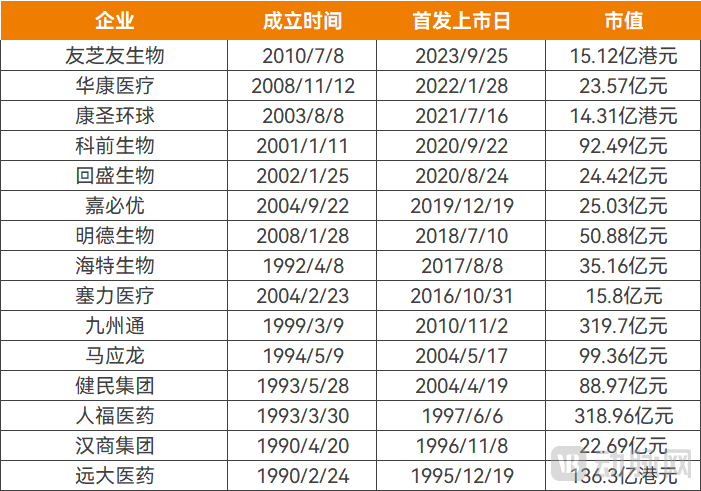 Listed companies in Wuhan's large health industry (market value as of the most recent trading day's closing data), source: Tiger Brokers International
Around 2015, driven by multiple factors such as policies and capital, China launched a wave of innovation and venture capital in the large health industry. Coinciding with this turning point, from 2016 to 2023, Wuhan saw the birth of new listed companies every year, becoming a rising force in industrial innovation.
In September 2023, YZY Bio went public on the Hong Kong Stock Exchange. Its core product is a biologic innovation drug developed based on a bispecific antibody platform to combat major diseases. Unlike most of its peers who focus on innovative drugs developed around specific cancers, YZY Bio primarily targets severe cancer complications—namely malignant ascites and malignant pleural effusion—which represent a significant unmet need in clinical practice.
Hite Bio focuses on the research and production of drugs for use in neurology and oncology. In November 2023, Hite Bio's Class I biologic product, Eprenetapoptide for injection, was approved for marketing. This medication, in combination with thalidomide and dexamethasone, is used to treat adult patients with relapsed or refractory multiple myeloma who have previously undergone at least two systemic treatment regimens. It will open up a completely new area of treatment for multiple myeloma and provide patients with a new drug option and method of administration. Previously, Hite Bio had already launched and marketed a Class I new drug, Mouse Nerve Growth Factor (NGF) for injection.
Overall, Wuhan's listed companies are involved in multiple fields such as innovative drugs, innovative medical devices, pharmaceutical distribution, and nutritional health, jointly leading the industrial innovation ecosystem.
In Wuhan, there are scientific research and educational resources such as Huazhong University of Science and Technology, Wuhan University, Wuhan Institute of Virology of the Chinese Academy of Sciences, and Wuhan Institute of Biological Products of China National Pharmaceutical Group. There are also high-quality medical service resources like Tongji Hospital affiliated with Tongji Medical College of Huazhong University of Science and Technology, Renmin Hospital of Wuhan University, and Zhongnan Hospital of Wuhan University. These well-known resources in the industry provide strong support for the development of the local large health industry.
The founder of an innovative pharmaceutical company in Wuhan told VCBeat that when selecting a location for the company's establishment, eastern coastal cities were also considered. However, after comprehensive comparison, taking into account factors such as the required laboratory space and cost-effectiveness of rent, they ultimately chose Wuhan. This shows that industrial space is also one of Wuhan's advantageous resources. Compared with other mature industrial clusters in China, Wuhan offers more price-competitive industrial space.
After introducing innovative projects and enterprises, how to optimize the internal industrial space allocation? After years of exploration and practice, Wuhan is also accelerating the optimization of its own industrial space.
It is reported that the 2019 Wuhan Big Health Industry Development Plan proposed to build a new "one city, one park, three zones" pattern with coordinated development in five fields: biopharmaceuticals, medical devices, pharmaceutical distribution, bio-agriculture, and health services.
"One City" refers to Optics Valley Biolake, which mainly focuses on the construction of headquarters economy for the greater health industry, R&D of innovative drugs, high-end medical devices and bio-agricultural products, incubation of innovative enterprises, collaborative innovation of industrial chains, technical platform support, and exploration and innovation of industrial policies, serving as the driving core of the city's greater health industry.
"One Park" refers to the Optics Valley South Grand Health Industrial Park, which承接并放大了光谷生物城产业的溢出效应; "Three Zones" are respectively the Hanyang Grand Health Industry Development Zone, the Tongji-Xiehe National Medical Service Area, and the Wuhan Yangtze River New City International Medical Innovation Zone.
Among them, as the core area, Optics Valley BioCity has become a 100-billion-level biopharmaceutical industry cluster after 15 years of development, gathering more than 3,000 biotechnology companies, nurturing 85 companies with revenues exceeding 100 million yuan and seven listed companies, and hosting nearly 100 national and provincial innovation platforms.
After developing to a certain stage, the large health industry of Optics Valley BioCity "spills over" to the surrounding areas. At the park level, Huangshi and Huanggang have respectively built local industrial parks of Wuhan National Biological Industry Base, while Ezhou's Gedian Development Zone has invested 4 billion yuan in building a large health industrial park in line with Optics Valley BioCity, to undertake the spillover of scientific and technological innovation resources from Optics Valley BioCity to the east.
At the enterprise level, the headquarters of Humanwell Healthcare is located in Optics Valley Biolake, while the industrial production base for new specialty active pharmaceutical ingredients at Huanggang Humanwell in the Huanggang Chemical Industry Park has already commenced operations.
Thus, the Wuhan Metropolitan Area Life and Health Industry Alliance was established in March 2024. The first batch of member units includes Optics Valley BioCity, Huangshi Economic and Technological Development Zone, Ezhou Gedian Economic and Technological Development Zone, Huanggang High-tech Industrial Development Zone, Wuhan Chemical Industrial Park, and Optics Valley South Big Health Industrial Park, among others. Leveraging Optics Valley's R&D advantages, Huanggang's compliant chemical industry park platform, and Ezhou's active pharmaceutical ingredients (API) characteristics, they complement each other to form a collaborative development model of "headquarters and R&D in Optics Valley, with supporting facilities in the metropolitan area."
Compared with other industrial clusters, Wuhan has comprehensive advantages in space, scientific research, talent, and medical care. Specifically, within Wuhan, the local area has made more detailed regional divisions based on the emphasis of core metropolitan areas and metropolitan circles on the above elements, allowing various enterprises to find suitable positions within them.
Dakang Technology, headquartered in Beijing, conducted extensive research before deciding on a city for its subsidiary. Ultimately, the company chose Wuhan, setting up in Optics Valley BioCity, where it has opened for business and placed the entire process of R&D, production, clinical trials, and scientific research technical services. In the view of Zhou Yu, co-founder and CEO of Dakang Technology, Wuhan "has unparalleled advantages nationwide that meet the internal needs of the company in terms of R&D, production, and application."
This is also a typical case under the background of Wuhan's comprehensive utilization of industrial resources and optimization of resource allocation.
It is understood that,In 2023, the revenue scale of Wuhan's life health industry exceeded 400 billion yuan, with each细分领域showing a steady growth trend. This data is driven by multiple factors including policy, innovative technology, capital, and supporting resources.
Previously, VCBeat has interpreted multiple cities or clusters in North China, East China, Southwest China, and other regions. Against the backdrop of the current trend in various places of "promoting investment through investment, linking investment and attraction," as well as the difficulties of raising funds in the capital market, observing cities and clusters in the large health industry not only provides geographical information for enterprises but also showcases the focus and advantages of industrial elements in different regions, offering businesses a more comprehensive reference.
As an active zone in the central China's large health industry, Wuhan's differentiated advantages have become increasingly evident. In the process of accelerating development, how will Optics Valley Biolake collaborate with innovative enterprises to achieve continuous breakthroughs in the next 15 years? How will Wuhan's core urban areas work with surrounding regions to further improve the industrial chain ecosystem? It remains to be anticipated.