In mid-November 2023, the world's first CRISPR gene-editing therapy was approved for marketing in the UK, marking a breakthrough in the application of gene-editing technology for disease treatment.
After more than a decade of development, the CRISPR technology initially pioneered by two scientists in 2012 has now been applied to various scenarios, including gene-edited cell therapy for thalassemia, gene-edited breeding, and gene-edited organ transplantation. The approval and market launch of the first gene-editing therapy marks a breakthrough in CRISPR gene-editing technology, transitioning from original basic research to clinical translational application, representing an important milestone in its development history.
It is worth noting that many blockbuster drugs have been launched by foreign pharmaceutical companies so far, but what about the progress of domestic pharmaceutical companies? Who will be the first to achieve a breakthrough?
Gene Editing Therapy Track Welcomes Commercialization,Who Will Take the Lead in China's First CRISPR Gene Editing?Gene Therapy?Casgevy, the CRISPR gene-editing therapy developed by Vertex Pharmaceuticals in collaboration with CRISPR Therapeutics, has been successively approved for marketing in the UK and the US. Initially, it received conditional approval from British regulatory authorities in November 2023 for treating sickle cell disease (SCD) and transfusion-dependent beta-thalassemia (TDT). Subsequently, on December 8, it was approved by the US Food and Drug Administration (FDA).The therapy approved this time is a "milestone advancement," marking a new breakthrough in gene therapy, providing a novel curative approach for difficult-to-treat genetic diseases such as thalassemia and sickle cell anemia. Similar to the million-dollar-per-dose CAR-T therapy, gene-editing therapy falls under personalized medicine: it is made from the patient's own hematopoietic stem cells, genetically edited and modified, and then reintroduced into the patient’s body through a single injection using hematopoietic stem cell transplantation.Therefore, it is destined to have relatively high costs and prices.Why Vertex and CRISPR Therapeutics?CRISPR Therapeutics, co-founded by Dr. Emmanuelle Charpentier of Umeå University, Sweden—one of the Nobel Prize winners for CRISPR technology—is one of the first companies to apply CRISPR in clinical treatment. Vertex Pharmaceuticals, Inc., an American pharmaceutical company established in 1989 with its headquarters in Massachusetts, is a publicly traded company. The company primarily focuses on the production and sale of drugs for treating pulmonary, renal, hematological, and other diseases. In the 2023 Fortune 500 Ranking of America's largest companies, it ranked 427th with a revenue of $8,930.7 million. This highlights its long history of development, strong financial capacity, and extensive experience accumulated across drug research and development, manufacturing, clinical application, and sales channels.
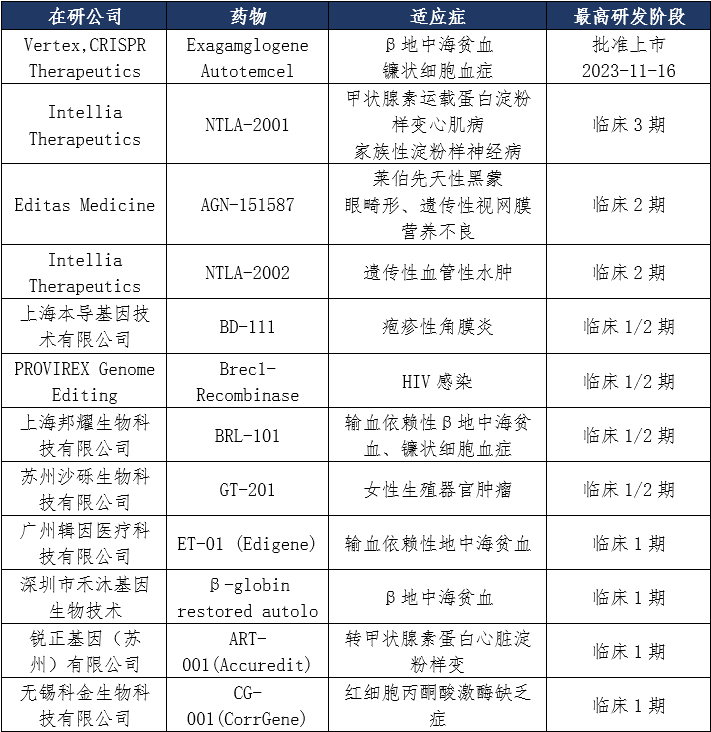
Therefore, through collaboration, CRISPR Therapeutics, a biotechnology company that owns CRISPR patent technology but lacks experience in drug industrialization, is leveraging the strength of large pharmaceutical enterprises to accelerate the clinical advancement and market launch of its pipeline.In fact, this can be seen from their early collaboration. As early as March 27, 2023, Vertex and CRISPR Therapeutics reached a non-exclusive licensing agreement to use CRISPR Therapeutics' gene-editing technology CRISPR/Cas9, obtaining non-exclusive rights to the CRISPR technology for developing low-immunogenic gene-edited cell therapies for T1D.The core technology patents for gene editing are largely held by the companies founded by two female scientists and Zhang Feng, includingDr. Emmanuelle CharFounded by pentierCRISPR Therapeutic,Dr. Jennifer A. Doudna founded Intellia Therapeutics, and Zhang Feng foundedEditas Medicine. Therefore, the progress of gene editing pipelines in these few companies is relatively fast, but currently, only CRISPR Therapeutics is advancing drug development through collaboration with traditional pharmaceutical enterprises.CRISPR Therapeutic:Founded in 2013 by Emmanuelle Charpentier, along with Rodger Novak and Shaun Foy. Charpentier was awarded the Nobel Prize in Chemistry in 2012 for the discovery of the next-generation gene-editing tool CRISPR/Cas9. Based on its proprietary CRISPR/Cas9 platform, the company develops genetic medicines targeting severe diseases and has received approval for the world's first CRISPR gene-editing therapy, Casgevy.Intellia Therapeutics:Founded in May 2014 by Jennifer A. Doudna, another Nobel Prize winner for gene-editing technology. Its NTLA-2001 is an innovative in vivo editing therapy that uses lipid nanoparticles (LNP) to package a CRISPR gene-editing system targeting the TTR gene, aimed at treating neurological and cardiac diseases caused by transthyretin amyloidosis (ATTR). It has currently entered phase three clinical trials.Editas Medicine:Zhang Feng's first gene-editing therapy company, which he co-founded, holds multiple gene-editing patents, including the application of CRISPR-Cas9 technology in eukaryotic cells and CRISPR-Cas12a. Its AGN-151587 gene-editing therapy for treating Leber congenital amaurosis, a hereditary blindness disorder, has entered phase II clinical trials.Pipeline Progress of Gene Editing Therapy Companies in ChinaIn addition to the first approved product, more than ten CRISPR gene-editing therapies worldwide have entered clinical trials, including several products developed by Chinese companies. According to data, the main emerging biotech companies with relatively rapid progress in gene-editing therapy in China include Bendao Gene, Grail Biotechnology, Hemu Gene, BRL Medicine, and EdiGene. The relevant companies’ pipelines are currently in Phase 1/2.Table 1. Global Research and Development Progress of Gene Editing Therapeutics (As of March 31, 2024)Data source: Collated from the PharmSnap database.) Shanghai Bendao Gene Technology Co., Ltd BD-111BD111 Injection is a novel in vivo gene-editing antiviral drug independently developed by Shanghai Bendao Gene Technology Co., Ltd., belonging to the global First-in-Class products. It utilizes the proprietary virus-like particle (VLP) technology to deliver CRISPR gene-editing tools, directly targeting and cleaving.1The genome of type 1 herpes simplex virus (HSV-1) is targeted to eliminate the virus. This marks the third in vivo gene editing therapeutic candidate globally to enter clinical stage, following the in vivo gene editing pipelines of U.S.-based Editas and Intellia. It also represents the world's first CRISPR antiviral gene editing drug.Its core technological advantage lies in its globally pioneering delivery vector technology, which modifies lentiviral vectors to deliver mRNA expressing CRISPR gene-editing tools, enabling the expression of CRISPR scissors for viral gene cutting in vivo.BRL-101 is a gene therapy product developed based on BRL Medicine's self-developed hematopoietic stem cell platform (ModiHSC), indicated for transfusion-dependent β-thalassemia. The product induces the expression of fetal γ-globin by reducing BCL11A expression through CRISPR/Cas9-mediated mutation of the BCL11A erythroid enhancer. BRL-101 officially launched a multi-center Phase 1/2 registrational clinical trial in China in October 2022.Its advantage lies in the use of non-viral vectors, offering superior safety and lower costs compared to products delivered using viral vectors.GT201 is the next-generation TIL (Tumor Infiltrating Lymphocyte) pipeline developed by Grail Bio based on its self-developed TIL expansion and editing platforms. It is the first gene-edited TIL drug in China to enter registered clinical trials. By extracting tumor tissue from patients and isolating TILs, specific genes are knocked out using Grail Bio's unique and efficient TIL gene knockout system. Subsequently, through Grail Bio’s self-developed retroviral system, StaViral, stable expression of the target gene can be achieved across multiple batches of TIL cells derived from different tumor types. After expansion, the cells are reinfused into the patient to combat gynecological tumors.The advantage lies in the combination of gene editing and immune cell therapy, applying gene editing technology to the genetic modification of TIL, which enhances the efficiency of immune cell therapy development.Overall, from a competitive perspective, BRL Medicine, EdiGene (Guangzhou Subsidiary), and Heme Gene are the three companies with relatively faster progress in targeting β-thalassemia. The first gene-editing therapeutic drug for thalassemia produced in China is likely to emerge from these three. In terms of new indications, BD-111 (Herpes Simplex Keratitis) by Shanghai Bendao Gene Technology Co., Ltd and GT-201 (Female Reproductive Organ Tumors) by Gracell Biotechnologies have entered Phase 1/2 clinical trials and are also expected to be the first to reach the market in China.The tweet is used to convey knowledge. If you have any questions about copyright, etc., please contact PharmaExpress within 30 days of the publication of this article.Original content is prohibited from being reproduced on other platforms without authorization.Questions can be sent.Email to yong_wang@pku.edu.cn for more information.©2021 Medicine Express All rights reserved

The WeChat Official Account "医药速览" currently hasNearly 12 communication groups(Eager to learn, interesting, and bustling with pharmaceutical talents gathered here). Join the group by addingAuthor's WeChat (yiyaoxueshu666)Or scan the QR code of the official account to add the author, with remarks "Name/Nickname-Company/University-Specific Research Field/Major". This group is exclusively for scientific research exchange, please do not disturb if not sincere.
Simple operation can star ⭐️ PharmaExpress, receive our push notifications in the first time.①Click "Pharmaceutical Express" below the title② to the upper right corner "..." ③ click "Set