

Merck Acquires Abceutics for $208 Million to Enhance ADC Safety with PBSE Technology

Abceutics
ADC Drug Developer

MSD
Pharmaceutical R&D and Manufacturer
Recently, according to an announcement released by the University of Buffalo, MSD acquired Abceutics Inc., a biotechnology startup, for $208 million. The potential consideration for this deal amounts to $208 million (approximately 1.505 billion RMB), including contingent milestone payments based on the progress of the candidate pipeline as per the agreement.
It is worth mentioning that the core team of Abceutics has designed "Payload-Binding Selectivity Enhancers (PBSEs)" to bind and neutralize stray payload molecules, preventing Antibody-Drug Conjugates (ADCs) from killing healthy cells, thereby improving the safety and efficacy of ADCs.
Previously, MSD's transactions in the ADC field mostly involved introducing product pipelines. This acquisition of Abceutics, however, focuses on bringing in PBSE technology, marking another significant step for MSD in enhancing its ADC sector.
Abceutics Inc. was spun out from the laboratory of Professor Joseph P. Balthasar, a researcher at the University at Buffalo in New York. The company was founded in 2020 by Dr. Balthasar (pictured below), his students Brandon Bordeau and Toan Duc Nguyen, and pharmaceutical consultant Larry Wienkers, who previously served as Vice President of Amgen and Global Head of Pharmacokinetics and Drug Metabolism.
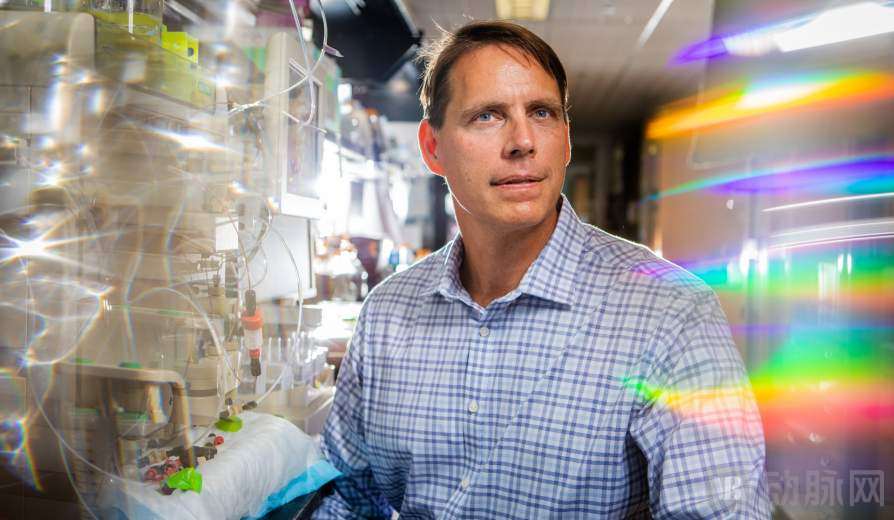
Joseph P. Balthasar, Founder of Abceutics, Image Source: University at Buffalo
Abceutics' core layout is closely related to ADC.ADCs consist of monoclonal antibodies conjugated to cytotoxic payloads through linkers. The antibody component of ADCs specifically targets the drug to particular cancer cells, and the cytotoxic payload utilizes highly potent cell-killing properties to then eliminate the targeted cancer cells.Based on the structural characteristics of ADCs, the team designed a "Payload Binding Selective Enhancer" (PBSE) to bind and neutralize stray payload molecules, reducing the impact of these payload molecules on healthy cells.
PBSE is a compound that can specifically bind to free payloads. It reduces the impact of toxins on healthy cells by binding to and neutralizing the toxicity of harmful payloads. Dr. Balthasar explained, "When used in combination with ADC, PBSE has the potential to optimize the selectivity and efficacy of ADC therapy while reducing side effects." Based on this technology, Abceutics Inc. has currently developed several promising preclinical candidate compounds.
It is worth mentioning that this core technology has been licensed by the University at Buffalo. In addition, the development of PBSE technology has received grants from the National Institutes of Health (NIH) and $110,000 in funding from the Buffalo Innovation Accelerator Fund.
In addition to its core technology gaining recognition from major institutions, Abceutics has also secured substantial resources by leveraging its university background. The company operates out of the incubator center at the University at Buffalo’s New York State Center of Excellence in Bioinformatics and Life Sciences, which provided Abceutics with $50,000 in R&D funding through the Science, Technology, and Innovation Department of Empire Development.
$40 Billion "Powerfully" Builds the ADC Landscape,
$200 Million "Fine-Tuning" ADC Layout
In recent years, MSD has ascended to the top position in the oncology pharmaceutical field due to its drug Keytruda (K药), accumulating substantial capital. According to MSD’s 2023 annual report, the company's total revenue for the year was $60.1 billion, with Keytruda generating sales of $25 billion, accounting for over 40% of the total revenue.
While sitting high on the throne, MSD has likely been planning ahead, seeking new growth points before the arrival of Keytruda's patent cliff. Clearly, ADC is one of the key areas that MSD is optimistic about for the future.Not only does MSD have high hopes for ADC, but pharmaceutical giants such as Pfizer, AbbVie, AstraZeneca, GSK, and Johnson & Johnson are also actively involved in this field, sparking a buying spree in the ADC sector, with billion-dollar projects frequently emerging.
Since publicly entering the ADC field in 2020, MSD has been "spending generously" in recent years, successively reaching deals with companies such as Seagen, VelosBio, Kelun-Biotech, and Daiichi Sankyo, with cumulative transaction amounts exceeding 40 billion US dollars.
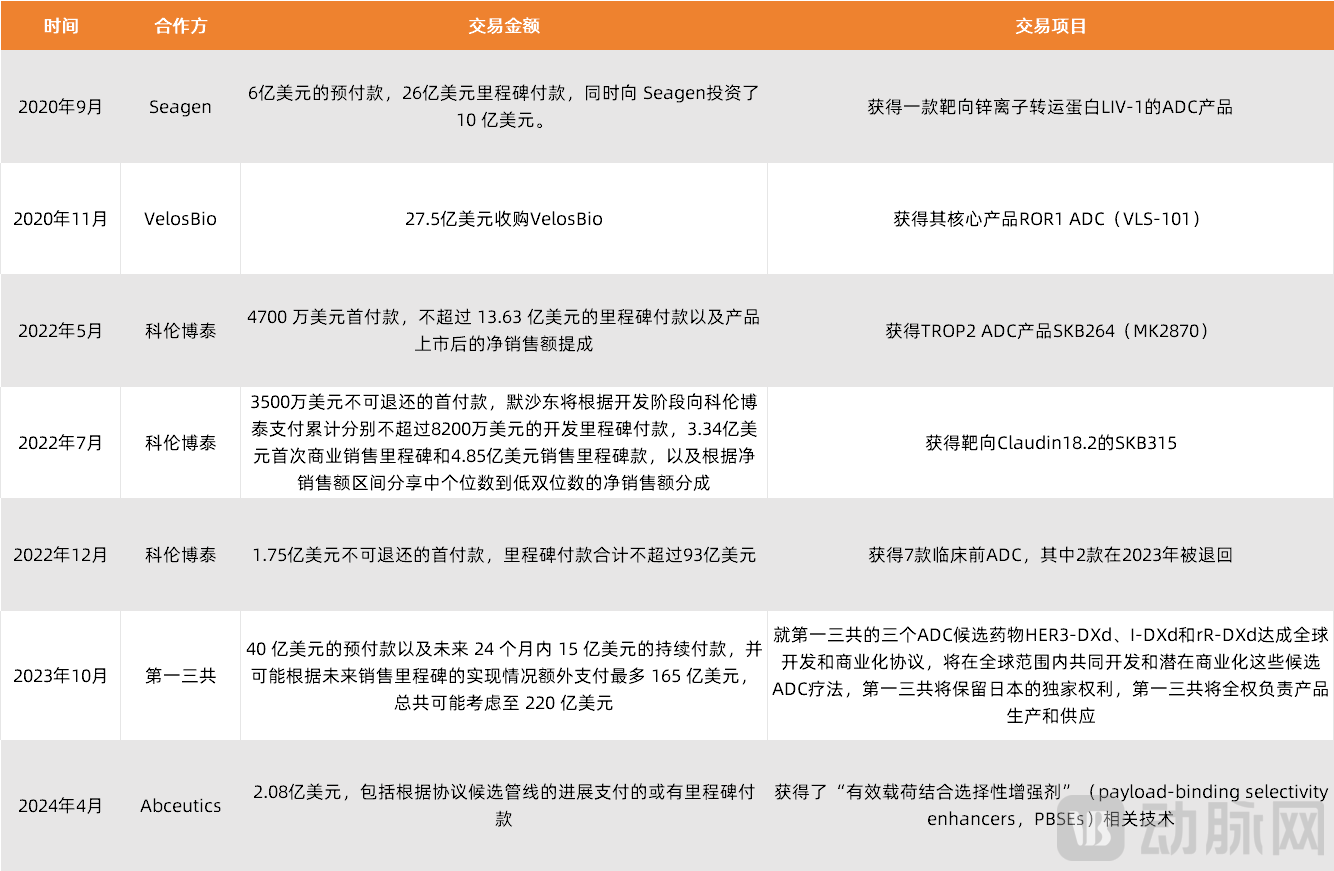
MSD's Recent Transactions in the ADC Field, Based on Public Information
Compared to previous expenditures of billions of dollars on ADC, this $200 million deal is quite a "small investment" for MSD. However, it represents a crucial and distinctive move in MSD's ADC strategy.
In the field of new drug development, the currently popular ADC is quite different from the once fiercely competitive PD-1. MSD once dominated the PD-1 battlefield but may not necessarily have the same ease in the ADC field.
ADC Drug Development Has Higher Technical Requirements and More Complex Molecular Design. In addition to antibodies, ADCs also involve cytotoxins, linkers, and the method of linking the linker to the antibody. ADCs encompass multiple dimensions, including targets, antibodies, small-molecule toxins, linkers, and methods of connection, all of which vary greatly. Different combinations of targets, cytotoxins, and linkers give each ADC its own unique characteristics and biological activity.
Previously, MSD's transactions in the ADC field mostly involved aggressively acquiring pipelines. AndThrough the acquisition of Abceutics, MSD is focusing on integrating PBSE technology to jointly develop it with the ADC pipeline, fine-tuning the ADC pipeline to reduce ADC side effects while enhancing its selectivity and efficacy.
In the past, MSD led the development of the tumor immunotherapy field with its Keytruda (K药), becoming the top pharmaceutical company in the anti-tumor sector. In the ADC field, MSD was the first to secure the approval for a combination therapy involving a PD-1 antibody and an ADC, while comprehensively expanding its presence in ADCs and related technology platforms. Clearly, by previously introducing several pipelines covering both popular and promising ADC targets, and now integrating its core technologies, MSD's competitiveness in the ADC space will be further strengthened.
Next, in the new round of competition in tumor immunotherapy, can MSD still maintain its leading position? Let's wait and see.
Reference: "MSD's ADC Landscape: Partnering with Kelun and Daiichi Sankyo, Initiating a New Era of PD-1 + ADC"