

Latest Clinical Advances of Overseas ADC Drugs at AACR 2024

Bayer
Pharmaceutical Product R&D Developer

AbbVie
Innovative Drug Developer

Novartis
Drug Development and Manufacturing

Roche
Oncology Drug Research, Development, and Manufacturing

Heidelberg Pharma
Drug Developer

Daiichi-Sankyo
Pharmaceutical R&D Developer

AstraZeneca
Biopharmaceutical Manufacturer
Welcome to follow Asymchem Pharma News
The 115th Annual Meeting of the American Association for Cancer Research (AACR) in 2024 grandly opened on April 5 in San Diego, USA. Themed "Inspiring Science · Driving Progress · Revolutionizing Treatment," the meeting aims to bring together top experts and scholars in the global cancer research field to jointly discuss early-stage research and innovative advancements in oncology.
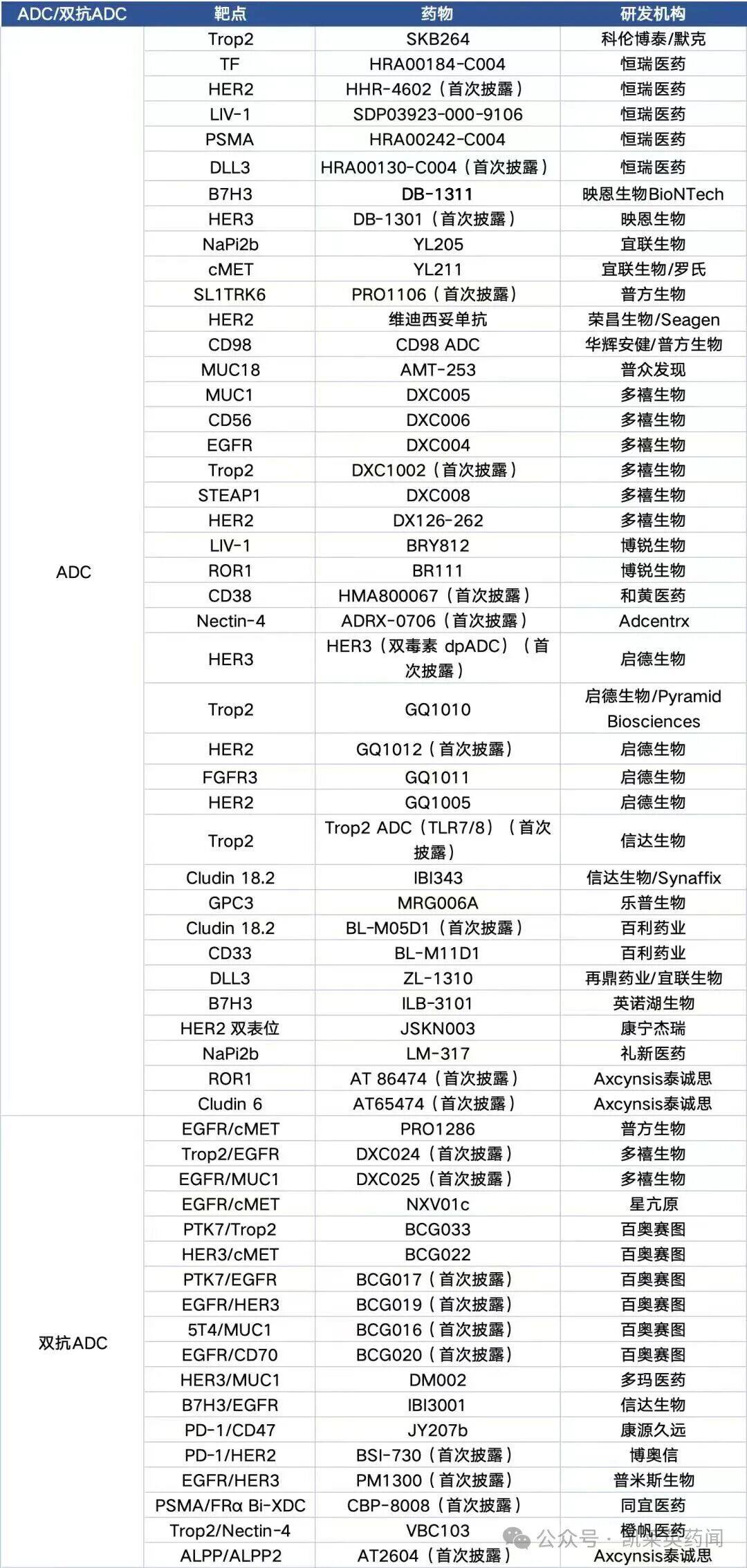
From the composition of reports at this conference, the emerging ADC drugs are on the rise, while monoclonal antibodies, bispecific antibodies, and small molecules still hold significant importance. Among them, Chinese companies such as Hengrui Medicine, Kelun Botai, Innovent Biologics, Baili Tianheng, Rongchang Bio, Zai Lab, Alphamab Oncology, Protheon Biotech, Guide Therapeutics, DualityBio, and Huadong Medicine presented crucial preclinical and clinical research data on ADC drugs, covering various solid tumors and demonstrating promising drug efficacy.
Disclosure of ADC Drugs Produced in China
However, overseas MNCs and well-known ADC companies also announced the research progress of their ADC drugs under development at this conference, and most are in the preclinical research stage. As of now,Among them, 7 drugs have updated their clinical progress.,Targets include HER2, BCMA, CD123, FRα, CCR7, Axl, etc.
Summary of Overseas ADC Drug Clinical Trials
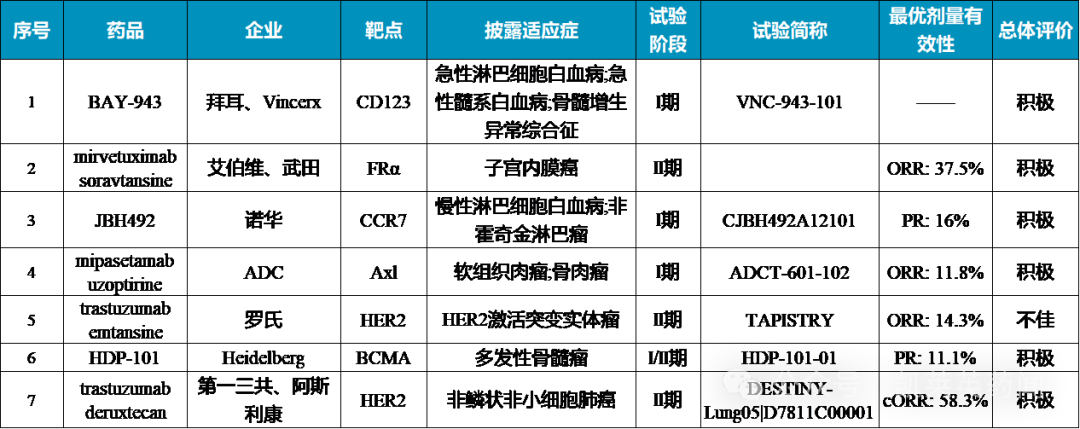
Overseas ADC Drug Clinical Progress
1. Bayer/Vincerx: BAY-943
Mechanism of Action: CD123-targeted ADC
Indication disclosed this time: Hematological tumors
BAY-943 (VIP943) is the first ADC developed by Vincerx using the company’s platform. It consists of an anti-CD123 antibody, a unique linker cleaved by legumain inside cells, and a novel payload of a Kinesin Spindle Protein inhibitor (KSPi). A Phase 1 dose-escalation trial is currently underway to evaluate its use in patients with relapsed/refractory CD123-positive acute myeloid leukemia (AML), B-cell acute lymphoblastic leukemia (B-ALL), or myelodysplastic syndromes (MDS) who cannot achieve therapeutic needs with standard treatment regimens.
The VNC-943-101 study is an open-label, multi-center, Phase 1 dose-escalation study using VIP943 monotherapy for patients with relapsed/refractory AML, B-ALL, and MDS. The primary objective of this trial is to determine the safe dose of VIP943 for further clinical development. Three patients were dosed in Cohort 1 (0.2 mg/kg), and four patients were dosed in Cohort 2 (0.4 mg/kg). All seven enrolled patients completed the 28-day DLT evaluation period.
PK data show that there is very little unbound free payload, consistent with the good safety observed in preclinical and clinical settings.
2. AbbVie: Mirvetuximab Soravtansine
Mechanism of Action: FRα-Targeted ADC
Indication disclosed this time: Endometrial cancer
Mirvetuximab soravtansine (Somi-tuximab, trade name: ELAHERE™) is the world's first ADC drug developed by ImmunoGen (acquired by AbbVie) for folate receptor alpha (FRα) positive ovarian cancer. The drug received FDA accelerated approval for marketing in 2022; Huadong Medicine holds its exclusive rights in mainland China, Hong Kong, Macao, and Taiwan.
The data disclosed this time pertains to a Phase II trial of mirvetuximab soravtansine (IMGN853) in combination with pembrolizumab for the treatment of patients with microsatellite-stable (MSS) recurrent or persistent endometrial cancer. Previously, the drug demonstrated good tolerability and single-agent activity in a Phase I dose-expansion study in FRα-positive advanced/end-stage patients. The co-primary endpoints of this study are the objective response rate (ORR) measured according to RECIST 1.1 and the frequency of patients achieving progression-free survival for 6 months (PFS6). The first phase of the study enrolled 16 patients; if there are ≥2 objective responses or ≥2 PFS6 responses, an additional 19 patients will be included in the second phase. If a total of 4 objective responses or 8 PFS6 events are achieved, the combination will be considered worthy of further investigation.
Results: As of the data cutoff in November 2023, a total of 16 patients had received the study treatment, with a median follow-up time of 4.7 months (IQR 2.9, 17.3). Among the 16 treated patients, 6 patients (37.5%, 95% CI: 15.2-64.6%) achieved an objective response, including 1 patient with a confirmed CR and 5 patients with PR [3 confirmed PRs (18.8%) and 2 unconfirmed PRs (12.5%)]. Additionally, 31.3% (5/16) of the patients had stable disease, and two patients remained alive without progression at 6 months.
In terms of safety, the most common TRAEs included elevated AST (50%), blurred vision (44%), fatigue (44%), and diarrhea (43%); 2 patients (12.5%) experienced grade 3 TRAEs. Ocular toxicity of any grade was reported in 56.3% of patients.
3. Novartis: JBH492
Mechanism of Action: CCR7-Targeted ADC
Indication disclosed this time: Hematologic malignancies
JBH492 is an ADC targeting CC-chemokine receptor 7 (CCR7), composed of a humanized anti-CCR7 IgG1 antibody linked to the maytansinoid microtubule inhibitor DM4 via a cleavable linker in a site-specific manner. Preclinical studies demonstrate that this drug exhibits potent target-dependent cytotoxic activity and shows strong and durable efficacy in various clinically relevant lymphoma models.
The ongoing first-in-human, open-label, Phase I/Ib, multicenter study disclosed herein has completed enrollment for the dose-escalation phase in patients with relapsed/refractory (r/r) chronic lymphocytic leukemia (CLL) and non-Hodgkin lymphoma (NHL). The purpose of the dose escalation is to evaluate the safety, tolerability, pharmacokinetics (PK), immunogenicity, and preliminary efficacy of JBH492, and to determine the maximum tolerated dose and recommended dose.
The study showed that four patients with NHL (two with T-NHL and two with B-NHL) had a partial response (PR), and two patients had stable disease, with PR observed at doses of 2.4 to 3.6 mg/kg every three weeks. After the data cutoff, one patient with T-NHL achieved CR after four treatment cycles. No correlation could be established between CCR7 expression and response (CCR7 expression was observed in all samples from the 14 patients).
In terms of safety, 23 patients (92%) experienced at least one adverse event (AE) (G ≥ 3, n = 11). Treatment-related AEs (TRAEs) were reported in 15 patients (60%) (G ≥ 3, n = 3). Among six patients (24%) with serious AEs (SAEs) (G ≥ 3, n = 3), two patients (8%) had treatment-related SAEs (TRSAEs). The most common AEs (≥ 20%) included anemia (32%), thrombocytopenia (28%), neutropenia, and dry eye (each 20%). Two patients died due to underlying diseases.
4、ADC:mipasetamab uzoptirine
Mechanism of Action: Axl-Targeted ADC
Indications disclosed this time: Soft tissue sarcoma; Osteosarcoma
Mipasetamab uzoptirine (ADCT-601) is an Axl-targeted ADC, a humanized anti-AXL antibody conjugated with SG3199 through a cleavable linker. AXL is a cell surface receptor tyrosine kinase that is widely expressed in solid tumors (ST), including sarcoma. In preclinical mouse models of sarcoma, adrenocortical carcinoma, and pancreatic cancer, ADCT-601 demonstrated anti-tumor activity and showed clinical activity in ST patients in the first-in-human trial.
In a Phase 1b, open-label, dose-escalation, dose-expansion study, patients were enrolled using a 3+3 dose-escalation design and received escalating dose levels of ADCT-601 every 3 weeks; as of December 4, 2023, among the 17 evaluable sarcoma patients according to RECIST v1.1, the best overall response was partial response (PR) in 2 patients (11.8%), including confirmed PR; stable disease (SD) in 8 patients (47.1%); and progressive disease (PD) in 7 patients (41.2%). Tumor reductions were observed at doses of 7.5 mg, 11 mg, and 13 mg. By week 12, 6 out of 17 patients (35.3%) had not exhibited PD.
In terms of safety, the most common TEAEs (all grades and relationships [≥20%]) were palmar-plantar erythrodysesthesia syndrome (7 cases [38.9%]); anemia (6 cases [33.3%]); maculopapular rash (5 cases [27.8%]); cheilitis and constipation (4 cases each [22.2%]). TEAEs ≥ Grade 3 occurred in 9 patients (50%). The most common TEAE ≥ Grade 3 (≥10%) was increased GGT (2 cases [11.1%]). Two dose-limiting toxicities were observed: Grade 2 and Grade 3 cheilitis at 15 mg and 13 mg, respectively. Skin reactions of all grades were more pronounced at higher doses. The maximum tolerated dose (MTD) has not yet been determined.
5. Roche: Trastuzumab Emtansine
Mechanism of Action: HER2-Targeted ADC
Indication disclosed this time: HER2-activated mutant solid tumors
Trastuzumab emtansine is an ADC targeting HER2, currently approved for the treatment of HER2-overexpressing metastatic breast cancer. HER2 point mutations are present in approximately 1.4% of solid tumors, but the prevalence varies across different tumor types.
The TAPISTRY disclosed this time is a Phase II, global, open-label, multi-cohort trial designed to evaluate the efficacy and safety of various therapies in patients with advanced/metastatic solid tumors. The primary endpoint is the ORR by the Independent Review Committee (IRC), and key secondary endpoints include the investigator's ORR; duration of response; progression-free survival; overall survival; and drug safety.
As of the data cutoff (July 16, 2023), 35 patients with 10 different tumor types were evaluable for efficacy, with non-small cell lung cancer (NSCLC) being the most common tumor type. After a median follow-up of 7 months, the IRC-assessed ORR was 14.3% among the evaluable patients; responses were observed in three tumor types: NSCLC (n/N=1/11), breast cancer (n/N=3/5), and endometrial cancer (n/N=1/1). The most common adverse events were decreased appetite, fatigue, and nausea (each 25.7%). No new safety signals were identified.
6、Heidelberg:HDP-101
Mechanism of Action: Targeted BCMA ADC
Indications: Multiple Myeloma
HDP-101 is an ADC drug targeting BCMA developed by Heidelberg Pharma. It consists of a BCMA antibody, a VA-PABC linker, and an Amanitin derivative, HDP 30.2115. Due to its high toxicity, the DAR value is set at 2, and site-specific conjugation is used to ensure uniformity and reduce potential toxicity. As an immunostimulatory agent, HDP-101 can induce immunogenic cell death (ICD) and exhibits synergy with immune checkpoint inhibitors, offering possibilities for combination therapies in clinical settings.
This disclosure reports a first-in-human, open-label, non-randomized, multi-center, Phase 1/2a trial designed to determine the maximum tolerated dose and recommend a dose for Phase 2 in patients with multiple myeloma. As of November 2023, 18 patients (7 females, 11 males) were enrolled in five consecutive dose cohorts at doses of 20, 30, 60, 80, and 100 µg/kg.
Preliminary data show that the pharmacokinetics of HDP-101 are in line with expectations, and the exposure of HDP-101 is dose-proportional. In Group 3, patients achieved stable disease (SD) after 15 cycles. In Group 5, there are four ongoing patients who have shown promising results after 3-4 cycles: two patients achieved partial response (PR), and two patients reached SD.
In terms of safety, the drug was well-tolerated, with no...Dose-Limiting Toxicity (DLT), including no signs of hepatotoxicity, nephrotoxicity, infusion reactions, or ocular diseases. Among the 5 treatment groups, 17 out of 18 patients were evaluable for DLT.
7. Daiichi Sankyo/AstraZeneca: trastuzumab deruxtecan
Mechanism of Action: HER2-Targeted ADC
Indications: Non-squamous Non-small Cell Lung Cancer
Trastuzumabderuxtecan (T-DXd), a HER2-targeted ADC, is composed of a humanized anti-HER2 antibody, an enzymatically cleavable peptide linker, and a topoisomerase I inhibitor. The Phase 2 DESTINY-Lung05 (DL-05) trial disclosed herein aims to evaluate its efficacy in previously treated Chinese patients with HER2-mutant non-small cell lung cancer (NSCLC). In this open-label, single-arm, Phase 2 trial, the primary endpoint is the ORR confirmed by ICR; secondary endpoints include ORR confirmed by investigator assessment (INV), duration of response by ICR and INV, disease control rate, progression-free survival, and safety.
Results showed that: at the data cutoff date (September 23, 2023), the median T-DXd exposure time was 7.9 (0.7-13.5) months. Among the patients, 71 experienced drug-related adverse events (AEs), of which 51.4% were Grade (G) ≥3. The most common G≥3 AEs by grouped terms were neutropenia (26.4%), thrombocytopenia (18.1%), and leukopenia (11.1%). Two (2.8%) patients had drug-related AEs leading to discontinuation. Seventeen (23.6%) patients experienced serious AEs, with no G5 events adjudicated by the Independent Review Committee (INV). Centrally adjudicated drug-related interstitial lung disease (ILD)/pneumonitis occurred in seven (9.7%) patients (n=6 G2; n=1 G5). The safety profile in Chinese patients was consistent with the known safety profile.




"Views"Click once