

DR30318: A Novel Tri-specific T Cell Engager Targeting CLDN18.2, HSA, and CD3 for the Immunotherapy of Gastric and Pancreatic Cancers

Doer Biologics
Biological Drug Developer
BispecificTCell Connector (BiTE) SpecificityTargetedTTumor cell antigens on cells andCD3, thereby inducing potentTCell-dependent cytotoxicity (TDCC). However, the classicalBiTEDue to its rapid clearance, a continuous intravenous infusion is required to maintain the therapeutic concentration. Antibody isotype immunoglobulinG(IgG) and human serum albumin (HSA) has a relatively long plasma half-life in the human body, approximately3Week. Based onIgG-FcFramework or Recognition and BindingHSAThe strategy of using affinity reagents can be employed to extendBiTEHalf-life。
AMG910It is based on Amgen's semi-extended (HLE)BiTEThe First Target of the PlatformCLDN18.2BispecificTCell Engager. A TargetedCLDN18.2Patients with Positive CancerAMG910TheIPhase clinical trials are currently underway.Claudin 18.2(CLDN18.2) is a highly anticipated target in the treatment of solid tumors, especially in advanced gastric cancer and pancreatic cancer. TargetedCLDN18.2TheTCell engagers represent a compelling strategy to enhance anticancer efficacy.
Recently, researchers from Zhejiang Doer Biologics Co., Ltd. and Zhejiang University published a research paper titled "DR30318, a novel tri-specific T cell engager for Claudin 18.2 positive cancers immunotherapy" in the journal Cancer Immunology, Immunotherapy.A trispecific T-cell engager, DR30318, targeting CLDN18.2, HSA, and CD3, has been developed. In vitro and in vivo studies have shown that DR30318 exhibits potent TDCC activity and efficacy in inhibiting tumor growth. Pharmacokinetic (PK) studies demonstrated linear PK distribution in cynomolgus monkeys. Additionally, the low level of cytokine release and robust tumor regression activity make DR30318 a promising therapeutic agent for CLDN18.2-positive cancers.
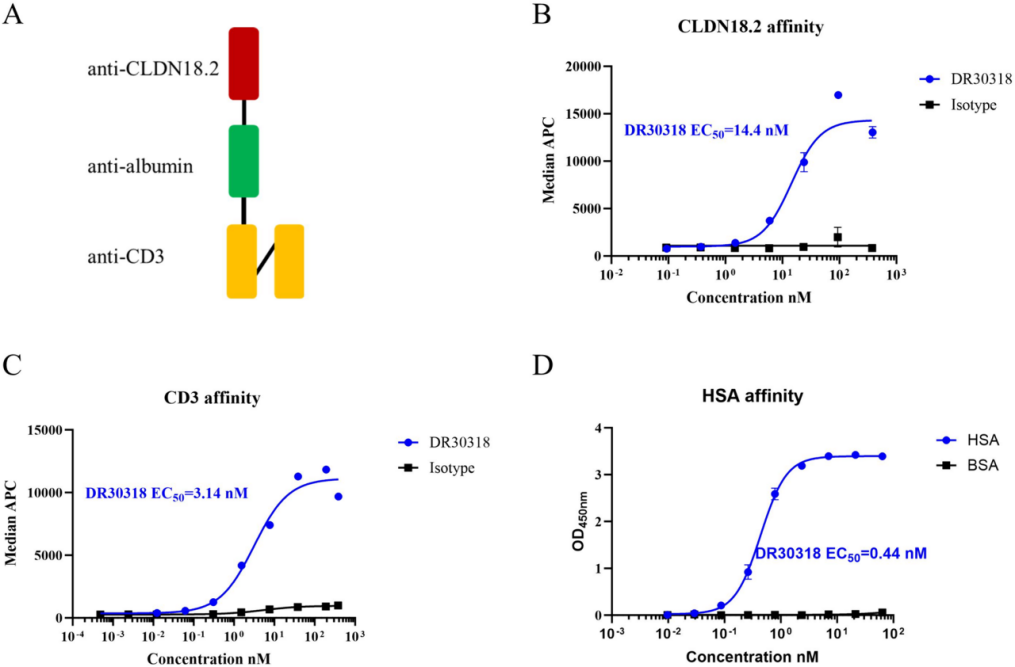
The study isolated multiple anti-CLDN18.2 heavy chain antibody variable domains (VHH) from llamas.At the same time, a new trispecific T-cell engager targeting CLDN18.2 was developed based on Doer Biologics' internal MultipleBody® platform.This trispecific antibody is designed to bind to CLDN18.2, human serum albumin (HSA), and T-cell CD3. DR30318 demonstrated binding affinity for CLDN18.2, HSA, and CD3 in vitro, and exhibited T cell-dependent cytotoxicity (TDCC) activity.
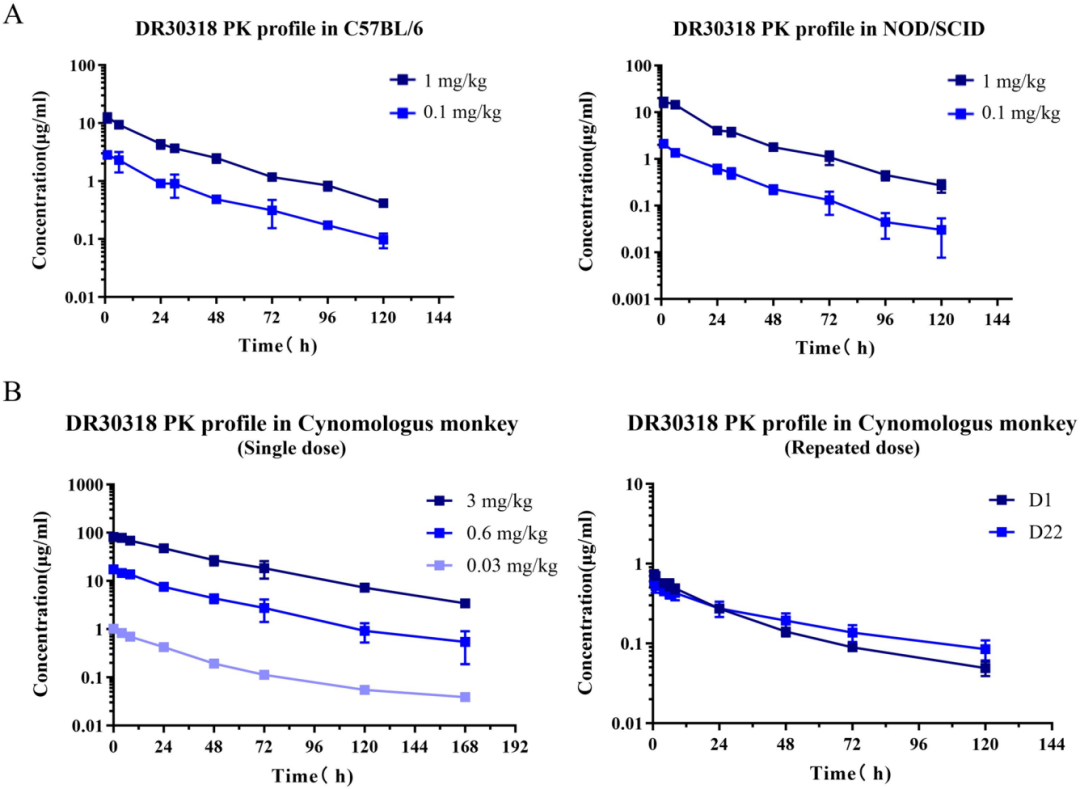
Pharmacokinetic analysis showed that the half-life of DR30318 was 22.2-28.6 hours in rodents and 41.8 hours in cynomolgus monkeys. Administration of DR30318 led to a slight increase in IL-6 and C-reactive protein (CRP) levels in cynomolgus monkeys. Moreover, incubation with human PBMCs and CLDN18.2-expressing cells resulted in DR30318 inducing TDCC activity and the production of IL-6 and IFN-γ.
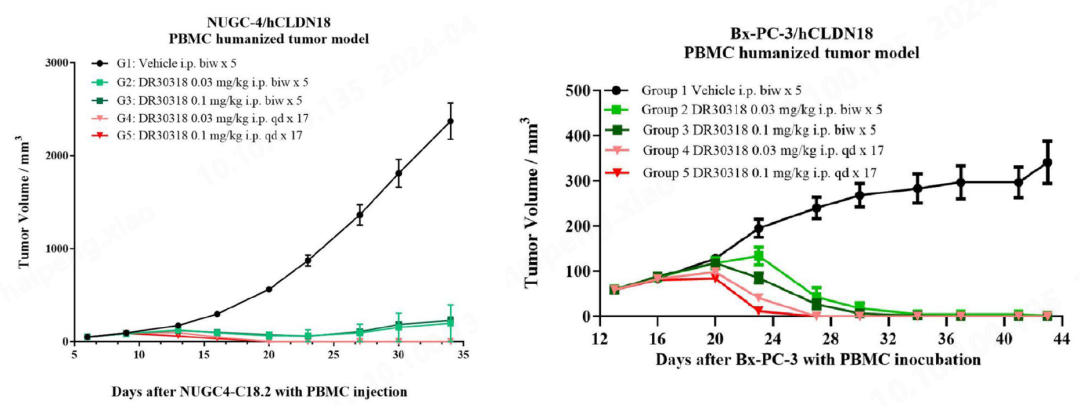
Notably, DR30318 demonstrated significant tumor suppression in the gastric cancer NUGC4/hCLDN18.2 xenograft model and the pancreatic cancer BxPC3/hCLDN1820 xenograft model without affecting the body weight of mice.
Thinking
Gastric cancer and pancreatic cancer are among the most common malignant tumors and are major factors in oncology mortality. The lack of effective early diagnosisA significant number of people are diagnosed with advanced or metastatic disease, resulting in a 5-year survival rate for gastric cancer of less than 20% and a 5-year survival rate for pancreatic cancer of only 2%.Therefore, there are significant unmet clinical needs in both gastric cancer and pancreatic cancer. CLDN18.2 shows abnormally high expression in various malignant tumors, including gastric cancer and pancreatic cancer, making it a promising therapeutic target for CLDN18.2-positive cancers.
This study successfully constructed a trispecific T-cell engager, DR30318. In vitro and in vivo studies demonstrated that CLDN18.2 has targeted-dependent TDCC activity for killing tumor cells. The lower level of cytokine release and potent tumor regression activity indicate that DR30318 is a promising therapeutic agent for CLDN18.2-positive cancers.
Reference:Ma, Z., Zhou, Z., Duan, W. et al. DR30318, a novel tri-specific T cell engager for Claudin 18.2 positive cancers immunotherapy. Cancer Immunol Immunother 73, 82 (2024). https://doi.org/10.1007/s00262-024-03673-x