

ENPP3 Takes Center Stage at AACR, Pioneering a New Era in Cancer Therapy

Johnson & Johnson
Medical Device R&D and Manufacturer
At the recently held AACR 2024 Annual Meeting, Johnson & Johnson presented a report titled "JNJ-87890387, a novel ENPP3 bispecific T-cell redirector (ENPP3xCD3) with tumor selectivity through targeting apical surface antigens," showcasing the significant potential of the bispecific antibody drug JNJ-87890387.
To accelerate the progress of relevant clinical studies, ACROBiosystems Bai Biosystems has actively launched several high-quality ENPP3 proteins and overexpression cell lines. The ENPP3 protein products cover multiple species including Human and Mouse, featuring verified high enzymatic activity and high purity. With over 90% high purity validated by rigorous SDS-PAGE and SEC-MALS, they ensure stability and reliability in various application scenarios such as immunity research, antibody screening, and cross-species validation.

Ectonucleotide Pyrophosphatase/Phosphodiesterase 3 (ENPP3), also known as CD203, is a type II transmembrane protein belonging to the family of membrane ectonucleotide pyrophosphatase/phosphodiesterases (E-NPPs/ENPPs). Its extracellular domain includes a nuclease-like domain, a catalytic domain, and a somatomedin B-like domain. It plays multiple roles in various physiological processes such as nucleotide cycling, phospholipid signaling regulation, cell motility, and cell proliferation.
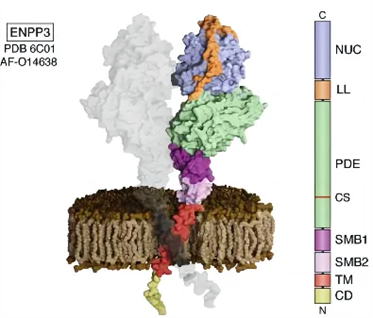
ENPP3Schematic diagram of the structure and domain structure
In recent years, ENPP3 has attracted widespread attention in the field of cancer research. Studies have shown that ENPP3 may be associated with the pathogenesis of various cancers. The expression of ENPP3 is elevated in several solid tumors, such as clear cell renal cell carcinoma, hepatocellular carcinoma, colorectal cancer, and cholangiocarcinoma. Particularly in renal cell carcinoma (RCC), ENPP3 is one of the most overexpressed surface proteins, with an expression rate as high as 94%, making it a potential tumor marker. ENPP3 also plays a significant role in many other types of cancer, suggesting that it could become a widely applicable target for cancer therapy.
Currently, research on ENPP3-related drugs is still in its early stages. The number of existing clinical studies is limited. Among them, bispecific antibodies and antibody-drug conjugates (ADCs) are the two main directions of research.
XmAb-819 (ENPP3 x CD3), developed by Xencor, is a tumor-targeting, T-cell-engaging "2+1" bispecific antibody with two binding domains targeting ENPP3 and one cytotoxic T-cell binding domain targeting CD3 (a component of the T-cell receptor complex). It can efficiently target and kill ENPP3-expressing tumor cells by activating T cells. Currently, Xencor is conducting a Phase I study of XmAb-819 in patients with advanced renal cell carcinoma (RCC). At the 2020 AACR meeting, Xencor presented preclinical data on XmAb819, showing that XmAb819 effectively inhibited tumor growth in KU812 and RXF393 xenograft models in a dose-dependent manner.
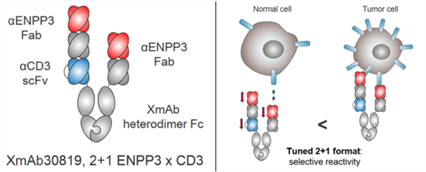
"2+1" Antibody Pattern Diagram
JNJ-87890387, developed by Johnson & Johnson, is a fully human bispecific antibody targeting ENPP3 and CD3. It has high affinity and specificity for binding to ENPP3 on tumor cells, with lower affinity for binding to CD3 on T cells. At the recently held AACR 2024 Annual Meeting, a presentation titled "JNJ-87890387, a novel ENPP3 bispecific T-cell redirector (ENPP3xCD3) with tumor selectivity through targeting apical surface antigens" was delivered. The abstract content showed that JNJ-87890387 demonstrated potent ENPP3 expression-dependent antitumor activity in both in vitro and in vivo experiments. Currently, JNJ-87890387 is undergoing Phase I clinical trials.

AGS-16M8F (expressed by hybridoma) and AGS-16C3F (expressed by CHO cells), developed by Agensys (acquired by Astellas), are two ADC drugs targeting ENPP3. They combine an anti-ENPP3 antibody with the cytotoxic agent MMAF, enabling specific recognition and destruction of RCC cells while demonstrating sustained antitumor activity and manageable adverse effects. AGS-16M8F is currently in Phase I clinical trials for the treatment of metastatic renal cell carcinoma (RCC), and clinical results have not yet been disclosed.
The Phase II study of AGS-16C3F primarily evaluated the efficacy and safety of AGS-16C3F in combination with Axitinib in patients with metastatic renal cell carcinoma (mRCC), but the study did not meet its objectives and development has been discontinued.Exploring a new generation of anti-ENPP3 antibody ADC drugs may provide a new therapeutic approach for the treatment of metastatic renal cell carcinoma.
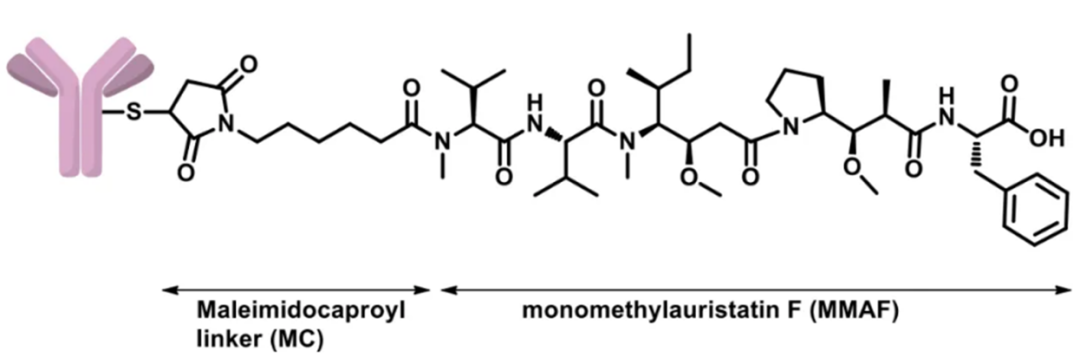
AGS-16C3FSchematic Diagram of the Structure

In addition to the field of cancer treatment, the diagnostic and therapeutic value of ENPP3 in allergic diseases is gradually emerging. As a surface activation marker of basophils, the expression of ENPP3 significantly increases upon activation, particularly standing out in diseases such as allergic asthma. Moreover, its abnormal expression also affects metabolic diseases like bone mineralization and is associated with vascular cell signaling and restenosis after angioplasty. ENPP3 also regulates respiratory fluid balance and bile formation, showing potential value in lipid metabolism and diabetes prevention.ThisThese findings provide new therapeutic options and opportunities for the prevention and treatment of allergic diseases and other metabolic disorders.
Preclinical and early clinical data from multiple drugs have clearly shown that ENPP3 is highly expressed in renal cell carcinoma (RCC), acute basophilic leukemia, certain colon cancers, and cholangiocarcinoma tumor cells. These studies not only reveal the close relationship between ENPP3 and these malignant diseases but also pave new avenues for the development of anti-cancer drugs. By further investigating the biological characteristics of ENPP3 and its role in cancer pathogenesis, researchers are hopeful to develop more precise and effective therapeutic drugs, bringing new hope to cancer patients.
To accelerate the progress of related clinical research, ACROBiosystems Bai Biosystems has actively launched several high-quality ENPP3 proteins and overexpression cell lines. The ENPP3 protein products cover multiple species including Human and Mouse, with verified high enzymatic activity and high purity. Over 90% high purity is validated by SDS-PAGE and SEC-MALS, ensuring their stability and reliability in various application scenarios such as immunity, antibody screening, and cross-species validation.
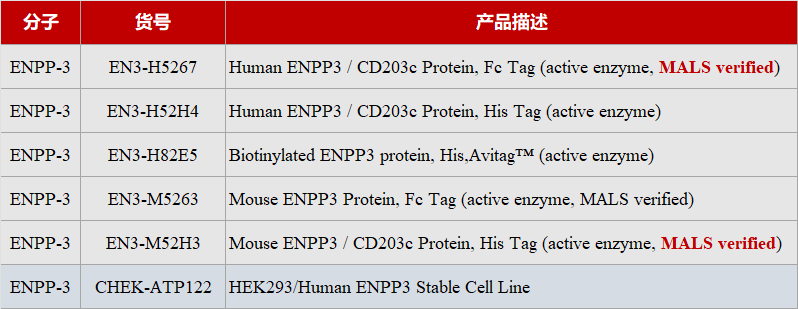

Protein uniform structure and high purity (>90%) verified by SEC-MALS
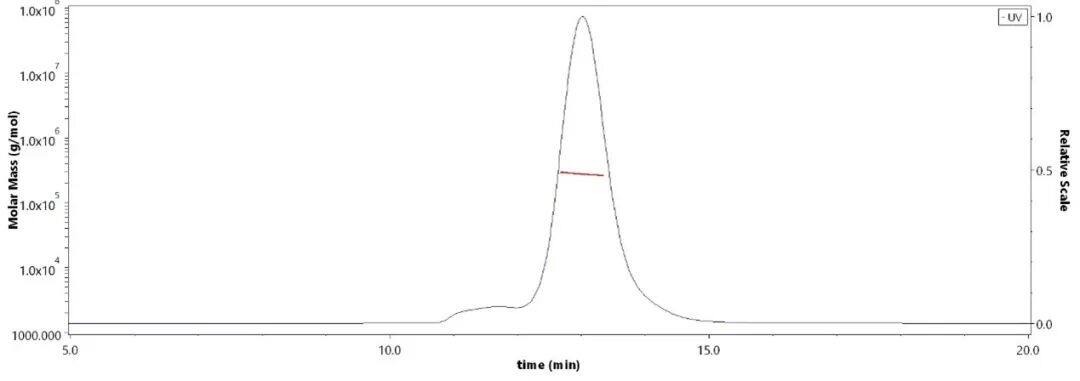
The purity of Human ENPP3 Protein, Fc Tag (Cat. No. EN3-H5267) is more than 90% and the molecular weight of this protein is around 265-315 kDa verified by SEC-MALS.
ENPP3 Overexpression Cell Line Expression Level Validated by FACS
HEK293/Human ENPP3 Stable Cell Line(Cat.No. CHEK-ATP122)
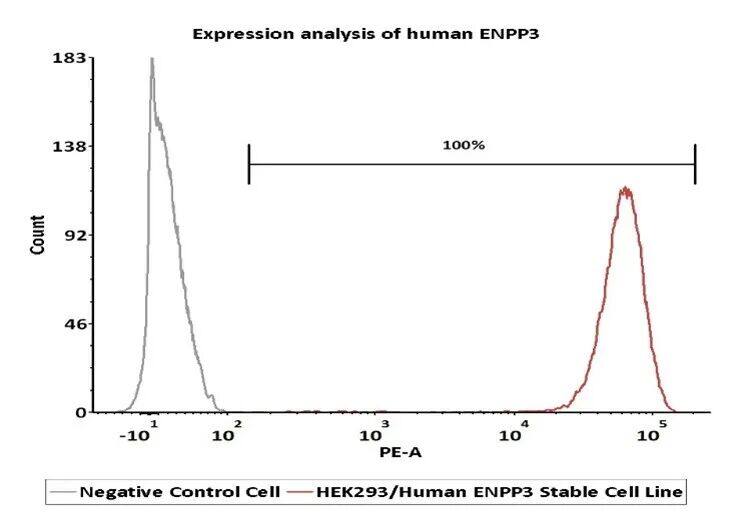
Expression analysis of human ENPP3 on HEK293/Human ENPP3 Stable Cell Line by FACS.
Cell surface staining was performed on HEK293/Human ENPP3 Stable Cell Line or negative control cell using PE-labeled anti-human ENPP3 antibody.




Scan to download:
Cell and Gene Therapy Drug Development and Evaluation Solutions

Scan to download:

Scan to download:


ACROBiosystems
inquiry@acrobiosystems.com
15117918562
(Note: Name + Company)