Qilu Pharma Launches China's First Romiplostim Biosimilar, Targeting a Multi-Billion-Dollar Thrombocytopenia Market

Qilu Pharmaceutical
Specialty Formulations and Active Pharmaceutical Ingredients (API) Developer

Recently, according to the official website of the National Medical Products Administration, Qilu Pharmaceutical's Romiplostim Injection (Ruilisheng) has been approved for marketing, becoming the first domestically produced biosimilar of romiplostim to be approved in China. It is used for adult patients (≥18 years old) with chronic immune thrombocytopenia who have had an inadequate response to other treatments (e.g., corticosteroids, immunoglobulins).
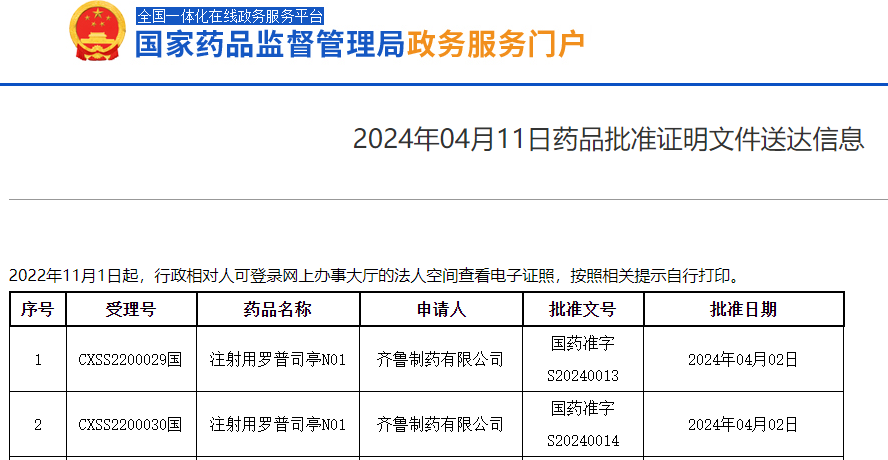
Source of the image: Official website of the National Medical Products Administration
The Billion Dollar Molecule
Romiplostim was originally developed by Amgen. It received approval from the U.S. FDA in August 2008 and from the European EMA in February 2009, marketed under the trade name Nplate. Kyowa Kirin holds the rights for Japan and Asia. It was approved for marketing in Japan in April 2011 under the trade name Romiplate.
More than a decade later, the key reason why Romiplostim remains resilient in the face of new drug impacts in today’s market is evident. According to Amgen's Q4 2023 report, Nplate generated $1.477 billion in revenue for Amgen throughout the year, including $996 million in sales revenue and $481 million in pipeline pass-through revenue, with sales growing by 13% year-over-year.
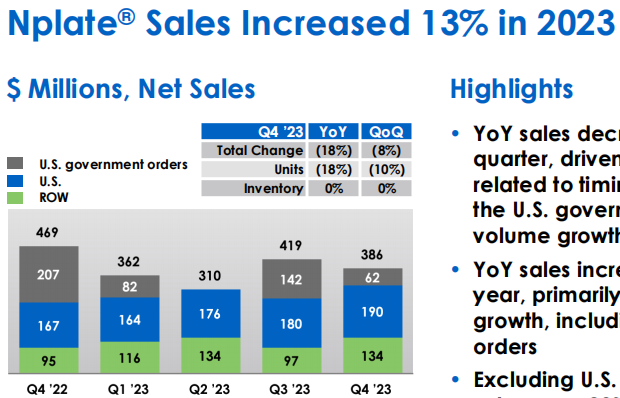
Source: Amgen Q4 2023 Earnings Report
On the other side of the ocean, Romiplate has become a crucial support for Kyowa Kirin's product revenue. According to the 2023 fiscal year report, Romiplate’s sales reached 12 billion yen, ranking third among its main products, behind G-Lasta (31.9 billion yen) and Nesp+Nesp-AG (17.1 billion yen). However, the market performance of G-Lasta and Nesp+Nesp-AG has shown signs of decline, with sales growth rates at 3% and -19%, respectively, while Romiplate achieved a robust 15% year-on-year growth.
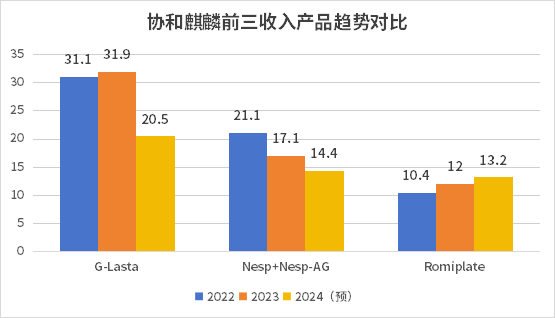
Data source: Kyowa Kirin Fiscal Year 2023 Annual Report
More crucially, Kyowa Kirin forecasts that Romiplate's sales will reach 13.2 billion yen in the fiscal year 2024, marking a 10% year-on-year increase. In contrast, G-Lasta, Nesp, and Nesp-AG are expected to see sales declines of 36% and 16%, respectively. For the foreseeable future, Romiplate will continue to be the primary driver of Kyowa Kirin’s performance.
Moreover, Amgen is still sparing no effort in exploring the clinical value of Romiplate. It is currently conducting a Phase 3 study on Nplate for the treatment of chemotherapy-induced thrombocytopenia in patients with gastrointestinal, pancreatic, or colorectal malignancies, with clinical data expected to be released in the second half of 2024. Meanwhile, Kyowa Kirin is also stepping up its market expansion for Romiplate. In September 2023, Japan approved a modification to the indication of Romiplate, changing it from "aplastic anemia in patients who are unresponsive to conventional treatments" to "aplastic anemia."
In Kyowa Kirin's clinical pipeline, the aplastic anemia indication for Romiplate has progressed to the Phase 2/3 clinical trial stage in the Asian region. Additionally, Kyowa Kirin is conducting a Phase 3 clinical trial in Hong Kong, China, to study Romiplate for the treatment of aplastic anemia patients who are refractory to or unsuitable for immunosuppressive therapy.
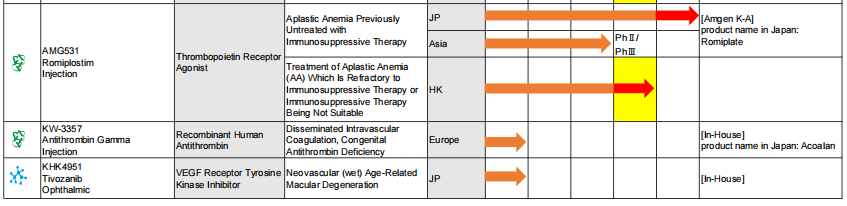
Source of the image: Kyowa Kirin's 2023 Fiscal Year Report
In January 2022, Kyowa Kirin's Romiplate was approved for marketing in China under the trade name Romiplostim, for use in primary immune thrombocytopenia, while Kyowa Kirin is in the process of expanding its patient population.Qilu’s Acquisition of Romiplostim Biosimilar Undoubtedly Signals a New "Turning Point".
Long-awaited Qilu
As the second-generation long-acting thrombopoietin (TPO) receptor agonist, romiplostim was awarded the "Best Biotechnology Product" by the Galien Award in 2009. However, it was not until 2022 that romiplostim, filed by Kyowa Kirin, received approval from the National Medical Products Administration (NMPA) in China.
Perfect Timing for Entry
The more than ten years of gap in between held significant appeal for Qilu. In fact, as early as November 2013, Qilu Pharmaceutical had submitted a clinical trial application (CXSL1300074) for Romiplostim (QL0911) to the National Medical Products Administration (NMPA). Additionally, in the same year 2022, its marketing application was accepted by the NMPA.
According to the PharmaGo data query, apart from Qilu Pharmaceutical, Taihe Pharmaceutical and Kelun Biotech are also developing a biosimilar of romiplostim. However, as of now, even the most advanced Taihe Pharmaceutical is only in Phase 1 clinical trials, still a long way from approval for marketing. This shows that Qilu Pharmaceutical had the foresight to act early and swiftly, and its strong market insight is truly admirable.
Excellent efficacy
Of course, Qilu is not only strong in market insight, but also its R&D strength is equally impressive. The efficacy of its biosimilar of Romiplostim is also excellent. According to the Phase III clinical study results publicly released by Qilu Pharmaceutical in December 2023 on the use of Romiplostim for the treatment of adult chronic primary immune thrombocytopenia, among the 216 enrolled patients (144 in the Romiplostim group and 72 in the placebo group), at 24 weeks of treatment, 61.8% of the patients in the Romiplostim group had a sustained platelet response, while no patients in the placebo group had a sustained platelet response.
Moreover, the average time to platelet response in the romiplostim group was 15.9 weeks, and for patients who had previously undergone splenectomy, the average time to platelet response was also 15.9 weeks. The median time that patients maintained a platelet count ≥50×10^9/L after treatment was 6 weeks, and the median time to first platelet response (platelet count ≥50×10^9/L) in the romiplostim group was 3.29 weeks.
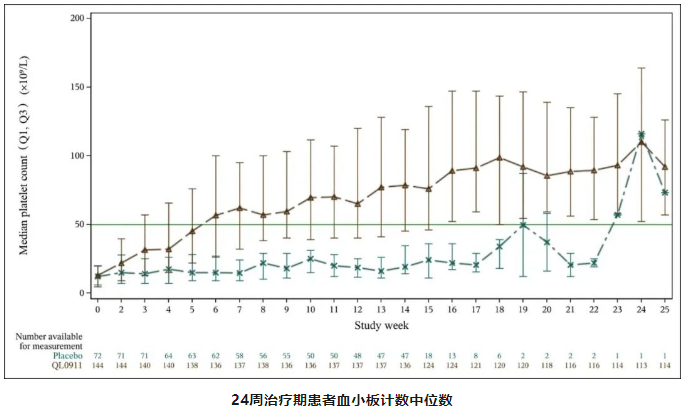
Image Source: Qilu Pharmaceutical Official WeChat
High cost-effectiveness treatment
According to the data from Pharma Intelligence, the winning bid price of Kyowa Kirin's Romiplostim (0.25mg) in Guangdong region in April 2024 was 1536 yuan. Qilu Pharmaceutical's Romiplostim (Ruilisheng), which has shown clinical efficacy consistent with the original drug and is a biosimilar, will undoubtedly bring about a significant price reduction in clinical treatment, alleviating the financial burden for patients.
Recall that last year, due to a market shortage of cisplatin injection, the U.S. FDA proactively sought supply from Qilu Pharmaceutical, which exported three batches totaling over 163,000 vials of cisplatin injection to the United States. This marked the first time a Chinese pharmaceutical company directly supplied a marketed product from China to address a drug shortage in the U.S. In December 2023, Qilu Pharmaceutical's oxaliplatin injection, the first to pass evaluation in China, won a United Nations procurement project, becoming the first drug from Qilu Pharmaceutical to participate in international public procurement.
In the field of biosimilars, Qilu Pharmaceutical has demonstrated its strong capabilities. Who says that only innovative drugs are the way out for pharmaceutical companies? Generic drugs can also stand out, and Qilu's strength in innovative drugs is equally impressive.
The innovation capability is also remarkable.
Qilu Pharmaceutical has become a leader in the generic drug field. In March 2024, with the approval and market launch of Cefpodoxime Proxetil for Oral Suspension, the company achieved consistency evaluation approval or deemed approval for 157 products, 54 of which were the first in China. According to data from Pharma Intelligence, Qilu Pharmaceutical ranks first in both the number of accepted applications and approved products for consistency evaluation.
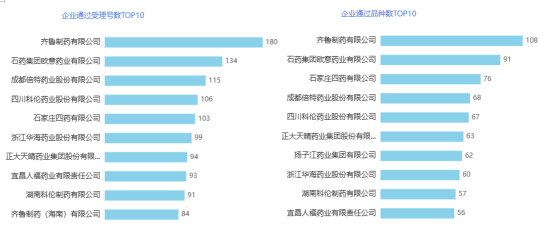
Image Source: Pharmcube Data
Large-scale advancement into the innovative drug field. Qilu Pharmaceutical currently has over 80 innovative drugs in development, among which 19 are classified as Category 1 new drugs already in the clinical research stage.
In June 2023, Qilu Pharmaceutical's innovative drug Irulak was approved by the National Medical Products Administration (NMPA) for marketing, becoming the first domestically produced Class 1 innovative drug in Jinan. In January 2024, it was further approved as a first-line treatment for patients with anaplastic lymphoma kinase (ALK)-positive non-small cell lung cancer (NSCLC).
Iruplak, developed over a decade, marks a significant step forward for Qilu Pharmaceutical in the field of innovative drugs. To date, Iruplak has been selected as a major achievement of the national "Major New Drug Creation" science and technology project. Its clinical data has been presented at top academic conferences both in China and internationally, including WCLC, ASCO, ESMO, and CSCO. Just last month, the results of a Phase 2 clinical study on the combination of chemoradiotherapy for unresectable ALK/ROS1-positive non-small cell lung cancer were also selected for poster presentation at the European Lung Cancer Conference (ELCC).
Conclusion
"To run a business, especially a pharmaceutical company, one must endure solitude and meticulously handle every detail." Li Yan, who took over from her father, once evaluated how to manage a pharmaceutical enterprise in this way. The ability to endure solitude is precisely Qilu Pharmaceutical's strategy for both offensive and defensive success in the pharmaceutical field: "Proficient in generics, precise in innovation."
 Reference Source:
Qilu Pharmaceutical Official Website, Official WeChat
Amgen Q4 2023 Earnings Report
Kyowa Kirin Annual Report 2023