

Ophthalmology Sector Surges with Record M&A and Funding: Zeiss Acquires DORC in $1.06B Deal

DORC
Ophthalmic Instrument R&D, Production, and Sales Provider

Carl Zeiss
Manufacturer of Optical Systems, Industrial Measurement, and Medical Devices
The Largest M&A Case in the Ophthalmology Industry Settled Since the Beginning of 2024.
Recently, Carl Zeiss Medical announced the completion of its acquisition of DORC, a Dutch ophthalmic company, for a staggering 9.85 billion euros, equivalent to approximately 1.06 billion US dollars or 7.7 billion Chinese yuan, drawing significant attention to the ophthalmology sector.
As we all know, there are continuous mergers and acquisitions in the ophthalmology industry. Only in 2023, there were more than five M&A deals in the ophthalmology industry with transaction amounts reaching hundreds of millions of dollars. The acquisition of Dutch Ophthalmic Research Center B.V. (DORC) by Carl Zeiss was finalized at the end of 2023 and recently completed the transaction.
"Whether in China or globally, the ophthalmology industry is a sector with a relatively mature business model and a rapidly growing market." Zheng Zhi, an investor in the ophthalmology industry, told VCBeat that both the ophthalmic pharmaceuticals and medical devices sector and the ophthalmic medical services field are keen on mergers and acquisitions.Frequent M&A transactions reflect the characteristics of the ophthalmology industry, which benefits from economies of scale and a "the strong get stronger" dynamic. "The ophthalmology industry is one of the medical innovation fields most capable of giving rise to mega-giants."
As one of the main players in this acquisition, Dutch Ophthalmic DORC is an innovative company focusing on ophthalmic products and solutions. It holds a strong position in the mid-to-high-end ophthalmic equipment field, with its most renowned device being the Eva Nexus phacoemulsification and vitrectomy combo machine, which features dual functionality. Additionally, the company ranks second globally in the vitreoretinal consumables market and holds a leading position in the dye market.
Regarding this transaction, Carl Zeiss Medical stated that the acquisition will strengthen its position as the "fastest-growing ophthalmic medical device manufacturer" globally.
Multiple industry insiders have told VCBeat that the ophthalmic equipment industry developed earlier overseas, and companies such as Alcon, Carl Zeiss, Heidelberg Engineering, Canon, and Topcon have already become leaders in the field, establishing extremely high barriers in the mid-to-high-end market.The development of mid-to-high-end equipment in China's ophthalmology field started relatively late. Eight years ago, it was still an investment desert, but now it has taken off, with a group of outstanding Chinese enterprises emerging as representatives.
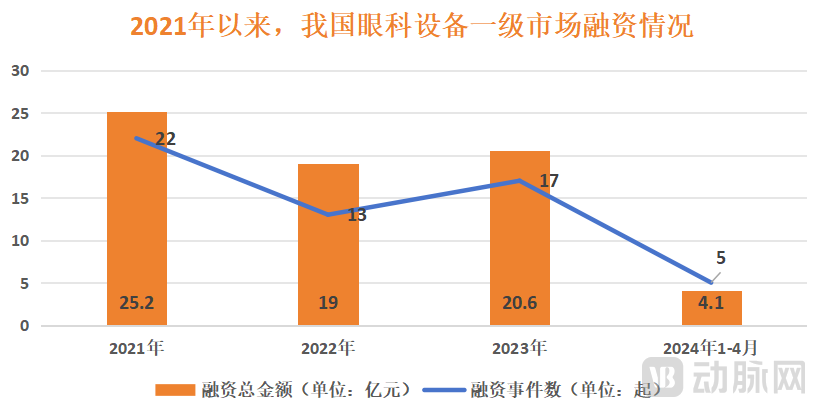
(Source: VCBeat Database, Chart by VCBeat)
Data from the VCBeat database shows,From 2021 to April this year, there have been 57 financing events in China's ophthalmic medical device sector.Including Beagle Medical, Disi Medical, Fuhan Medical, Intalight Saiwei, Jia Shinuo De, Langmu Medical, Motting Medical, Ruier Mingkang, Tianchen Biotech, Tupai Medical, Weimou Medical, Weiqing Medical, Xiran Medical, Xianwei Vision, Yaoshi Medical, Zhenghong Technology, Zhiding Medical and other innovative companies that have secured financing. Behind them are a gathering of prominent enterprises and investment institutions such as Aiboh Medical, Aier Eye Hospital, Baidu Ventures, Dachen Capital, Danlu Capital, Delian Capital, Fosun Health, Legend Capital, Qiming Venture Partners, Shenzhen Capital Group, Shuimu Ventures, and CMB International.
Behind the frequent mergers, acquisitions, and financing activities, the venture capital enthusiasm in the mid-to-high-end ophthalmic equipment field has been ignited.
Ophthalmology is a large market.
Taking ophthalmic devices as an example, according to data from Huajing Industrial Research Institute, the global ophthalmic medical device market size is expected to grow from USD 21.5 billion in 2017 to USD 56.4 billion by 2030. The compound annual growth rate (CAGR) between 2021 and 2025 is projected to be 11.1%, while the CAGR between 2025 and 2030 will be 6.7%.
From the industry perspective, ophthalmology can generally be divided into three sub-sectors: services, devices, and drugs. Among these, ophthalmic medical devices can be further segmented into two sub-categories: equipment and consumables, with a market size slightly larger than that of the ophthalmic drug market.
The Dutch ophthalmic company DORC, which has been acquired this time, is deeply engaged in the field of ophthalmic medical devices and holds a globally leading position in the ophthalmic equipment sector — the company pioneered the dual-blade vitrectomy probe and the EVA surgical system in the industry, with the latest product being the all-new EVA NEXUS phacoemulsification-vitrectomy integrated machine.
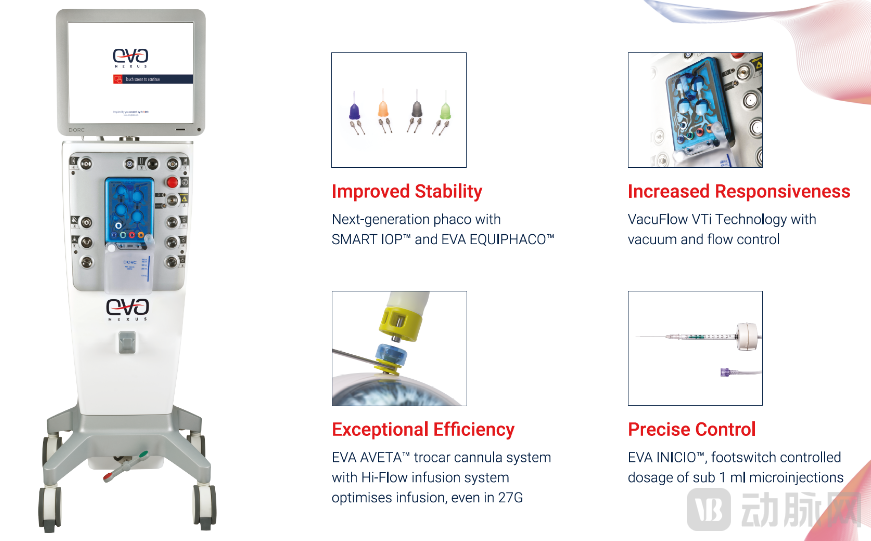
(NEXUS Phacoemulsification and Vitrectomy Integrated Machine promotional image, Source: Official WeChat Account of Dutch Ophthalmic Research Center DORC)
One industry background that needs to be mentioned here is that the phacoemulsification and vitrectomy integrated machine is an ophthalmic ultrasonic treatment device, mainly composed of ultrasonic accessories, vitrectomy accessories, irrigation/aspiration accessories, main unit, illumination accessories, infusion pressure accessories, and others.An important tool for vitreoretinal surgery.
In clinical practice, vitreoretinal surgery is an important procedure for addressing fundus diseases such as macular holes, epiretinal membranes, or retinal detachment. According to the "Big Data Report on the Status of Fundus Lesions in China" released by Aier Eye Hospital, the prevalence rates of fundus diseases among people aged 60-70 and over 70 are as high as 21.39% and 25.61%, respectively, severely affecting the vision health and quality of life of the elderly.
"The phaco-vitrectomy machine combines the two steps of ultrasonic cutting and vitreous cutting into one, greatly simplifying the surgical process and improving surgical efficiency." In the view of Zheng Zhi, an ophthalmology industry investor,The phacoemulsification and vitrectomy integrated machine is a high-end product in ophthalmic medical equipment, with high technical barriers, thus being very expensive.
According to the statement on the official WeChat account of Dutch Ophthalmic DORC, the EVA phaco-vitrectomy machine can be used for minimally invasive surgeries for fundus diseases, including vitrectomy, vitrectomy combined with cataract surgery, etc., and can also apply VisionBlue Trypan Blue Lens Anterior Capsule Staining Solution for staining or identifying the anterior capsule of the lens.
Not only that, but the instruments and consumables matched with the company's EVA phaco-vitrectomy machine can prevent peripheral retinal tissue from tearing and detachment during vitrectomy, reducing potential vision damage. For instance, the dual-blade high-speed cutting feature of the DORC TDC vitrectomy probe can minimize traction on ocular tissues, thereby decreasing the incidence of surgical side effects and complications.
At the same time, Dutch Ophthalmic Research Center B.V. (DORC) has designed cost-reduction measures into its overall solutions. For instance, the lifespan of the EVA LED internal illumination system is 25 times that of a traditional xenon lamp (based on 10,000 hours for LED lighting versus 400 hours for xenon lamps), and it can reduce the risk of phototoxicity-induced retinal damage caused by prolonged exposure to harmful light.
It is reported that the EVA Phaco-Vitrectomy Machine from Dutch Ophthalmic DORC has been approved for marketing by China's National Medical Products Administration in December 2022.
"Dutch Ophthalmic DORC is an innovative company. Whether it’s introducing the industry's first disposable vitrectomy consumables equipped with self-closing valve cannulas or developing a series of dyes for critical tissue imaging in cataract and retinal surgeries, it consistently brings some surprises to the industry every so often," said Zheng Zhi, an ophthalmology industry investor.
On the other hand, as a global giant in the medical device industry, Carl Zeiss Medical possesses a series of significant ophthalmic products in the field of ophthalmic equipment, including the SMILE refractive surgery system, 3D digital navigation surgical microscope, the true color high-definition ultra-widefield fundus camera CLARUS 500, and optical coherence tomography (OCT).
From this perspective, Carl Zeiss Medical's acquisition of Dutch Ophthalmic Research Center B.V. (DORC) for 7.7 billion yuan has completed the company's product lines such as retinal surgery, expanded its territory, and consolidated its "giant" status in the ophthalmic medical device market.
It is worth mentioning that many core products of both Dutch Ophthalmic Research Center B.V. (DORC) and Carl Zeiss AG have entered the Chinese market. The former currently holds seven registrations (covering vitrectomy probes, ophthalmic surgical systems, etc.), while the latter has been deeply engaged in the Chinese market for many years. At the fifth China International Import Expo, Carl Zeiss AG launched its "ZEISS+" strategy to promote the sharing of cutting-edge technological advancements with China.
Therefore,After Carl Zeiss Medical acquires Dutch Ophthalmic Research Center B.V. (DORC), it will also enable both parties to synergize their operations in the Chinese market.
As international giants strengthen their positions through mergers and acquisitions, the demand for the domestic production of mid-to-high-end ophthalmic equipment in China is also very urgent.
As one of the departments with the most extensive variety of equipment, the ophthalmology department has more than 30 types of primary equipment (mainly including diagnostic and therapeutic devices), whereas other general departments typically have around 5 to 10 types of primary equipment. Despite the large number of devices,China currently has an extremely high import monopoly rate in the ophthalmic medical device industry.
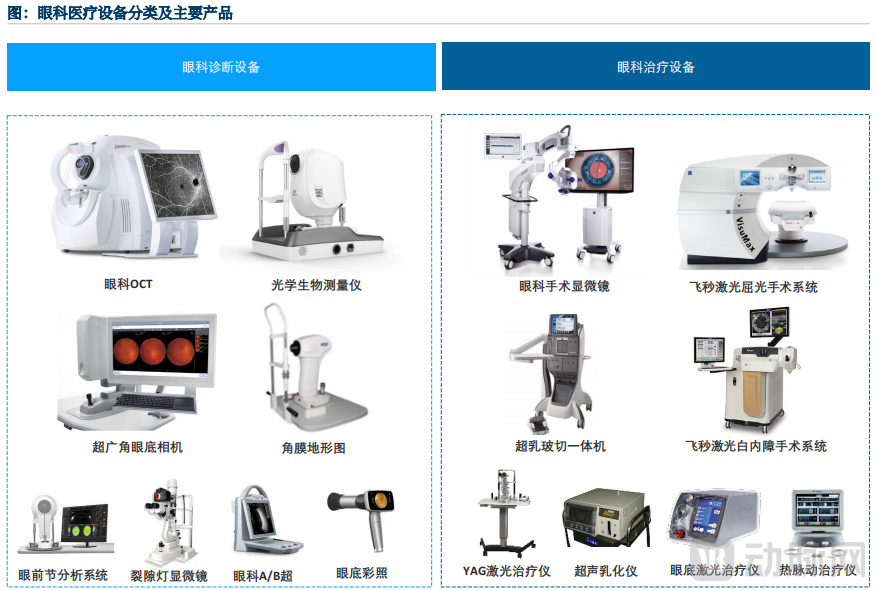
(Source: Sullivan & "Blue Paper on the Current Status and Future Development Trends of High-End Ophthalmic Medical Device Industry")
According to incomplete statistics, the market share of imported ophthalmic equipment suppliers accounts for over 90% in terms of sales revenue. A look at the top-tier brands in ophthalmic medical devices reveals that most are long-established high-end manufacturing giants from Germany, Japan, and the United States. Among them, mid-to-high-end equipment is concentrated in secondary-level hospitals and above, occupying the vast majority of the ophthalmic equipment market capacity.The sales of phacoemulsification and vitrectomy machines, femtosecond lasers, ophthalmic surgical microscopes, optical biometers, ophthalmic OCT, and ultra-widefield fundus cameras account for approximately 3/4 of the total sales of ophthalmic equipment. The import market share of phacoemulsification and vitrectomy machines and femtosecond lasers reaches 100%.
Taking femtosecond lasers as an example, currently, the commonly used semi-femtosecond surgical systems in China are all imported brands. In the field of full-femtosecond surgical equipment, Carl Zeiss dominates the market, with its product VisuMax being the world's only equipment capable of performing full-femtosecond surgeries.
This reflects the past situation where the technical strength of ophthalmic medical device companies in China lagged far behind imported products, with insufficient research and development. Fortunately, now many innovative Chinese-produced mid-to-high-end ophthalmic medical device companies are emerging, gradually reversing this situation.
"CurrentlyThere are two investment logics in the direction of ophthalmic medical devices: one is the acceleration of infrastructure construction for specialized medical institutions, and the other is the speeding up of the process of domestic substitution for mid-to-high-end ophthalmic medical devices."This will inevitably lead to rapid growth of local companies in the mid-to-high-end ophthalmic equipment sector," Zheng Zhi, an ophthalmology industry investor, told VCBeat.
According to a previous survey by VCBeat, in the field of mid-to-high-end ophthalmic equipment, ophthalmic OCT, all-femtosecond laser, ophthalmic surgical microscopes, phacoemulsification and vitrectomy integrated machines, fundus cameras (fluorescein angiography), and optical biometers (listed in no particular order) have garnered the most attention in the industry. The annual sales revenue of these six categories of high-end instruments and devices (including consumables bound to the equipment) each range between one billion to several billion yuan, indicating enormous market potential. Chinese innovative enterprises are also entering the market and developing these six types of equipment.
In the field of ophthalmic OCT, the rise of Chinese-produced products has been rapid.OCT products from companies such as Big Vision Medical, Intalight Saiwei, Mo Ting Medical, Tu Pai Medical, Wei Ren Medical, and Zhi Ding Medical have obtained certification from the National Medical Products Administration (NMPA) and entered the commercialization stage. Additionally, Fuhua Medical is preparing to register and launch an OCT device this year for infant posterior eye imaging.
What is OCT? Its full name is Optical Coherence Tomography, the "gold standard" in the field of ophthalmic diagnosis. OCT technology is widely used in ophthalmology to provide images showing retinal and choroidal lesions for diagnosing various ophthalmic diseases such as diabetic retinopathy and age-related macular degeneration.
"Starting from the development of the first commercial ophthalmic OCT device in 1996,Over 28 years, ophthalmic OCT has evolved through three generations: time-domain OCT, spectral-domain OCT, and swept-source OCT.Technology. Currently, multiple enterprises in China are already in the latest technological fields andMatch or even surpass foreign equipment in multiple indicator levels, standing in the leading group of the industry."Zheng Zhi, an investor in the ophthalmology industry, said."
As supply innovation accelerates, there are two incremental market directions that benefit ophthalmic OCT: traditional medical needs represented by public secondary hospitals and private ophthalmic hospitals, as well as emerging medical needs represented by physical examination centers and optometric centers.
Thanks to the rapid growth in demand for ophthalmic OCT products in China, the sales scale of the ophthalmic OCT market continues to expand. According to the "2023 White Paper on the Mid-to-High-End Ophthalmic Equipment Industry," the sales scale of China's ophthalmic OCT market has increased from 660 million yuan in 2015 to 1.1 billion yuan in 2023, nearly doubling.
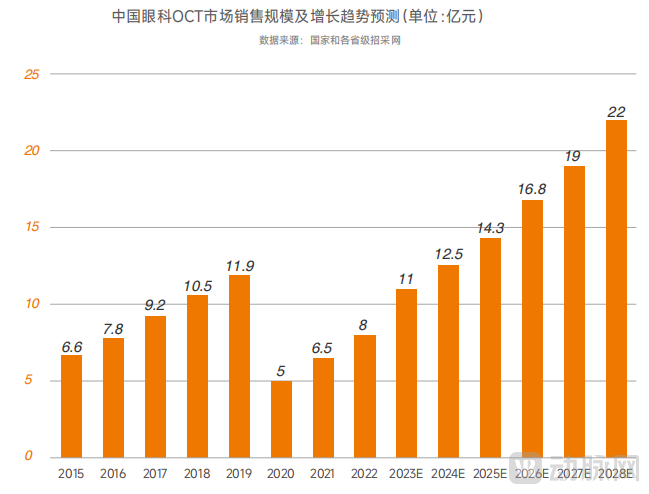
(Source: VCBeat & "2023 Mid-to-High-End Ophthalmic Equipment Industry White Paper")
Looking at Ophthalmic Surgical Microscopes Again, this device is often hailed as the "aircraft carrier" in the field of ophthalmic medical equipment. The reason is that almost all ophthalmic surgeries need to be performed under an ophthalmic surgical microscope. However, for a long time, the market for ophthalmic surgical microscopes has been monopolized by German optical manufacturing giants such as Carl Zeiss and Leica. Even now, the market share of domestically produced equipment in China is less than 3%, leaving significant room for substitution.
"The development of ophthalmic surgery is inseparable from the advancement of ophthalmic microsurgery." An ophthalmologist from a tertiary hospital in Chongqing stated that performing surgery on the eye particularly tests the precision of related equipment such as ophthalmic surgical microscopes, thus creating high technical barriers.
Currently, Chinese brands are making continuous efforts in the field of ophthalmic surgical microscopes. For instance, Liuliu Vision, Motic Medical, and Yide have already launched and are selling ophthalmic surgical microscope products. Tupai Medical's "Boyun" ophthalmic surgical microscope is also expected to be launched in June this year.
According to the "2023 White Paper on the Mid-to-High-End Ophthalmic Equipment Industry," the terminal sales revenue of the ophthalmic surgical microscope market in China was approximately 1.6 billion yuan in 2022. By 2028, the market sales scale is expected to reach 3.5 billion yuan per year.
Next is the all-femtosecond laser., which is one of the most advanced corneal refractive surgery methods internationally. Specifically, the entire Small Incision Lenticule Extraction (SMILE) procedure utilizes femtosecond laser. A lenticule with a pre-set refractive power is created by laser pulses within the corneal stromal layer, and then the lenticule tissue is removed through a micro-incision, thereby altering the corneal refractive power to achieve the purpose of myopia correction.
According to data from Frost & Sullivan, the total sales and installation volume of various femtosecond laser devices in China in 2023 was approximately 300 units. Among them, the Carl Zeiss ophthalmic laser treatment device VisuMax is currently the only full-femtosecond laser product on the market.
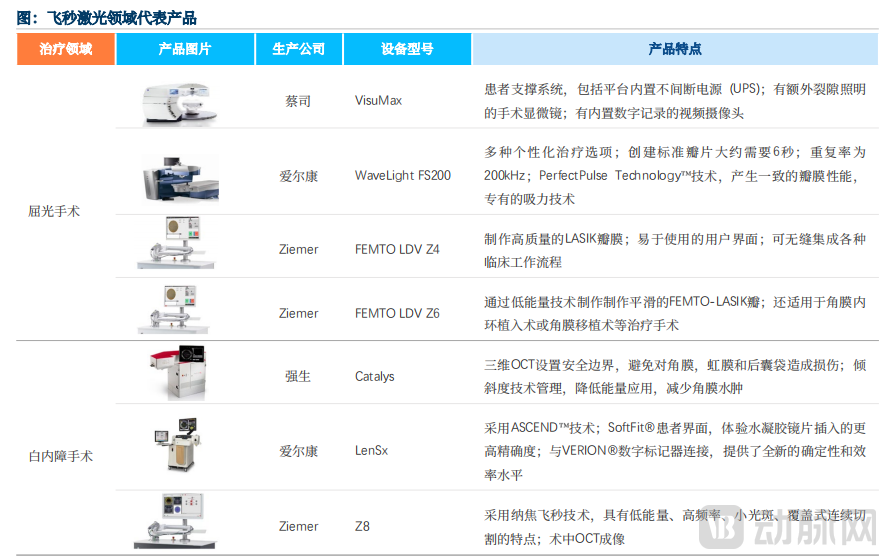
(Source: Sullivan & "Blue Paper on the Current Status and Future Development Trends of High-End Ophthalmic Medical Device Industry")
In this direction, innovative companies in China are accelerating the research and development of all-femtosecond laser equipment. Among them, Xianwei Vision successfully independently developed the "All-Femtosecond Laser Corneal Refractive Surgery Treatment Machine" in October 2023, which is about to enter clinical trials and will be launched soon.
Then there is the ultra-wide-angle fundus camera., This device plays an important role in the screening and diagnosis of ophthalmic diseases and is one of the most widely used examination devices in ophthalmology. From the perspective of industry development, the commercial ultra-wide-angle camera field was pioneered by Optos in the UK, followed by Japanese and German import manufacturers such as Nidek and Carl Zeiss.
According to Sullivan's data, the ultra-wide-angle fundus camera from the Chinese company MicroClear Medical ranked among the top three in terms of total bid value for ultra-wide-angle fundus cameras in China’s public hospitals in 2023. Additionally, the "Zhuzhao" ultra-wide-angle fundus camera from Tupai Medical has just been launched and its performance is capable of competing in the high-end market; the ultra-wide-angle full-layer fundus imaging product, the digital fundus camera DF600 developed by Ruier Mingkang, has been successfully approved; Yaoshi Medical’s ultra-wide-angle fundus camera product — the SLO ultra-wide-angle confocal laser scanning ophthalmoscope — has initiated clinical trials in China and is expected to be launched within this year.
Continue to look at the optical biometerIt is an instrument used in the field of clinical medicine, mainly for measuring axial length, corneal curvature, and intraocular lens power, and is widely used in myopia prevention and control as well as refractive cataract diseases.
High-end optical biometers have long been monopolized by imported brands such as the Carl Zeiss Master series and the Tomey OA2000 series. In particular, the Carl Zeiss Master 500/700 series, with its dominant market share, has made "Master" almost synonymous with biometers.
Currently, domestically produced brands include the ophthalmic optical biometer based on frequency-domain OCT technology launched by Mo Ting Medical, and the high-end optical biometer "Meridian" series introduced by Tu Pai Medical, the latter of which went on sale in March this year.
Finally, look at the phacoemulsification and vitrectomy integrated machine., the entrants in this device field include not only Dutch Ophthalmic, which was acquired by Carl Zeiss this time, but also Alcon, Bausch + Lomb, DORC, and Oertli. All of these are imported brands, and domestically produced brands remain absent.
The good news is that Chinese innovative companies have begun to enter the field of developing integrated phacoemulsification and vitrectomy machines. For instance, the first integrated phacoemulsification and vitrectomy machine, Genesis, developed by Xiran Medical, is expected to be submitted for registration within the year; the "Vanguard" integrated phacoemulsification and vitrectomy machine under development by Tupai Medical is anticipated to commence type inspection and registration in 2025; Jia Shi Nuo De’s product line planning also includes products such as vitrectomy machines and phacoemulsification machines. Additionally, there are several companies in China engaged in the research, development, and production of consumables like vitrectomy probes.
Of course, in addition to phacoemulsification and vitrectomy machines, all-femtosecond lasers, ophthalmic surgical microscopes, optical biometers, ophthalmic OCT, and ultra-widefield fundus cameras, the ophthalmology field also includes a range of devices such as ophthalmic surgical robots, corneal topographers, and photodisruption lasers.
In these areas, Chinese-produced forces have entered the market and are quickly catching up. Although it will take time for Chinese brands to rise across all product categories, the overall trend of Chinese substitution has already been set.
As a giant in the global device field, Carl Zeiss Meditec achieved a revenue of 2.089 billion euros, approximately 16.2 billion yuan, in 2023, representing a year-on-year increase of 9.8%. Meanwhile, the company's two highest revenue-generating businesses were surgical microscopes and femtosecond lasers, with ophthalmic devices becoming its business pillar.
After the acquisition of Dutch Ophthalmic Research Center B.V. (DORC), Carl Zeiss Medical has completed its comprehensive layout in the fields of surgical microscopes, femtosecond lasers, phacoemulsification and vitrectomy machines, ophthalmic OCT, ultra-widefield fundus cameras, and biometers.Already a truly "full-platform" R&D and manufacturing company for high-end ophthalmic medical devices.
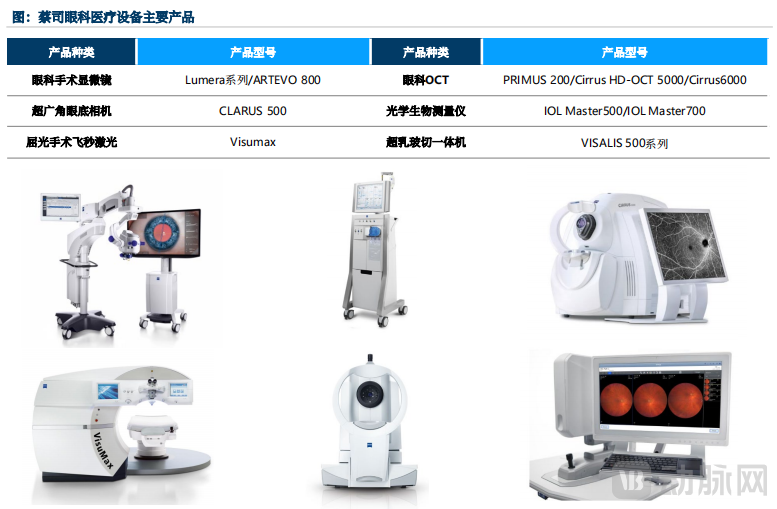
(Source: Sullivan & "Blue Paper on the Current Status and Future Development Trends of High-End Ophthalmic Medical Device Industry")
In contrast, innovative enterprises in the field of ophthalmic equipment in China are still in a stage of rapid development and are still some distance away from maturity. Therefore, the industry is in urgent need of more support.
At the policy level, the state has issued a series of relevant documents to support the domestic substitution of medical devices. Some policies aim primarily at enhancing the innovation capabilities of domestic medical enterprises, with a focus on improving the quality and efficiency of medical device approvals, laying the foundation for achieving domestic substitution. Under this trend, the domestic substitution in the ophthalmic equipment field will continue to advance.
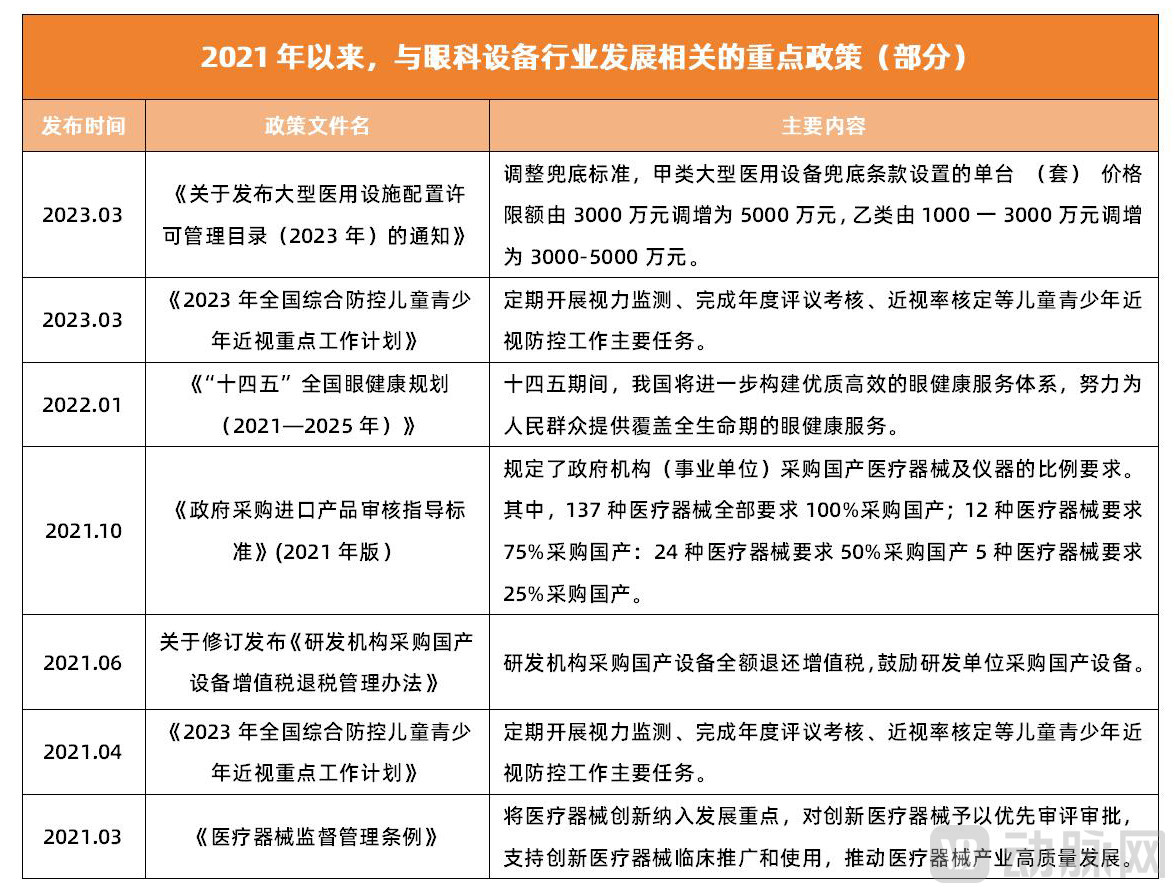
At the capital level, the attention of VC/PE to ophthalmic innovation equipment enterprises has reached an unprecedented height. Among them, target enterprises that have both a safety margin and can ensure high growth and long-term sustainable profitability are the most favored by investment institutions.
Of course,The development of the industry requires continuous breakthroughs from innovative companies.In the high-end ophthalmic equipment field, Chinese-produced ophthalmic device innovators—including Big Vision Medical, DiVision Medical, Fuhhan Medical, Intalight Saiwei, Jia Shi Nuo De, Longmu Medical, Moptim Medical, Ruier Mingkang, Tianchen Biotech, Tupai Medical, Weimou Medical, Weiqing Medical, Xiran Medical, Xianwei Vision, Yaoshi Medical, Zhenghong Technology, and Zhiding Medical—continue to iterate and accelerate R&D. Breakthroughs have been achieved in multiple areas, breaking the long-standing impression of domestic ophthalmic medical devices as low-end products.
According to VCBeat, in addition to the aforementioned companies, there are quite a few emerging ophthalmic device enterprises under the surface that are surfacing. Subsequently, driven by research and development and bolstered by capital, these companies will undoubtedly continue to take the baton, entering the global market competition and going head-to-head with international giants.
In this process, the innovation story of ophthalmic equipment made in China is bound to write a new chapter.
Note: In the course of this article, when involving multiple enterprises/institutions in parallel, unless otherwise specified, they are generally sorted in alphabetical order according to the pinyin of the enterprise names. There is no intention of comparing enterprises based on the order of names.
References:
1, VCBeat: "2023 Premium Ophthalmic Equipment Industry White Paper"
2. Frost & Sullivan: "Blue Paper on the Current Status and Future Development Trends of the High-End Ophthalmic Medical Device Industry"
3. Dutch Ophthalmic DORC Official WeChat Account: "Highlights Review | Dutch Ophthalmic DORC at APVRS 2023"