Source: Heart Future; Editor: Bai Xiaofei
Reprint requirements: If the source of the article is indicated at the beginning of the text, it can be reprinted directly.
April 2024,Abbott (NYSE: ABT)Announce itsTranscatheter Tricuspid Valve Repair Product (TriClip G4)Approved for marketing by the FDA, becomeThe World's First FDA-Approved Transcatheter Tricuspid Valve Edge-to-Edge Repair Product, which is applicable toTreatment of Tricuspid Regurgitation (TR) or Tricuspid Leakage。Two months before the device registration and market launch, on February 14, 2024, Abbott announcedFDA's Medical Device Advisory Committee Circulatory System Devices Panel met to discuss TriClip and voted on its safety and efficacy.. The voting results showed that, on the three issues of safety, efficacy, and benefits outweighing risks,It is almost unanimously agreed that TriClip offers more benefits than risks in treating tricuspid regurgitation.。But recently, there has been news disclosure,This FDA advisory committee reviewing Abbott's cardiac devices10 Doctors Have Financial Ties with Abbott, whereinOne member is associated with hundreds of payments from Abbott.,Total Amount Nearly 200,000 USD;Another member is associated with 100 payments.,The total amount is approximately 100,000 US dollars.,And conducted by AbbottApproximately 50,000 USDSupported research. The third member of the committee is engaged in research work provided by the company.More than 180,000 US dollarsFunding Support。
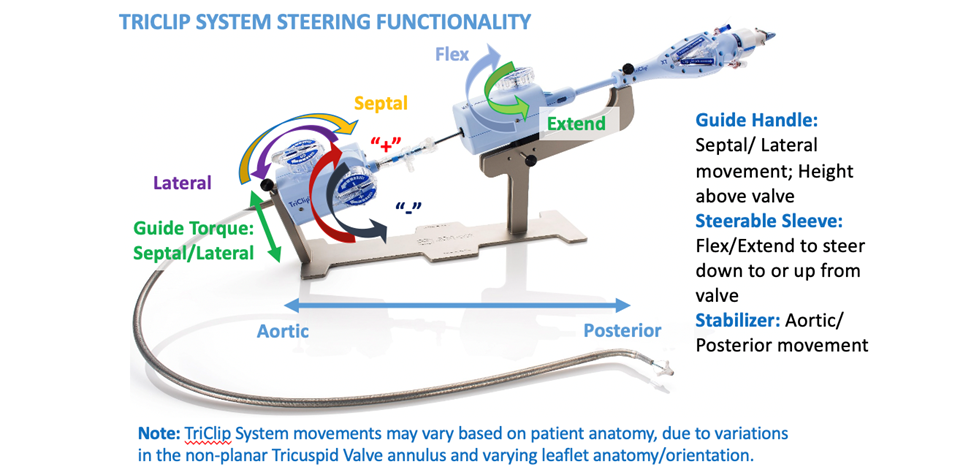
But when the FDA advisory committee came to evaluate the cardiac device produced by Abbott Laboratories,Not disclosedMost of them received payments from Abbott or conducted research funded by Abbott., although this information is easily accessible in a federal database called "Open Payments."The Open Payments database is a database website that records several types of payments from pharmaceutical and device manufacturers. It mainly consists of two categories.The first category, referred to as "relevant research funding," supports research., one of the doctors was named as the principal investigator and recorded in the database.Another category is called "General Payment", including consulting fees, travel expenses, and meals connected to doctors in the database. Money can flow from manufacturers to third parties, such as hospitals, universities, or other business entities,But the database explicitly links the doctor's name with the payment.。Although these data do not fully reflect any misconduct between the institution and external experts or equipment manufacturers. As in this case,The database did not show any payments directly related to the Triclip device., but some people familiar with this process, including those who have served on FDA advisory committees, say,These funds should have been disclosed at the meeting on February 14, if not as a regulatory requirement, then for the sake of transparency, as the money could raise questions about the objectivity of committee members.。# Information Disclosed by the Database► Craig Selzman, Director of the Division of Cardiothoracic Surgery at the University of Utah, one of the committee members,Abbott provides him with the University of Utah Hospital and ClinicsApproximately 180,000 USD"Relevant Research Funding";► One of the committee members, Dean Hauptman of the University of Nevada-Reno School of Medicine268 "General Payments" with Abbott, totaling$197,000Related;► One of the committee members, Marc Katz, Chief of Cardiothoracic Surgery at the Medical University of South Carolina, with AbbottThere are 77 "general payments," with a total amount of approximately$53,000, and engage in research sponsored by the company for approximately 10,000 USD.;► One of the committee members, Professor Mitchell Krucoff from Duke University School of Medicine, and AbbottThere are 100 "general payments," with a total amount of approximately$105,000, including funds flowing in from the third-party HPIC consulting firm. At the same time, he is also engaged in research sponsored by Abbott Laboratories for approximately $51,000;► One of the committee members, John Hirshfeld Jr., Emeritus Professor of Medicine at the University of PennsylvaniaThe total amount of Abbott's 6 transactions is$60,000Related to "General Payment"According to the database, two payments associated with him were directed to the non-profit organization Cardiovascular Research Foundation. Meanwhile, he cast affirmative votes on all three questions regarding Triclip.The currently disclosed information also includes that, in a briefing submitted to the advisory committee,FDA Staff Point to Unfavorable Clinical Trial Results for Triclip。Compared with the control group, patients who received Triclip treatment had "numerically higher" mortality and heart failure hospitalization rates within 12 months post-surgery.,But the FDA still designated Triclip as a “breakthrough” device.。Although FDA officials announced that committee members had been screened, no potential financial conflicts of interest were found, and they met government requirements. Abbott's spokesperson, Brent Tippen, also stated in a declaration, "Abbott has no influence over who is selected to participate in the FDA advisory committee."But a slight comparison with the conference rules through which doctors obtain credits via continuing medical education can fully illustrate the point.The Scope of Financial Coverage in the Medical Industry and the Limitations of FDA Transparency. For example, at a recent conference on heart failure treatment technology held in Boston, including Triclip, the panel instructed speakers to trace and disclose information on consulting fees, grants, travel expenses, etc., received from which companies 24 months prior, in both slide presentations and on the conference website.Of course,This is not the first time in history that the FDA has appointed advisory committee members who have ties to the manufacturers of the products under review.For example, in 2020, the doctor who chaired the FDA advisory committee reviewing Pfizer's COVID-19 vaccine had been a consultant for Pfizer.Even if all the experts agree that participating in industry-funded clinical trials is beneficial for doctors' professional development,But there indeed needs to be a better way to enhance the transparency of the review process.。# TriClip G4 System (Abbott)The TriClip system was developed by Abbott based on another best-selling cardiac repair device, the MitraClip.MitraClip helps treat mitral regurgitation, a condition where blood flows backward through the valve with each heartbeat. Regurgitation is one of the most common valve diseases. After the MitraClip device is implanted in the patient, it can clamp the two leaflets of the heart in between, creating two smaller openings to prevent blood backflow.TriClip G4 features four sizes of clip heads, suitable for different types of patients.。The TriClip system utilizes the same clipping technology as the MitraClip system., clinicians can fix a portion of each valve in the patient's heart together and customize the surgical procedure according to each patient's unique valve. In addition,Abbott has also specifically designed a differentiated delivery system for implantation in the tricuspid valve., allowing the surgeon to grasp individually before fixation. During the surgery,The doctor will implant the TriClip system into the patient's heart through the femoral vein., using the edge-to-edge technique to clip part of the tricuspid leaflets together, reducing blood regurgitation.The TriClip system is delivered through the leg veins,Can repair the tricuspid valve and help blood flow in the correct direction, without the need for open-heart surgery.- Transcatheter Tricuspid Valve Repair, Without Extracorporeal Circulation (Without Cardiac Arrest);
- Allow real-time positioning and repositioning;
- Via the femoral vein approach;
- Can be used in standard catheterization laboratories or hybrid rooms;
- No preoperative CT scan required;
- Various sizes of chucks, suitable for different types of patients;
# Overview of the Tricuspid Valve Repair MarketAccording to data disclosed by Sullivan, the number of patients with tricuspid regurgitation is second only to those with mitral regurgitation, and it is expected to affect more than 50 million people worldwide in the future; in terms of prevalence (based on total population statistics),The prevalence of tricuspid regurgitation is above 0.62%, second only to mitral regurgitation and surpassing that of aortic stenosis patients.。In domestic community surveys,The prevalence of moderate or severe tricuspid regurgitation (TR) is as high as 0.55%, and increases to 3% after the age of 75., similar to aortic stenosis or mitral regurgitation, has become one of the burdens of global public health diseases. In addition to the high prevalence,The severity of TR is also significantly correlated with mortality., only a small number of patients with severe TR undergo surgical intervention, and this is often performed concurrently with left-sided valvular heart disease or other cardiac surgeries.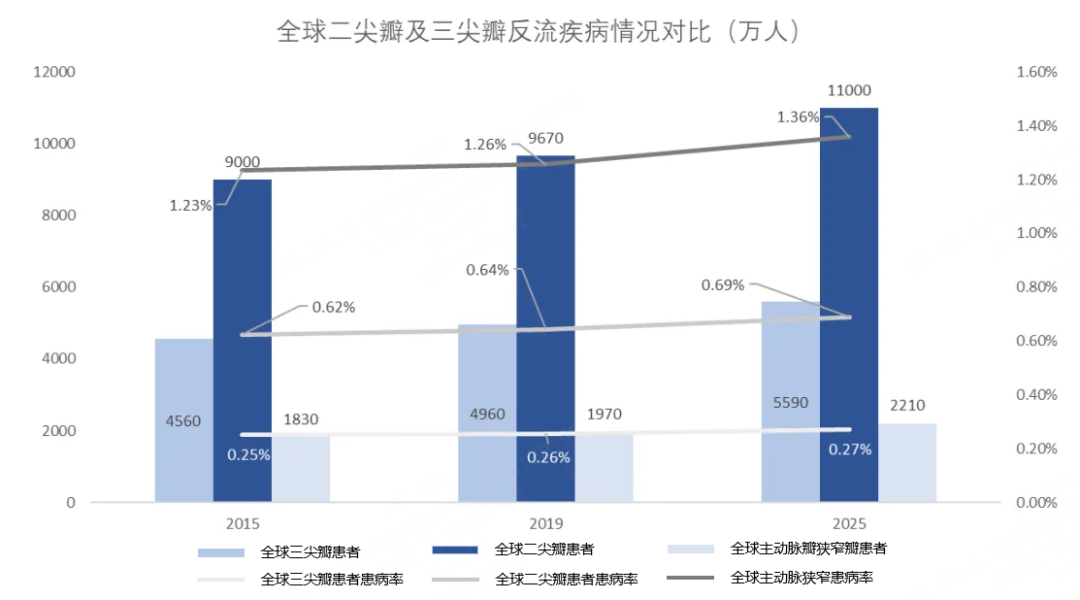 ▲Originated fromFrost & Sullivan
On the other hand,Conservative treatment for patients with tricuspid regurgitation has an extremely high mortality rate, and surgical intervention is the most high-risk.Combined with the epidemiology related to valvular heart disease, the mortality rate of conservative treatment for severe tricuspid regurgitation is generally higher than that for severe mitral regurgitation.The mortality rates of patients with severe tricuspid regurgitation at 1-5 years are approximately 35%, 42%, 50%, 58%, and 66%, respectively, reaching 86% at 10 years.; The mortality rates for patients with severe mitral regurgitation at 1 to 5 years are approximately 20%, 29%, 37%, 46%, and 50%, respectively.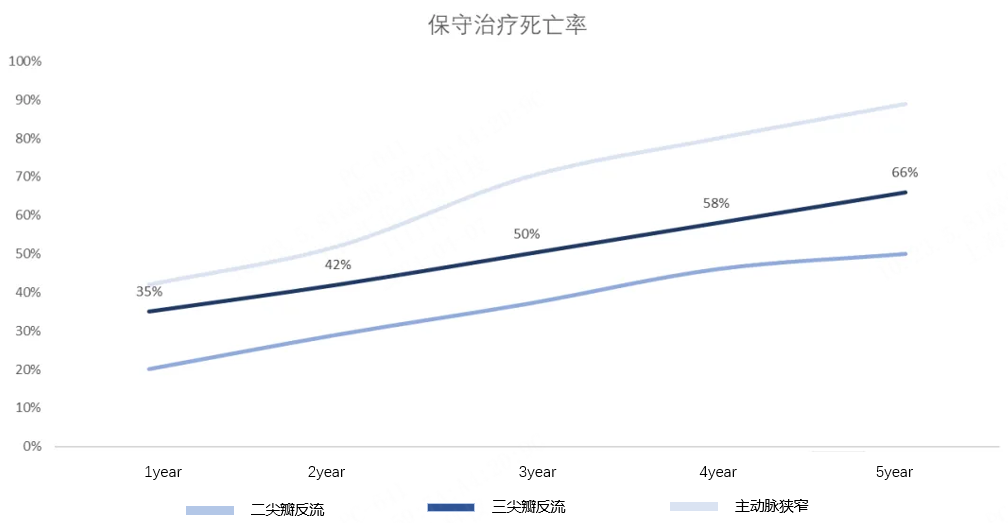 ▲ Originated fromFrost & Sullivan
The perioperative mortality rate of TR patients is the highest among all valve surgeries.,The perioperative mortality rate of isolated surgical tricuspid valve replacement is as high as 10.9%.,Perioperative Mortality Rate of 8.1% for Isolated Surgical Tricuspid Valve Repair, which is several times higher than the perioperative mortality rates of isolated surgical mitral valve repair (1.4%–2.6%), mitral valve replacement (3.8%), and aortic valve replacement (2.2%). Therefore, there is an urgent need to develop safer and more effective treatments for tricuspid regurgitation.
Currently, the treatment options for TR are limited.No significant benefit from surgical tricuspid valve repair or replacement, and poor response to medical treatment. Left heart valve surgery combined with tricuspid valve repair may improve the prognosis of TR patients, indicating the necessity of timely TR treatment. Recently, studies have shownTranscatheter tricuspid valve intervention is associated with better survival rates and lower rates of heart failure readmission compared to conservative drug therapy alone., preliminarily confirming the effectiveness of interventional treatment.
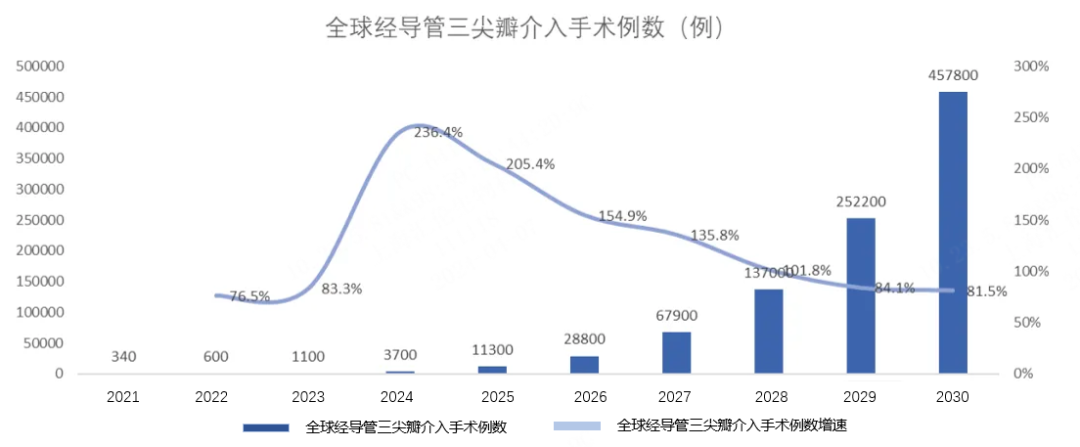
In terms of surgical volume, according to Sullivan data forecasts,The global volume of transcatheter tricuspid valve interventions will increase from 340 cases in 2021 to 450,000 cases by 2030.; andThe number of transcatheter tricuspid valve interventions in China is expected to surge from 600 cases in 2023 to 200,000 cases by 2030.。
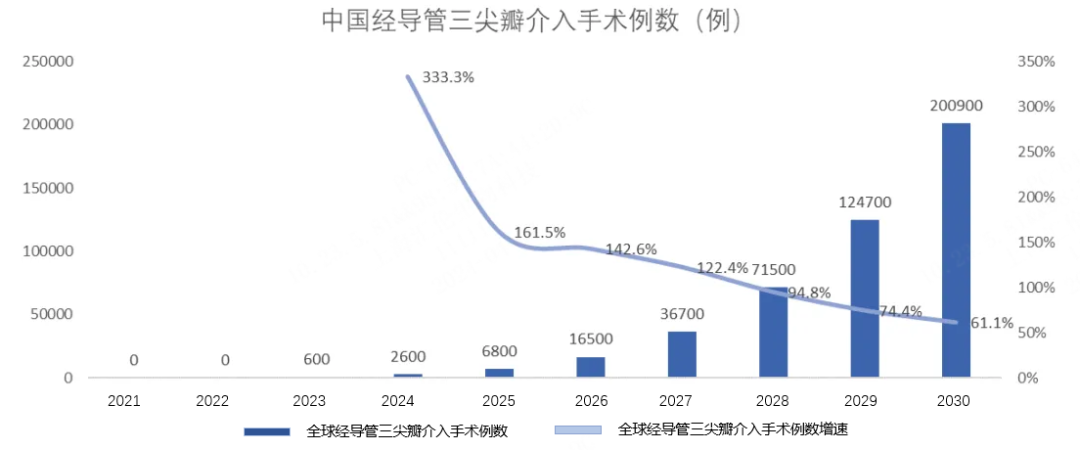 ▲ Originated fromFrost & Sullivan
In terms of market size,From 2021 to 2030, the global market size for tricuspid valve interventional devices will grow from USD 0.1 billion to USD 112.8 billion., with a CAGR of 118.35%;From 2023 to 2030, the overall market for tricuspid valve interventional devices in China is expected to grow from 0.9 billion yuan to 203.1 billion yuan, with a CAGR of 118.44%.; It can be seen that the growth rate of the transcatheter tricuspid valve market in China is relatively consistent with the global growth rate.Will all be in a state of rapid growth。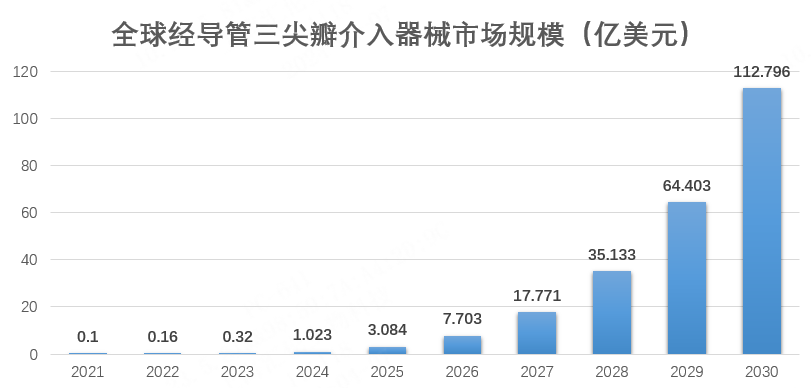
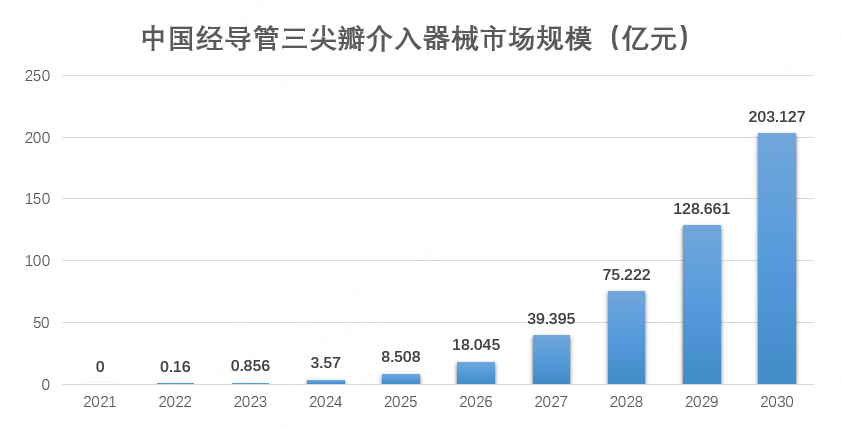
▲ Source: Frost & SullivanCurrently,Globally, only four tricuspid valve interventional treatment devices have received CE certification, two products have been approved by the U.S. FDA, and no products have been approved for marketing by China's NMPA.。
Based on the R&D experience of mitral valve repair,Obtained CE CertificationThe 4 products include the edge-to-edge repair (T-TEER) pathway.Abbott TriClip, Edwards PASCAL, Edwards Cardioband for annuloplasty, and a heterotopic replacement path device, the German PF TricValve.;Obtaining FDA ApprovalThe product is from Abbott.Abbott TriClip, EdwardsEVOQUE。
Similar to mitral valve repair, T-TEER is currently the most widely used TTVr technology internationally. The safety, availability, and usability of TriClip and PASCAL have been supported by evidence from some clinical studies.From the perspective of global product approvals, the progress of tricuspid valve replacement devices has been relatively slow, with onlyEdward's EVOQUEReceived FDA approval in February 2024,Becoming the First Approved Tricuspid Valve Replacement Device。
As of now, no tricuspid valve interventional products have been approved in China., but several leading companies have launched R&D and registration efforts focused on tricuspid valve interventions, among whichLuX-Valve and LuX-Valve Plus products independently developed by Jian Shi TechnologyWith unique designs in stress structure, leaflet clamping, septal anchoring, and delivery systems, it has achieved significant competitive advantages.Currently under NMPA review, with the hope of being approved in 2024 to become the first of its kind in China., enjoying a 3-year exclusivity period.
But on March 28, 2023, Jenscare Technology revealed in a thematic exchange meeting for investors that,The company's transcatheter tricuspid valve replacement product, LuX-Valve, has not yet obtained NMPA registration at this stage.(NMPA) approval, the final registration results will be subject to further internal review and decision by the NMPA, which may require additional clinical evidence.
Regarding the reason why LuX-Valve was not approved, an industry insider explained that"Now the FDA requires all tricuspid valve products to be compared with drugs in control studies, but current clinical trials do not have control groups, so they will all be returned for re-clinical trials."
Apart from Jian Shi Technology,Shanghai Huihe MedicalIt is also developing a transcatheter tricuspid annuloplasty repair system called K-Clip. The company stated,K-Clip has entered the "Green Channel" for special review of innovative medical devices in China, completed registration clinical research, and submitted a registration application to the National Medical Products Administration (NMPA), with the hope of being approved this year.。
Venus Medtech's Mitral and Tricuspid Valve Replacement Product CardiovalveHas entered pivotal clinical trials, with over 40 patients enrolled in Canada, Europe, and other regions as of mid-2023, showing significant progress;Peijia Medical's Tricuspid Valve Replacement Product MonarQThe first human implantation has been completed in the United States, marking the potential start of clinical enrollment;Nuvalve Medical's Tricuspid Valve Replacement Product Prizvalve-THas entered the design phase;Hanzee Medical's Tricuspid Valve Replacement System ValveNeo-TCurrently undergoing prototype iteration;BalRen Medical's Surgical ValvesHas also begun the first early-stage human clinical trial.
Abbott (NYSE: ABT) is a global healthcare company founded in 1888, with its headquarters located in Chicago, USA. After a century of development, the company has now become a Fortune 500 enterprise with diversified pharmaceutical and nutritional products.
AbbottBusiness spans across more than 160 countries and regions worldwide, with nearly 110,000 employees., with products covering the fields of nutritional products, pharmaceuticals, medical devices, diagnostic instruments, and reagents.
The Fourth Quarter of 2023,Abbott's global medical device sales reached $4.4 billion, increasing 15.4% year-over-year.。The business's total sales for the year reached $16.9 billion, representing a year-on-year increase of 14.2%.Among them, the sales of diabetes, neuromodulation, structural heart disease, electrophysiology, and heart failure businesses all achieved double-digit growth in the fourth quarter.