JACC Study Compares Five-Year Reintervention Rates Between Minimally Invasive TAVR and Surgical Aortic Valve Replacement

Medtronic
Medical Device Manufacturer
Daily Yi Xun
+
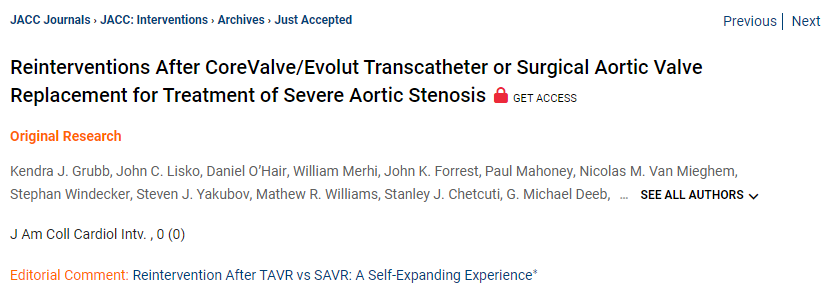
Minimally Invasive Transcatheter Aortic Valve Replacement (TAVR) has become the mainstream procedure for aortic valve replacement, and its indications are also expanding. However, surgical aortic valve replacement (SAVR) remains the classic procedure in this field. There are relatively few studies comparing the long-term reoperation rates of TAVR and SAVR. Recently, the JACC journal published a comparative study exploring this topic.
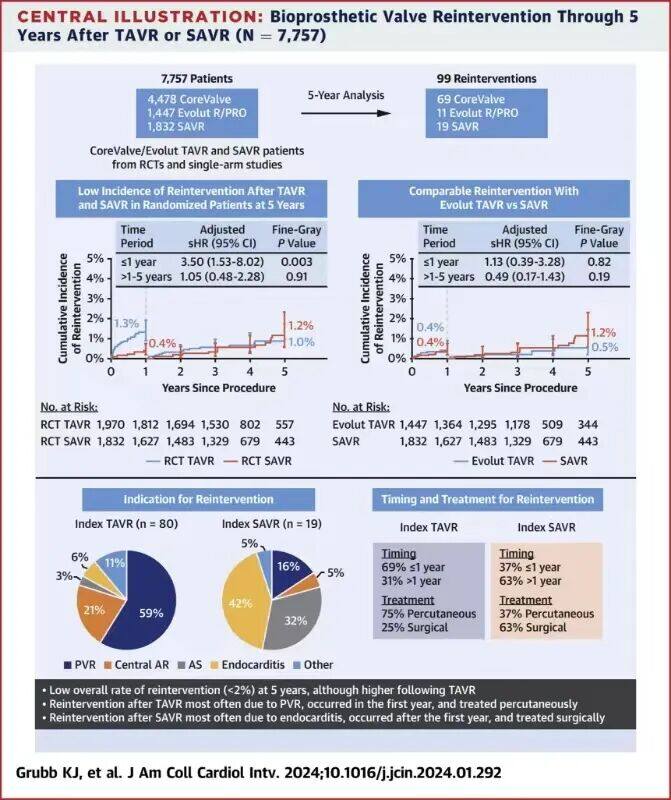
This study pooled data from randomized trials and single-arm studies of CoreValve and Evolut R/PRO (Medtronic), encompassing a total of 5,925 TAVR patients (4,478 with CoreValve and 1,447 with Evolut R/PRO) and 1,832 SAVR patients. Reoperations were categorized by indication, timing, and treatment method. The cumulative incidence of reoperations was compared between TAVR and SAVR, Evolut and CoreValve, as well as Evolut and SAVR.
Study results showed that: within 5 years, there were a total of 99 reoperations (80 occurred in TAVR patients and 19 in SAVR patients). Compared with SAVR, TAVR had a higher cumulative incidence of reoperation (2.2% vs. 1.5%; P=0.017), with the difference evident early on (≤1 year; adjusted subdistribution hazard ratio: 3.50; 95% CI: 1.53-8.02), but no significant difference was observed between 1 to 5 years (adjusted subdistribution hazard ratio: 1.05; 95% CI: 0.48-2.28). The most common reasons for reoperation were paravalvular regurgitation after TAVR and infective endocarditis after SAVR. Compared with CoreValve, Evolut had a significantly lower incidence of reoperation within 5 years (0.9% vs. 1.6%; P=0.006), with the difference evident early on (adjusted subdistribution hazard ratio: 0.30; 95% CI: 0.12-0.73), but no significant difference was observed between 1 to 5 years (adjusted subdistribution hazard ratio: 0.61; 95% CI: 0.21-1.74). The incidence of reoperation within 5 years was similar between Evolut and SAVR (0.9% vs. 1.5%; P=0.41).
“
YiXun Review
”
This study compared the follow-up data of over 5,000 TAVR patients enrolled in Medtronic-related clinical trials with more than 1,800 SAVR patients in the control group. The results showed that the reoperation rate at five years post-TAVR was slightly higher than that of SAVR (2.2% vs 1.5%), with most reoperations occurring within the first year after surgery. The primary reason for reoperation after TAVR was paravalvular leakage, while for SAVR it was mostly due to endocarditis. Interestingly, with the iteration of Medtronic valves, the reoperation rates for their later products (Evolut/PRO) significantly decreased, becoming comparable to the outcomes of SAVR. Therefore, it can be anticipated that as TAVR devices and techniques continue to improve, there is still significant room for surpassing surgical aortic valve replacement solutions.
References:
https://www.jacc.org/doi/10.1016/j.jcin.2024.01.292
The technical opinions in this article do not represent the views of CCI.

Author Introduction
Zhang Yi, MD, PhD, FACC, FESC, Chief Physician, Associate Professor, Doctoral Supervisor. Director of the Panvascular Disease Center/Hypertension Center at Shanghai Tenth People's Hospital, Deputy Director of the Scientific Research Department, and Deputy Minister of the Science and Technology Management Department at Tongji University (on assignment).
Holding concurrent positions as the Youth Deputy Director of the Internal Medicine Branch of the Chinese Medical Association, Executive Member of the China Cardiovascular Innovation Club (CCI), Member of the China CTO Veterans Club, Deputy Leader of the Hypertension Group of the Shanghai Medical Association, Outstanding Technical Leader of Shanghai, Column Author of "Daily Yi News," and Director of the Shanghai Boxing Association. Has presided over four projects of the National Natural Science Foundation of China. Published papers in journals such as *Lancet 2020* (commentary article), *Nature Aging 2024*, *Advanced Science 2020*, *Cardiovascular Diabetology 2019*, *European Journal of Internal Medicine 2024*, and *Hypertension 2011/2021*, with an H-index of 23, one ESI highly cited paper, and key work cited in the 2023 European Hypertension Guidelines. Awarded the First Prize for Scientific and Technological Progress by the China Association for the Promotion of Traditional Chinese Medicine, the Second Prize for Scientific and Technological Progress by the Chinese Medical Association, and the Third Prize of the Shanghai Medical Science and Technology Award. Applied for 21 national invention patents, received authorization for five, and one has been successfully commercialized.



CCI Cardiovascular Physicians Innovation Club
Long press the QR code to follow us
This Issue's Planning: Shen Li
Editorial Responsibility: Chen Baolin
Author of this article: Zhang Yi
Post-production: Wang Rui