Global Pharma R&D Pipeline Top 25: Hengrui Leads China, Roche Tops Worldwide

Citeline
Professional Intelligence and Data Provider

AstraZeneca
Biopharmaceutical Manufacturer
Recently, Citeline, a well-known international consulting firm, released the "2024 Pharmaceutical R&D Annual Review" and selected the top 25 pharmaceutical companies with the largest pipeline scales globally.
Top 25 Global Pharmaceutical Pipelines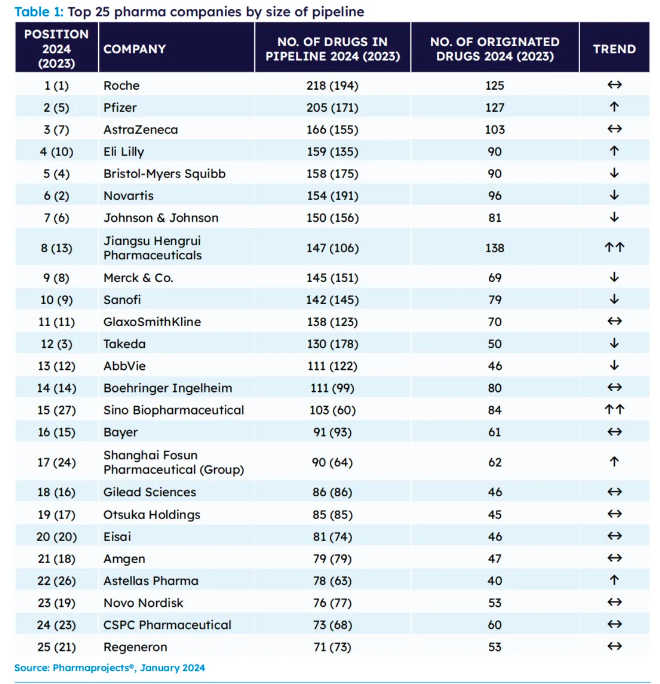
Source of the image: Citeline official website
Among the top ten list, MNCs occupy nine seats. Roche successfully defended its leading position with 218 pipelines, maintaining a significant lead. Pfizer and AstraZeneca rose in rankings compared to 2023, securing the second and third positions respectively.
Jiangsu Hengrui Medicine is the only Chinese pharmaceutical company in the Top 10, ranking 8th, rising 5 places compared to 2023, with the number of R&D pipelines increasing from 106 in 2023 to 147.
MNC Rankings Shakeup
Overall, the ranking of MNCs has changed significantly compared to 2023, with most either declining or remaining stable. For instance, multinational corporations such as Bristol-Myers Squibb (BMS), Novartis, Johnson & Johnson, Merck, Sanofi, Takeda, and AbbVie experienced a drop in rankings due to the reduction in clinical pipelines. In contrast, Pfizer, AstraZeneca, and Eli Lilly achieved upward movement by expanding their product pipeline matrices through licensing-in or acquisitions.
In 2024, the number of BMS pipeline drugs under development is 158, a decrease of 17 compared to 2023. In fact, throughout 2023, BMS was continuously cutting back on its pipelines.
On September 14, 2023, BMS announced at the 2023 R&D Day that it would cut six R&D programs due to efficacy and safety reasons. The two mid-stage clinical programs are HSP47 and a TIGIT solid tumor project, while the four Phase I clinical programs include a CD20/CD47 bispecific antibody, CC-90009—an innovative protein degrader targeting GSPT1, an RIPK1 inhibitor, and a cancer molecule targeting an undisclosed target.
Earlier, according to the financial report released by BMS in February 2023, at least 9 pipelines were cut, including targets such as CTLA-4 and TIGIT.
Similarly, after Novartis underwent a "drastic self-restructuring" in 2023, the number of pipeline projects decreased from 191 to 154.
On April 25, 2023, Novartis announced during its first-quarter financial report conference call with investors that it would halt or out-license 10% of its clinical development programs to focus more resources on core therapeutic areas.
This divestment will leave Novartis with 136 clinical-stage assets across its five core areas (solid tumors, hematology, immunology, neuroscience, and cardiovascular diseases) and a sixth area (referred to as TAX), which the company will also focus on going forward.
Takeda Pharmaceutical, on the other hand, has shown even stronger momentum, with frequent news of pipeline cuts over the past year. Compared to 2023, the number of pipelines in research in 2024 has sharply decreased by 48, leaving only 130 currently, and its ranking has also dropped out of the top ten from third place in 2023.
In November 2023, Takeda Pharmaceutical disclosed its half-year financial report data, while announcing the termination of four pipelines and a significant 71% downgrade in performance expectations. The financial report indicates that growth has encountered certain bottlenecks.
In April 2023, Takeda Pharmaceutical revealed that it is withdrawing from early-stage research and development efforts in gene therapy based on adeno-associated virus (AAV) and rare hematology, while some related employees may face layoffs.
The rare disease field has always been a strong focus for Takeda Pharmaceutical. In 2018, the company’s massive acquisition of rare disease giant Shire, which propelled it into the global top 10 pharmaceutical enterprises, is still widely discussed within the industry.
The sudden "withdrawal" was shocking.
Although the trend of "open source, cost reduction, and efficiency enhancement" in the pharmaceutical field continues to grow, no matter how much companies cut costs, they are only trimming pipelines outside their core ones, while maintaining their core pipelines with unwavering determination. What makes Takeda Pharmaceutical's recent move shocking is that its samurai sword has been directed at the highly valued "rare disease gene therapy R&D pipeline."
The Chinese team is unstoppable
The "2024 Pharmaceutical R&D Annual Review" also ranked the top 10 Chinese pharmaceutical companies by pipeline size. In addition to Hengrui Medicine, known as the "innovative drug leader," China Biologic Products, Fosun Pharma, BeiGene, and Junshi Biosciences also made the list.
Top 10 Pipeline Counts of Chinese Pharmaceutical Companies
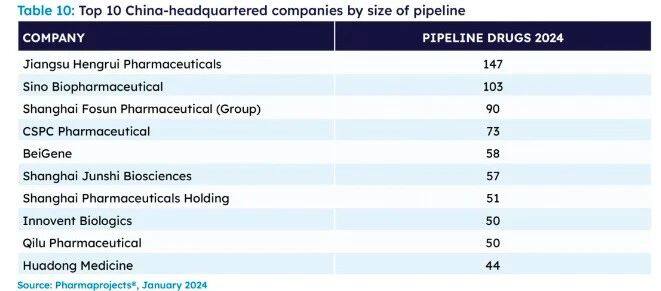
Image Source: Citeline Official Website
In addition to breaking into the global TOP10 for the first time, Hengrui Medicine also took the top spot in China for the number of pharmaceutical pipelines.
The report statistics show that in 2023, Hengrui's R&D pipeline increased by 38.7%. Of the 147 pipelines, approximately 94% were self-developed, demonstrating its powerful R&D capabilities.
In the second tier (TOP11-TOP25), China's biopharmaceutical companies once again shone brightly, surpassing Fosun Pharma to become China's second-largest pharmaceutical enterprise, ranking 15th globally. The scale of its pipeline increased significantly by 72% compared to the previous year, reaching a total of 103 projects.
The rapid growth in the pipeline scale is primarily attributable to the company's forward-looking strategic layout in innovation and transformation in recent years.
In step with comprehensive innovation and transformation, the accelerated advancement of internationalization has also been a key factor in the rapid growth of China's biopharmaceutical R&D pipeline scale. China Biopharmaceutical was among the first group of leading Chinese pharmaceutical companies to expand overseas, early on establishing a dual-circulation development strategy of “In China for Global” and “In Global for Global.”
Recently, China Biologic Products has once again leveraged its advantages in mergers and acquisitions as well as collaborations, forming a strong alliance with Boehringer Ingelheim, a pharmaceutical company with deep historical roots. Through this partnership, China Biologic Products has introduced several promising assets, including Brigimadlin, Zongertinib, and DLL3/CD3, further enriching its oncology treatment pipeline.
Fosun Pharma also achieved solid growth, with its R&D portfolio increasing by 41% to 90 in 2023, propelling its ranking to 17th place, closing in on German pharmaceutical giant Bayer.
CSPC Pharmaceutical Group, on the other hand, has shown steady progress. Currently, approximately 60 key drugs under development have entered clinical or submission stages, with 8 having submitted for market approval, and 16 in registration clinical trials or about to submit for market approval, securing its position within the top 25.
Summary
The unveiling of a new drug is never an easy feat. Facing pressures such as the difficulties in new drug development and declining sales performance, pharmaceutical giants have been compelled to make decisions to adjust their pipelines—both additions and reductions target different "winning strategies." However, the underlying development mindset remains consistent: a differentiation strategy to consolidate core competitive advantages in key areas.
Source:
1.Citeline Official Website
2.https://mp.weixin.qq.com/s/glXsMnEvpUOENZQPOqvKVQ

Editor: Pea Shooter
Disclaimer: The views expressed in this article are solely those of the author and do not represent the position of PharmSnap. We welcome discussions and additional insights in the comment section; for reprints, please be sure to credit the author and source. If there are any issues regarding the content, copyright, or other aspects of the article, please leave a message on this platform, and we will address it promptly.
—————————Battlefield Report—————————
2024 China Pharmaceutical CRO/CDMO Enterprise Rankings
Vote Countdown: 1 Day
As of 9:00 on April 16, 126 companies have registered for the competition. The total number of votes has reached 204,906, with a page view exceeding 910,000.
Duzheng Biotech tops the CRO enterprise popularity list with 32,938 votes, followed by Comer Pharma and Huawei Pharma in second and third place respectively;
Yabao Pharmaceutical tops the CDMO Enterprise Popularity Brand List with 14,782 votes, while Hengdi Pharmaceutical and Xinghao Pharmaceutical rank second and third respectively.